
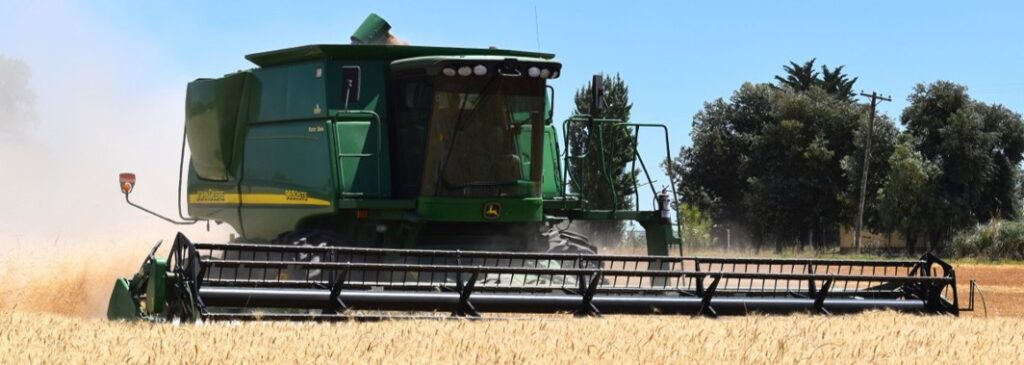
Take advantage of Latin America’s size and grow with our agricultural products consulting.
Agriculture rewards companies that can see beyond the next season.
You may have a strong product, an experienced commercial team, and attractive markets in front of you. But profitable growth still depends on a series of difficult choices: where to invest, which customers and crops to prioritize, how to differentiate, which channels to back, how much local adaptation you need, and how competitors may react.
Those decisions become harder when climate, regulation, commodity economics, technology adoption, distributor power, currencies, and competitive intensity can move in different directions at the same time.
Midas Consulting helps you turn that complexity into strategic choices you can act on.
For more than 25 years, we have worked with companies across Latin America on growth, competition, market entry, strategy, customer value, and commercial execution. Our role is not to give you another generic market report. It is to help you decide where you can create the most value, how you can build an advantage, and what must be true for your strategy to work.
Whether you compete in crop protection, seeds, fertilizers, biologicals, adjuvants, machinery, irrigation, precision agriculture, animal health, or adjacent agricultural technologies, we help you connect evidence with decisions.
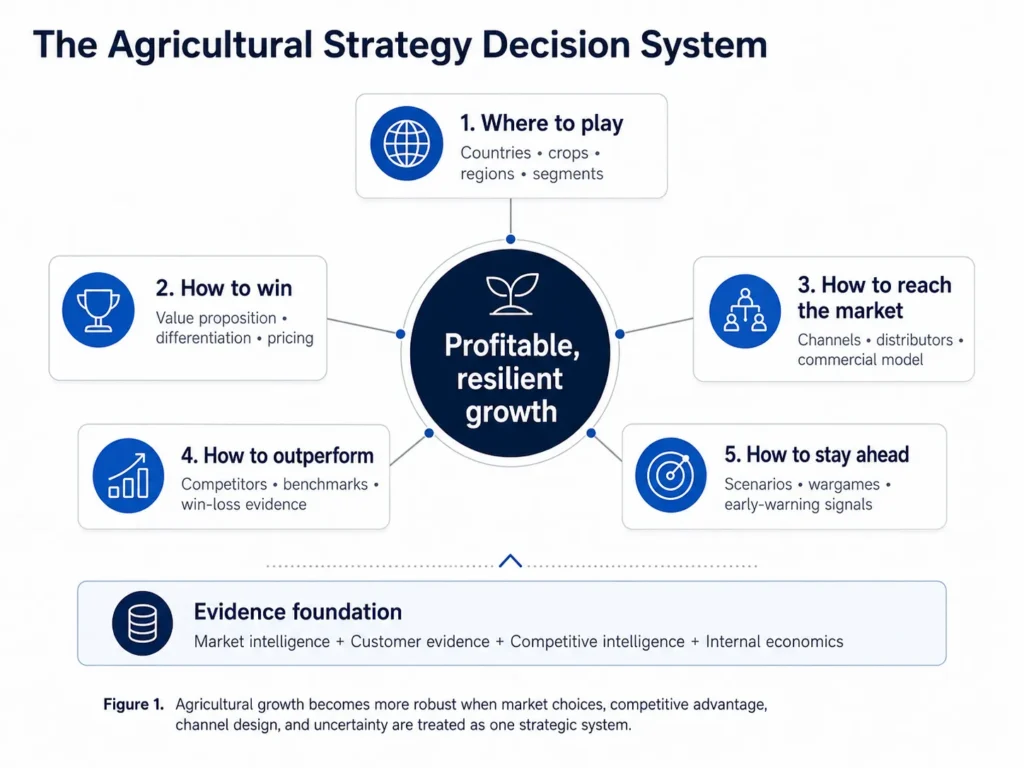
Figure 1. Agricultural growth becomes more robust when market choices, competitive advantage, channel design, and uncertainty are treated as one strategic system.
Your Agricultural Strategy Should Begin With the Decision
You do not need more information for its own sake. You need the right evidence to support a consequential decision.
That is why we begin by clarifying what you are actually trying to decide.
You may need to determine:
- Which countries, regions, crops, or applications deserve investment.
- Whether a market is attractive enough to justify entry.
- Which segments offer the best combination of growth, margins, and strategic fit.
- Why customers should choose you instead of an established competitor or lower-cost alternative.
- Whether your current distributor model can support your ambitions.
- How competitors are likely to respond to a launch, price change, channel move, or geographic expansion.
- Which capabilities must be strengthened before you scale.
- What should change if regulation, climate, input costs, commodity economics, or customer behavior move against your base plan.
Once the decision is clear, we build the fact base around it.
That keeps the work focused on what you can actually do differently—not on producing a large volume of analysis that never changes a decision.
Where Should You Play?
Agricultural opportunities can look attractive at a high level and still disappoint in execution.
A country may be large but highly concentrated. A crop may be growing but difficult to access. A region may offer strong demand but weak distributor economics. A product may perform technically but require too much support to scale profitably.
We help you compare opportunities using the criteria that matter to your business, such as:
- Market size and expected growth
- Crop area and production dynamics
- Customer economics and adoption barriers
- Regulatory conditions
- Competitive intensity
- Channel structure and access
- Pricing and margin potential
- Technical-support requirements
- Import and logistics complexity
- Strategic fit with your portfolio
- Investment requirements
- Execution feasibility
- Risk and uncertainty
The goal is not to identify the largest market. It is to identify the opportunities where your company has the strongest risk-adjusted ability to win.
Our market analysis consulting can help you build that fact base:
When geographic expansion is the decision, our market entry consulting helps you compare countries, entry models, risks, and implementation priorities:
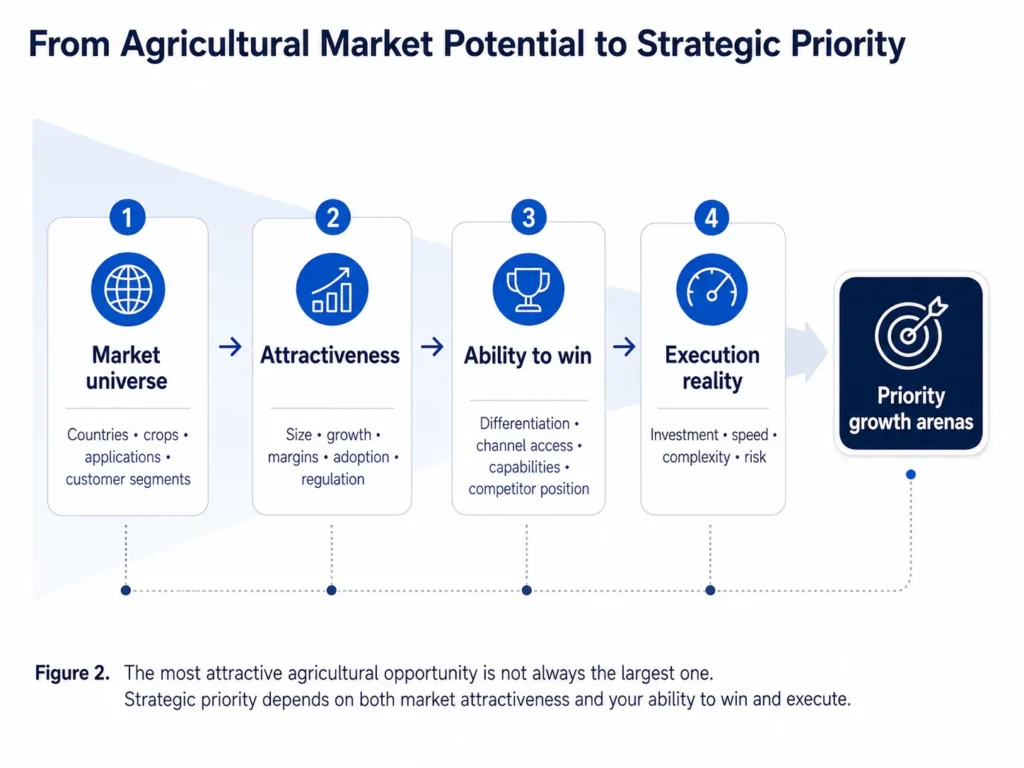
Figure 2. The most attractive agricultural opportunity is not always the largest one. Strategic priority depends on both market attractiveness and your ability to win and execute.
How Will You Win Once You Choose the Market?
Choosing an attractive market is only the first decision.
The next question is more difficult: why should customers, distributors, advisers, or other market participants choose you?
In agriculture, technical superiority does not automatically translate into commercial preference. Customers may weigh yield, consistency, risk reduction, convenience, financing, agronomic support, availability, compatibility, service, trust, and total economics differently.
The same product can therefore require different positioning across crops, regions, or customer segments.
We help you understand:
- Which customer needs truly drive the decision
- Which benefits customers value enough to act on
- Which proof points are credible
- Which competitive claims are overused or weak
- Where your offer is genuinely distinctive
- How price and value interact
- Which service elements strengthen the offer
- Which messages distributors can sell effectively
- Which adaptations can improve commercial relevance
Our value proposition consulting helps you turn those insights into a compelling reason to choose your company:
Our brand consulting can help you strengthen the broader market meaning, credibility, and preference surrounding that offer:
Understand Competitors Before They Shape the Market for You
Your strategy does not operate in a vacuum.
Competitors can change prices, increase distributor incentives, bundle products, accelerate launches, expand technical support, defend key accounts, alter credit conditions, acquire local players, or reposition their portfolios.
A strong agricultural strategy therefore requires more than a snapshot of market shares.
You need to understand what competitors are trying to achieve, what capabilities they possess, where they are vulnerable, and how they are likely to respond to your moves.
Our competitor analysis consulting helps you examine issues such as:
- Competitor objectives and strategic priorities
- Portfolio strengths and gaps
- Pricing and commercial conditions
- Channel relationships
- Geographic strengths
- Technical and field capabilities
- Customer perceptions
- Cost or service advantages
- Likely strategic moves
- Potential reactions to your strategy
Learn more:
Do Not Benchmark the Visible Result, Benchmark What Produces It
A competitor may have higher share, stronger margins, better channel coverage, or faster growth. The strategic question is why.
Benchmarking helps you look behind the visible outcome.
Depending on the decision, we can compare:
- Commercial models
- Sales-force deployment
- Territory design
- Distributor economics
- Pricing practices
- Technical service
- Launch processes
- Portfolio architecture
- Marketing investments
- Customer coverage
- Operating practices
- Organizational models
- Innovation processes
We normalize the comparison where necessary so you do not mistake structural differences for superior performance.
The purpose is not to copy a competitor. It is to identify practices, capabilities, and performance gaps that can improve your own strategy.
Learn Why You Win, and Why You Lose
Internal explanations for commercial wins and losses are often incomplete.
Sales teams may attribute a loss to price while the customer cared more about availability, technical credibility, distributor support, response time, perceived risk, or the strength of the relationship. A win may be credited to product performance even when financing or service actually tipped the decision.
Win-loss analysis brings the customer’s perspective into the strategy.
It can help you understand:
- Why customers chose you
- Why they chose a competitor
- Which criteria carried the most weight
- Where your offer was misunderstood
- Where your commercial process helped or hurt
- Which competitor strengths are most consequential
- Which changes could improve future conversion
These insights can directly inform positioning, pricing, distributor management, account strategy, and product priorities.
Turn Strategic Evidence Into Choices and Commitments
Good analysis is only valuable if it changes what you do.
Agricultural strategy often requires choices across market priorities, investment, portfolio, pricing, channels, technical resources, product development, partnerships, and organizational capabilities.
Those choices can be difficult because different teams see different parts of the market.
Our strategy consulting helps you bring the evidence together, challenge assumptions, evaluate alternatives, make trade-offs explicit, and translate decisions into an actionable roadmap.
Depending on your situation, we can help you:
- Clarify the strategic question
- Build a common fact base
- Evaluate strategic options
- Define where to play and how to win
- Prioritize initiatives
- Identify capability gaps
- Establish decision criteria
- Assign ownership
- Define milestones and metrics
- Create an implementation roadmap
Stress-Test the Strategy Before the Market Does
A strategy can look compelling when every assumption is considered independently.
The real risk appears when several assumptions move at once.
What happens if a major competitor cuts price while a distributor changes priorities? What if a regulatory shift accelerates biological adoption? What if a drought changes crop economics? What if exchange rates, input costs, or credit conditions alter the customer’s decision?
This is where strategic foresight becomes practical.
Midas Consulting’s work on strategic foresight, competitive response, early-warning systems, and business wargaming provides an additional foundation for helping you prepare for uncertain and interactive markets:
Rather than pretending uncertainty can be eliminated, we help you identify what could materially change the strategy and how you would respond.
Use Wargames to Anticipate Reactions
A business wargame lets your team simulate the actions of competitors, distributors, customers, regulators, or other market participants before you commit resources.
You can use it to pressure-test:
- A market entry
- A major launch
- A pricing move
- A distributor change
- A new value proposition
- A regional expansion
- A strategic partnership
- A defensive response
- A significant portfolio decision
The objective is not to predict one exact future. It is to expose hidden assumptions, anticipate plausible reactions, identify second-order effects, and prepare countermoves.
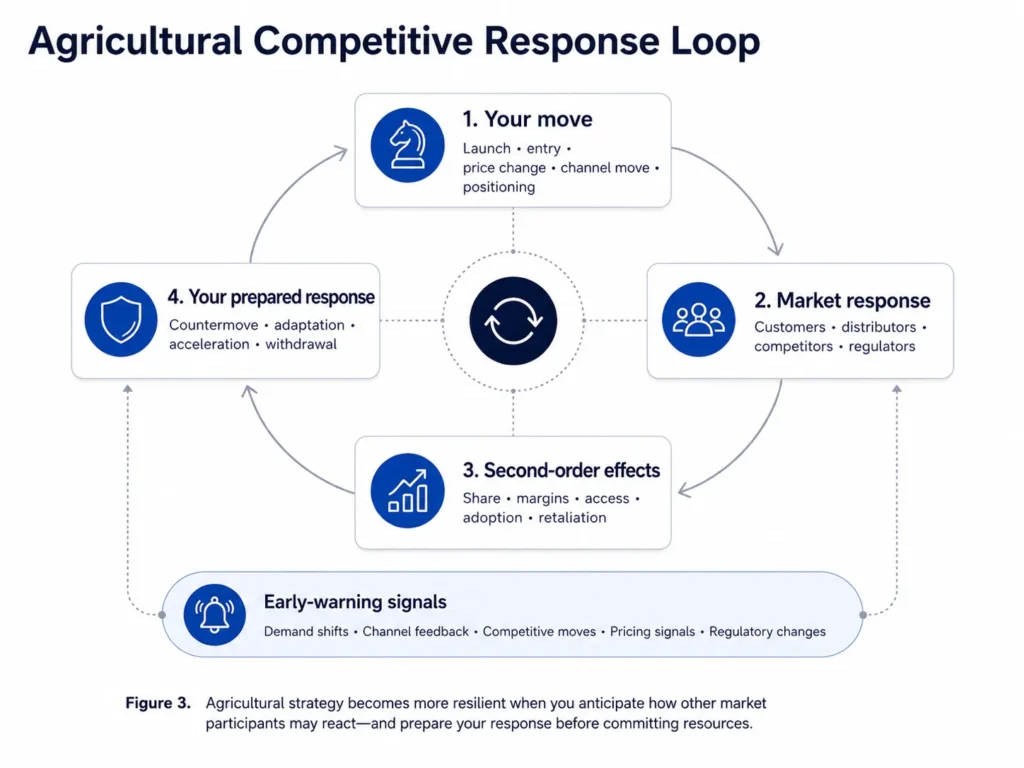
Figure 3. Agricultural strategy becomes more resilient when you anticipate how other market participants may react, and prepare your response before committing resources.
An Integrated Agricultural Strategy Can Combine Several Workstreams
Your challenge may require one focused engagement or several capabilities working together.
For example:
- Market entry consulting. Determine which countries or regions to prioritize, how attractive they are, and which entry model best balances control, investment, speed, and risk.
- Strategy consulting. Turn evidence into strategic choices, priorities, ownership, and an implementation roadmap.
- Wargame consulting. Anticipate competitive and channel reactions before you make a major move.
- Benchmarking consulting. Understand the practices and capabilities behind stronger competitor or peer performance.
- Competitor analysis consulting. Build a deeper view of rival strategies, strengths, vulnerabilities, and likely actions.
- Market analysis consulting. Size opportunities, understand demand, segment customers, map channels, and build the market fact base.
- Value proposition consulting. Clarify why customers should choose you and which benefits and proof points create preference.
- Win-loss analysis consulting. Understand the real reasons behind customer decisions and use them to improve commercial performance.
- Brand consulting. Strengthen the strategic meaning, relevance, credibility, and differentiation of your brand.
The advantage of combining these capabilities is that your strategy is built as one coherent system rather than as disconnected analyses.
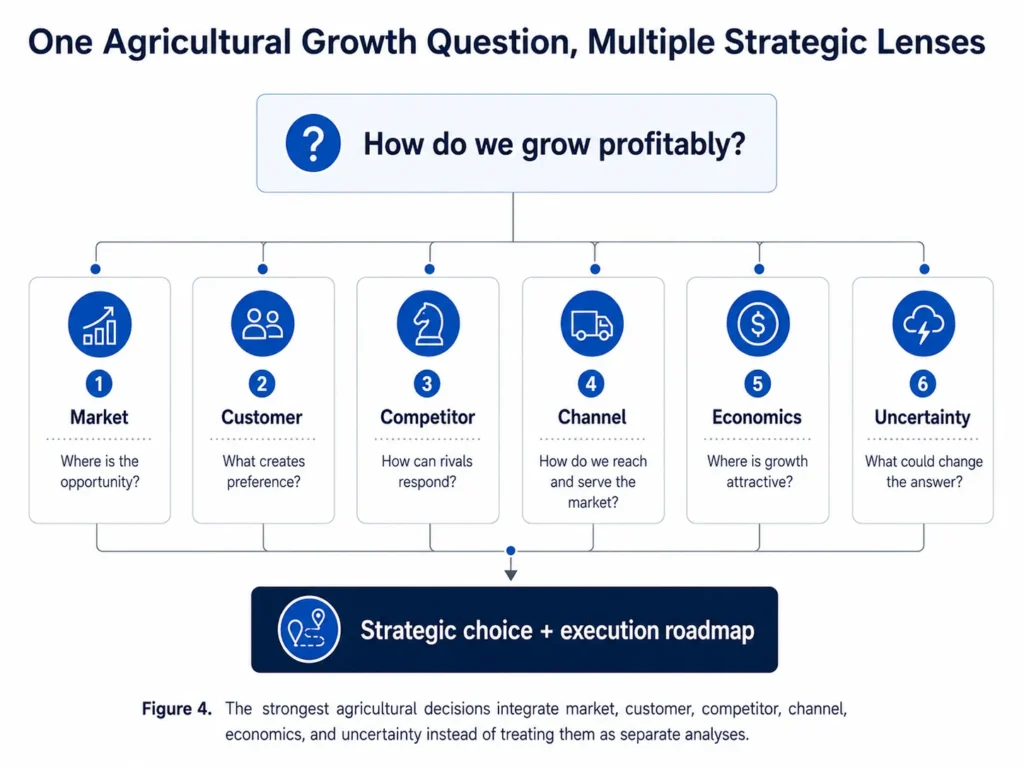
Figure 4. The strongest agricultural decisions integrate market, customer, competitor, channel, economics, and uncertainty instead of treating them as separate analyses.
A Practical Example: Prioritizing Growth Without Spreading Resources Too Thin
An international agricultural-products company saw multiple growth opportunities across Latin America.
The problem was not a lack of possibilities. It was too many possibilities.
Different countries, crops, and product categories offered different levels of demand, competitive intensity, channel access, and implementation complexity. Pursuing all of them at once would have diluted resources and made execution harder.
Midas Consulting developed a structured comparison of the opportunities, combining available market information with local research and management input.
The analysis considered factors such as:
- Market potential
- Priority crops
- Customer needs
- Competitive pressure
- Channel access
- Strategic fit
- Execution feasibility
Rather than recommending simultaneous expansion everywhere, the strategy sequenced the opportunities.
The first wave focused on markets and product opportunities where customer relevance, competitive advantage, partner access, and implementation feasibility were strongest. Other opportunities were deferred until the necessary capabilities or market conditions were in place.
The resulting roadmap supported expansion into selected Central American markets and helped strengthen the company’s position in Chile.
The broader lesson is simple: growth strategy is often as much about choosing what not to pursue yet as it is about identifying attractive opportunities.
Client identity and commercially sensitive details are withheld to protect confidentiality. Outcomes reflect the specific conditions of the engagement and are not a guarantee of equivalent results for another company or market.
How We Build a Stronger Evidence Base
Agricultural markets are not equally transparent.
Reliable public data may exist for planted area, production, imports, exports, or crop economics, while customer behavior, distributor performance, competitor practices, and local commercial conditions may require primary research.
Depending on your decision, we may combine:
- Company information
- Official statistics
- Market and trade data
- Crop and production data
- Customer interviews
- Distributor interviews
- Expert interviews
- Competitive intelligence
- Pricing and channel research
- Management input
- Regulatory sources
- Scenario assumptions
- Internal financial and commercial data
Where precision is limited, we make the assumptions visible.
We prefer defensible ranges, scenarios, and triangulated estimates over false precision.
Institutional Sources We May Use to Strengthen the Context
Client-specific strategy should never be based on a generic public report alone. However, credible institutional sources can improve the broader market, policy, sustainability, climate, and economic context surrounding a decision.
Depending on the engagement, useful sources may include:
- Food and Agriculture Organization of the United Nations (FAO)
- World Bank: Agriculture, Food and Rural Development
- Inter-American Institute for Cooperation on Agriculture (IICA)
- OECD: Agriculture and responsible business conduct resources
These sources can strengthen the contextual fact base. They do not replace direct research with customers, channels, competitors, and market participants when the decision requires primary evidence.
What You Can Expect From Midas Consulting
More than 25 years of regional experience
We have spent more than two decades helping companies make growth and competitive decisions across Latin America.
That experience matters because the region cannot be treated as one homogeneous market. Country economics, regulations, crop structures, customer behaviors, channel dynamics, and competitive positions can differ substantially.
Strategy before methodology
We do not begin by forcing your challenge into a standard framework.
We begin with the decision you need to make, then determine which evidence and analytical methods can best support it.
Senior involvement
Senior professionals remain involved in framing the problem, interpreting the evidence, challenging assumptions, and discussing the strategic implications with your team.
Triangulation instead of convenient answers
When a conclusion matters, we look for corroborating evidence.
Agricultural markets can contain incomplete or contradictory data. We make the strength of the evidence and the important assumptions visible.
Confidentiality
Projects can involve sensitive information about pricing, products, customers, distributors, competitors, investments, launches, partnerships, and future strategy.
We can work under confidentiality agreements and anonymize client examples when disclosure has not been authorized.
Recommendations built for execution
Your strategy must work commercially, financially, operationally, and organizationally.
We focus on decisions, trade-offs, actions, responsibilities, and practical next steps—not just analysis.
When Agricultural Products Consulting Creates the Most Value
You may benefit from an external strategic perspective when:
- You are entering or expanding in a Latin American market.
- Your growth is below expectations and the cause is unclear.
- You need to prioritize markets, crops, regions, or customer segments.
- Your current distributor model is not delivering.
- You need to sharpen your value proposition.
- A strong technical product is not translating into commercial preference.
- Biological, digital, or lower-cost alternatives are reshaping the category.
- You need a clearer view of competitor economics or commercial practices.
- You are preparing a major launch or pricing move.
- Different internal teams hold conflicting views of the market.
- You need to challenge a strategic plan before committing significant resources.
- Regulation, climate, technology, currencies, or commodity economics could materially change your assumptions.
- You need to identify early-warning signals and contingency actions.
When the cost of a wrong decision is high, improving the fact base before execution can be far less expensive than learning only after capital, time, and market credibility have already been committed.
Frequently Asked Questions About Agricultural Products Consulting
What types of agricultural companies do you work with?
We support companies involved in crop protection, fertilizers, seeds, biologicals, adjuvants, agricultural machinery, irrigation, precision agriculture, animal health, and related products, technologies, and services.
The methodology depends on your product, market, strategic question, customer structure, and available evidence.
Which markets can you cover with your agricultural products consulting?
Our core experience is in Latin America, including Argentina, Brazil, Chile, Colombia, Mexico, Peru, Central America, and other regional markets. Depending on the project, we can also support broader international comparisons.
Can you estimate the size of an agricultural market with your agricultural products consulting?
Yes, when sufficient evidence is available.
Depending on the category, we may combine official data, planted area, production, application assumptions, import and trade information, pricing, channel research, company data, expert interviews, and other relevant sources.
When the evidence does not support one precise number, we normally use ranges or scenarios and make the assumptions explicit.
Can you interview farmers, distributors, advisers, or other market participants in your agricultural products consulting?
Yes. Depending on the project, primary research may include farmers, large producers, agronomists, technical advisers, distributors, cooperatives, retailers, former industry executives, associations, and other informed participants.
Access naturally depends on the market, topic, timing, and willingness of qualified participants to take part.
Can you assess our distributors in your agricultural products consulting?
Yes. We can evaluate issues such as customer and crop access, geographic coverage, portfolio fit, sales-force quality, technical capabilities, logistics, financial strength, conflicts, management commitment, strategic alignment, and willingness to invest.
We can also support decisions involving distributor replacement, supplementation, renegotiation, or redesign of the channel model.
Can you analyze competitors without relying only on public information in your agricultural products consulting?
Yes, subject to legal and ethical research practices.
Depending on the assignment, we can combine public sources, market interviews, customer and channel evidence, expert input, benchmarking, commercial observations, and other legitimate sources of competitive intelligence.
The objective is to improve your strategic understanding without misrepresenting who we are or requesting confidential information improperly.
Can the work combine several services?
Yes. Many strategic questions cut across market analysis, competitors, customers, channels, value proposition, benchmarking, strategy, and uncertainty.
We can structure the engagement as one integrated program or as phases with decision gates between them.
How long does an agricultural products consulting project take?
It depends on the number of markets, research depth, interview requirements, product categories, and decisions involved.
A focused strategic assessment may require several weeks. A multicountry study or integrated strategy program can require longer.
We define the scope, milestones, deliverables, and expected timing before the work begins.
What information do you need from us for an agricultural products consulting project?
Useful inputs can include your strategic objectives, portfolio, sales, market presence, pricing, customer information, distributor information, previous research, regulatory status, internal performance data, and management hypotheses.
We start from what is already available and identify which additional evidence is worth obtaining.
How do you protect confidential information in your agricultural products consulting projects?
We treat client information as confidential and can work under a nondisclosure agreement.
Sensitive information is limited to relevant project participants, and public examples may be anonymized when disclosure has not been authorized.
Do you guarantee a specific commercial result from your agricultural products consulting projects?
No responsible strategy advisor should guarantee a specific sales, market-share, margin, or market-entry outcome.
Commercial performance depends on factors that include your product, investment, execution, customers, distributors, competitors, regulation, climate, economics, and market conditions.
Our role is to strengthen the evidence, choices, preparation, and execution behind your decisions.
Ready to Make the Next Agricultural Growth Decision With Greater Confidence?
You may be evaluating a market, defending a position, repositioning an offer, challenging a distributor model, preparing a launch, or deciding where the next growth investment should go.
You do not need to have the entire problem defined before contacting us.
Tell us the decision you are facing, what you already know, and what remains uncertain.
We will help you determine what evidence is worth gathering, which assumptions need to be tested, and what strategic choices deserve management attention.