

Strategy Consulting to Achieve Your Goals!
When your market changes, competitors move, growth slows, or too many strategic initiatives compete for limited resources, you do not need another presentation that tells your leadership team what it already knows. You need clarity about where to compete, how to win, what to prioritize, what to stop doing, and how to turn those choices into execution.
That is what our strategy consulting is designed to help you achieve. At Midas Consulting, we work directly with your leadership team to clarify the strategic question, build or challenge the external fact base, develop realistic alternatives, pressure-test assumptions, make trade-offs explicit, align decision-makers, and translate the selected direction into a practical roadmap.
We do not design your strategy in isolation and reveal it at the end of the project. Your executives and managers know your business, your customers, your capabilities, and your internal constraints. We bring the outside perspective, evidence, structure, facilitation, and constructive challenge needed to convert that knowledge into stronger strategic decisions.
When Strategy Consulting Is Worth Bringing in From Outside
Most leadership teams do not lack ideas. The harder problem is deciding which ideas deserve resources, which assumptions are still valid, how much risk to accept, and what the organization can realistically execute.
External strategy support becomes especially valuable when the decision is important, cross-functional, politically sensitive, dependent on information you do not yet have, or repeatedly discussed without resolution. It can also help when leadership is too close to the issue, different countries or business units interpret the market differently, or a competitor move has created uncertainty about where to invest.
You may benefit from our strategy consulting if:
- Your current strategy no longer reflects the market you are facing.
- Growth has slowed and your leadership team disagrees about the causes.
- You have more initiatives than you can realistically fund or execute.
- Business units, functions, or countries are pursuing conflicting priorities.
- You need to decide where to grow, which segment to prioritize, or which market to enter.
- You need to respond to a competitor, new technology, regulation, substitute, or business-model shift.
- Your organization needs to reposition an offer, sharpen its value proposition, or redefine how it will win.
- Your strategic plan states ambitions but does not establish clear trade-offs, owners, milestones, or measures of success.
- You need to pressure-test a major move before committing significant resources.
Our Strategy Consulting Starts With the Decision, Not the Workshop
Workshops are an important part of our approach, but they are not the service itself. A strategy workshop is useful when leadership already has enough evidence to debate alternatives, make choices, prioritize, and build ownership. It is not a substitute for missing market, customer, competitor, financial, or operational information.
When the fact base is weak, we may begin with market analysis, competitor analysis, benchmarking, win-loss analysis, customer interviews, internal stakeholder interviews, financial analysis, or another focused diagnostic before bringing your leadership team together.
When the evidence already exists and the main problem is alignment, prioritization, or decision-making, a strategy workshop may be exactly the right mechanism. Our detailed guide to strategy workshops explains when to use them, how to prepare them, how to facilitate the discussion, and how to make sure the session produces decisions rather than simply energy in the room.
What We Help Your Leadership Team Decide
Where should you compete?
We help you evaluate growth arenas across markets, customer segments, products, channels, geographies, applications, and business models. The objective is to focus resources where market attractiveness and your ability to win justify the investment.
How will you win?
We help you clarify the sources of advantage that can make your strategy distinctive and defensible: customer value, capabilities, cost position, service, channels, relationships, technology, brand, speed, portfolio, business model, or another competitive strength that matters in your market.
What should you prioritize, and stop?
Most strategy problems are allocation problems. We help leadership compare initiatives against explicit criteria such as impact, feasibility, urgency, investment, risk, strategic fit, capability requirements, and likely competitive reaction. That forces the trade-offs that turn a list of initiatives into a strategy.
What must be true for the strategy to work?
Every strategy rests on assumptions. We make the critical assumptions visible and identify which ones require validation. That can include demand growth, customer adoption, competitor behavior, distributor commitment, pricing power, regulatory timing, operational capacity, investment availability, or the capabilities your organization must build.
How should you respond if the market does not behave as expected?
A strategy should not depend on one fixed forecast. When uncertainty or competitive reaction is material, we can incorporate scenarios, competitor-response analysis, business wargaming, early-warning indicators, and decision triggers so your leadership team knows what to watch and what would justify changing course.
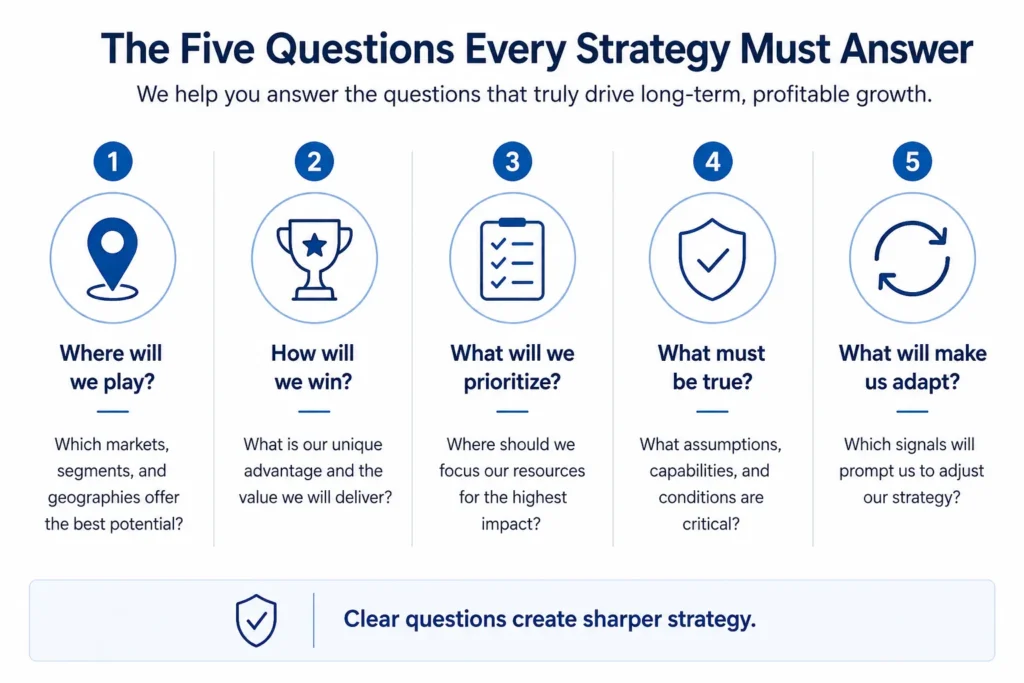
Figure 1: A useful strategy makes five things explicit: where you will compete, how you will win, what you will prioritize, which assumptions must hold, and what signals would cause you to adapt.
Our Strategy Consulting Process
1. Define the strategic decision
We clarify what must actually be decided, why it matters now, what success looks like, which options are already being considered, who owns the decision, and what could materially change the answer.
2. Build the fact base that the decision requires
We determine which external and internal evidence is necessary. Depending on the engagement, this can include market trends, customer priorities, competitor behavior, benchmarking, financial performance, capabilities, channels, regulation, technology, stakeholder interviews, or other strategic intelligence.
3. Develop realistic strategic alternatives
We help your team move beyond the false choice between the current strategy and one preferred alternative. Strong strategy work creates several credible paths, makes the logic behind each one visible, and identifies the implications for growth, investment, capabilities, organization, customers, and competitors.
4. Pressure-test the options
We challenge the options against market evidence, execution feasibility, financial logic, competitor responses, uncertainty, and organizational constraints. Depending on the decision, this may include scenario exercises or a business wargame.
5. Make choices and trade-offs explicit
Leadership evaluates the strategic alternatives against agreed criteria and makes the choices that will guide resource allocation. We help make clear not only what the organization will do, but what it will postpone, stop, or deliberately not pursue.
6. Translate the strategy into an implementation roadmap
The final strategy should identify priorities, initiatives, accountable owners, timing, dependencies, milestones, metrics, risks, and follow-up mechanisms. Where uncertainty remains high, it should also define assumptions, signals, and decision triggers that leadership will monitor after implementation begins.
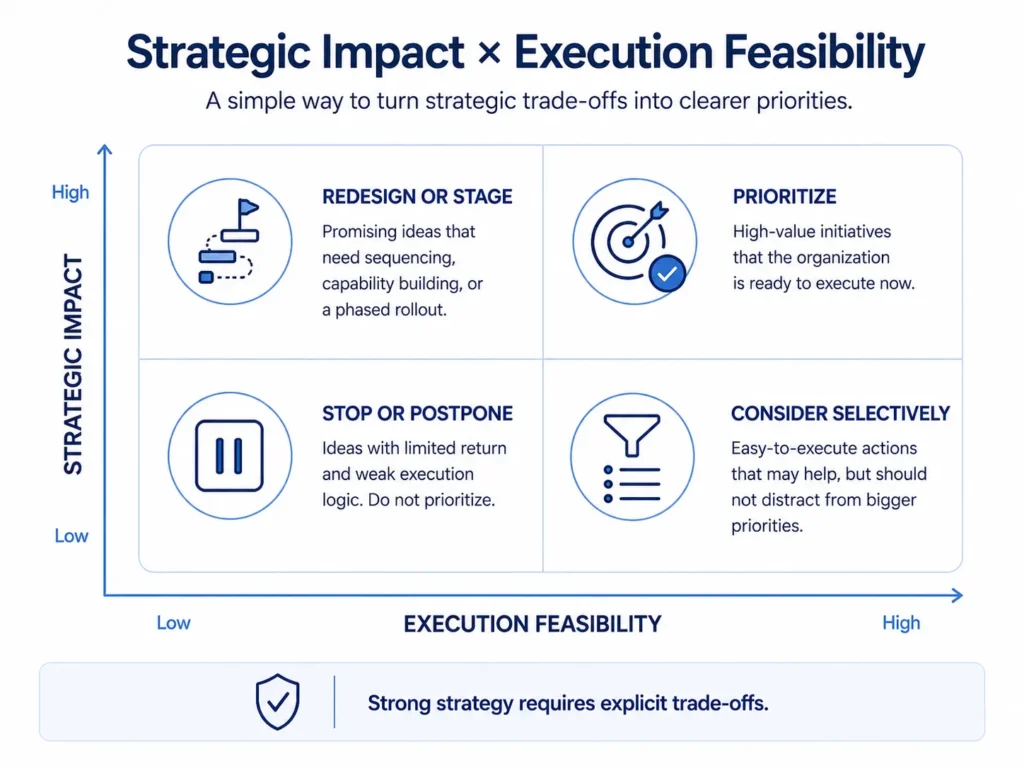
Figure 2: Strategy requires trade-offs. Comparing strategic impact with execution feasibility helps leadership distinguish priorities from attractive ideas that the organization is not yet ready to execute.
Strategy Under Uncertainty: Build Adaptability Into the Plan
The purpose of strategy is not to predict the future perfectly. It is to make a strong choice today while remaining alert to developments that could change the logic behind that choice.
For decisions exposed to substantial uncertainty, we can complement the strategy process with strategic foresight. That means identifying the few external variables that matter most, examining plausible developments, defining weak or early signals, and agreeing in advance on the conditions that would trigger a different response.
This is especially important when the strategy depends on competitor moves, regulation, pricing behavior, new technologies, channel disruption, customer adoption, supply conditions, or another variable that leadership does not control.
Our Strategic Foresight and Competitive Response executive insights bring together Midas thinking and published work on early-warning systems, competitive response, market intelligence, wargaming, and the link between strategic intent and market execution.
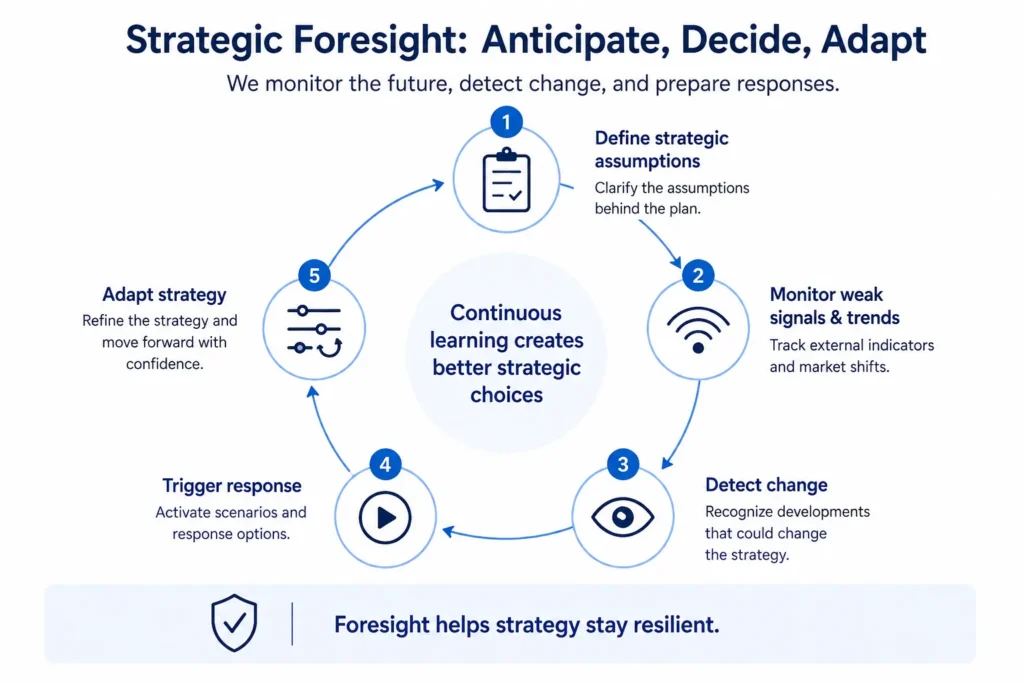
Figure 3: A resilient strategy defines not only what you will do, but what you will monitor and which developments would justify adapting the plan.
Why Strategy Consulting Workshops Are Powerful, When They Are Used for the Right Reason
A well-designed strategy workshop compresses fragmented discussions into a structured decision process. It brings together the people who understand the market, own the decision, and will execute the result. It gives different functions permission to surface conflicting perspectives, challenge assumptions, compare alternatives, and make trade-offs in the same room.
But collaboration is not the objective by itself. The objective is a better decision. Strong workshops are designed backwards from that decision and use relevant preparation, clear roles, structured facilitation, explicit prioritization criteria, and concrete outputs.
The result should include strategic choices, priorities, responsibilities, timing, and follow-up, not merely sticky notes and an inspiring afternoon. You can explore the methodology in depth in Driving Success with Strategy Workshops.
Why We Build Strategy With Your Team
There is a reason we involve your team in the strategy instead of disappearing for several weeks and coming back with a finished answer.
Adrian Alvarez, Managing Partner of Midas Consulting, explores this approach in Strategy Workshops: From Vision to Action, published by the Faculty of Economic Sciences at the Universidad de Buenos Aires (UBA).
The article examines a challenge we see repeatedly in companies: developing a strategy is only part of the job. The real challenge is turning it into decisions, alignment, ownership, and execution. Structured strategy workshops help leadership teams surface different perspectives, challenge assumptions, agree on priorities, and translate those choices into initiatives with clear responsibilities, metrics, and milestones.
That is why our strategy consulting is collaborative by design. We bring external perspective, market insight, proven frameworks, and facilitation, but we build the strategy with you. Your team understands why the choices were made, has challenged them along the way, and is much more prepared to turn them into action once the consulting engagement ends.
What You Receive From a Strategy Consulting Engagement
Deliverables depend on the strategic question and agreed scope. Typical outputs may include:
- Executive diagnosis of the strategic challenge.
- Market, customer, competitor, and internal fact base relevant to the decision.
- Critical assumptions and uncertainties.
- Strategic alternatives and the logic behind each option.
- Evaluation criteria and explicit trade-offs.
- Prioritized strategic choices.
- Growth, competitive, market-entry, positioning, or portfolio priorities, depending on the assignment.
- Initiative roadmap with accountable owners and milestones.
- Metrics and management follow-up mechanisms.
- Risks, early-warning indicators, and decision triggers when uncertainty is material.
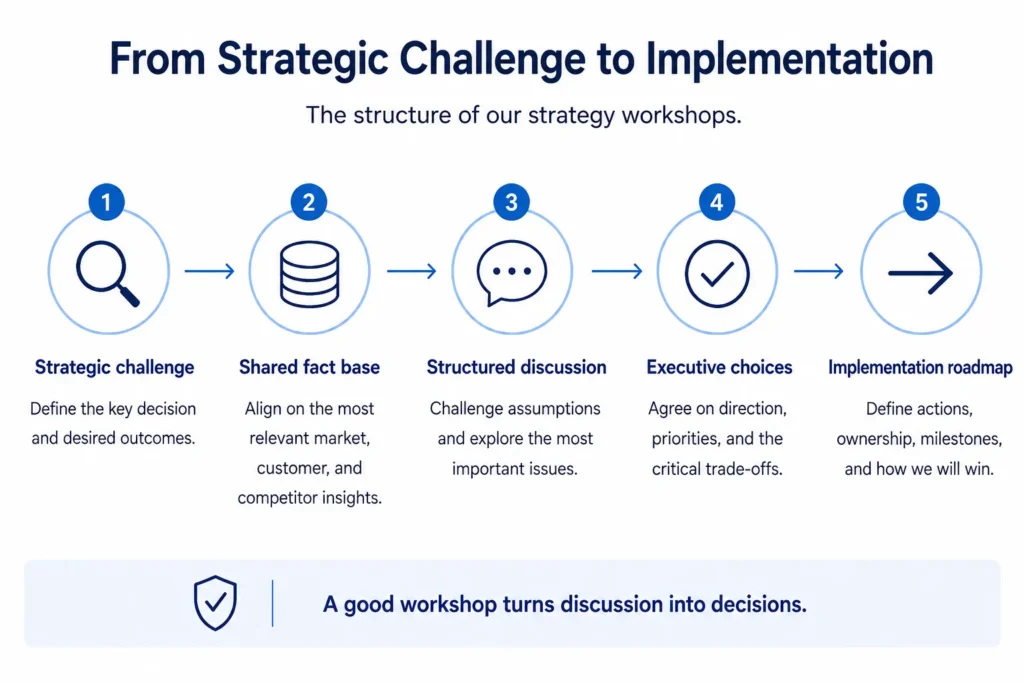
Figure 4: Strategy creates value when choices are translated into accountable initiatives, milestones, measures, and a management rhythm that keeps execution connected to strategic intent.
What Makes Midas Strategy Consulting Different?
You help build the strategy
We believe leadership involvement improves both decision quality and implementation. Your team does not receive the strategy as an external recommendation it must later “buy into.” The people with relevant knowledge and implementation responsibility help interpret the evidence, evaluate alternatives, and understand the reasoning behind the final choices.
We bring evidence before asking for alignment
A workshop cannot correct a weak fact base. When the strategic question depends on external information, we can integrate market analysis, competitor analysis, benchmarking, customer research, win-loss analysis, or other intelligence before asking the leadership team to make a choice.
We challenge assumptions and competitive blind spots
We encourage your team to examine the problem from different perspectives, including the perspective of customers, competitors, channels, and other market actors. Where useful, we can use simulations or wargames to make competitive response part of the strategy rather than an afterthought.
We connect strategy with execution
A strategy is incomplete until priorities, responsibilities, sequencing, and follow-up are clear. We therefore design the process to end with decisions and an execution path, not only strategic concepts.
Senior experience is part of the engagement
Midas Consulting has more than 25 years of consulting experience. Our partners and directors bring decades of leadership, consulting, market intelligence, marketing, sales, finance, research, and business-development experience across industries and markets. You can learn more about the people behind the work on our team page.
Experience Across Industries and Markets
Strategy cannot be separated from industry economics. Customer decision-making, regulation, channels, capital intensity, innovation cycles, competitive structure, and implementation constraints vary substantially across sectors.
Midas has worked across industries including:
We also support multinational and regional companies with country-specific and Latin American strategy challenges.
A Strategy Consulting Example: Responding to a Growing Competitive Threat
In one engagement, a multinational B2B company faced increasing pressure from a global competitor that was building a stronger position and considering further expansion in Latin America. Leadership needed to understand where the client was most vulnerable and whether one regional response would be appropriate.
Midas combined competitive analysis with structured executive workshops. We examined the client’s capabilities and vulnerabilities, assessed the competitor’s likely objectives, advantages, constraints, investments, and possible moves, and helped cross-functional and country teams develop offensive and defensive alternatives.
The leadership team compared the alternatives based on likely market impact, feasibility, urgency, investment requirements, and competitor response. The result was a coordinated regional direction with country-specific priorities, clearer ownership, previously unrecognized blind spots, and locally relevant actions rather than one undifferentiated response across Latin America.
The client’s identity and certain commercial details are withheld to protect confidentiality. Case examples illustrate our approach; outcomes depend on market conditions, company capabilities, execution, and other factors.
What Clients Say About Working With Midas
“Thanks to Midas, we walked away with a clear, well-organized strategy. The collaboration between different business units and the fresh market insights were outstanding.”
Go-to-Market Manager
“We left with great ideas to grow our market share. I realized there’s not just one way to win, but many.”
Marketing Manager
“A disruptive activity, it allowed us to think outside the box. I loved how we changed our thinking and strategy to stop being followers and dared to try different things.”
Revenue Manager
Client feedback collected by Midas between 2020 and 2025 produced a Net Promoter Score of 82.2%. We treat that as one trust indicator alongside repeat assignments, client referrals, and the quality of the decisions and execution that emerge from our work.
Strategy Consulting, Strategy Workshops, and Business Strategic Advisory: How They Fit Together
Strategy consulting helps your leadership team make choices about where to compete, how to win, which priorities deserve resources, and what capabilities or investments will be required.
A strategy workshop is one mechanism we may use within that engagement. It is most valuable when leadership needs structured debate, prioritization, alignment, and ownership. When important evidence is missing, research normally comes first.
Business strategic advisory is broader decision support for high-stakes growth, market, competitive, and strategic questions that may combine several Midas disciplines around one executive decision.
If you are looking for a broader view of all the problems and consulting disciplines Midas can support, visit our Business Consulting Services hub.
Frequently Asked Questions About Strategy Consulting
What does a strategy consultant actually do?
A strategy consultant helps your leadership team define the decision, gather and interpret the evidence that matters, develop realistic strategic alternatives, evaluate trade-offs, challenge assumptions, align decision-makers, and translate the selected direction into a practical roadmap.
When should we hire a strategy consulting firm?
External strategy support can be useful when the decision is high-stakes, complex, cross-functional, politically sensitive, dependent on external evidence, or repeatedly discussed without resolution. It can also add value when leadership needs an independent perspective or structured challenge.
Do you work only through workshops?
No. A workshop is one mechanism we may use. Depending on the decision, the engagement may also include market analysis, competitor analysis, benchmarking, customer or stakeholder interviews, win-loss analysis, strategic intelligence, scenario planning, financial evaluation, business wargaming, or implementation support.
What if we do not have enough market or competitor information?
We can build the required external fact base before the decision workshop. That may involve market research, competitor analysis, customer interviews, benchmarking, win-loss analysis, or another focused intelligence workstream.
How do you avoid groupthink in a strategy workshop?
We design the discussion around evidence and explicit decision criteria, structure participation so different perspectives are heard, challenge assumptions, make trade-offs visible, and use facilitation techniques that reduce circular discussion, dominant voices, premature consensus, and hierarchy-driven answers.
Can you help us anticipate competitor reactions with your strategy consulting?
Yes. Depending on the strategic decision, we can integrate competitor analysis, competitive-response modeling, scenarios, business wargaming, or early-warning indicators to help your team assess how competitors and other market actors may react.
How long does a strategy consulting engagement take?
Timing depends on the decision, geographic scope, evidence required, number of stakeholders, workshop design, and level of implementation detail. A focused alignment assignment may take several weeks; a multi-country project with primary research, competitive analysis, strategic alternatives, and an implementation roadmap may take longer. The workplan and milestones are defined in the proposal.
Can strategy consulting be done virtually?
Yes. Research, interviews, analysis, and many executive sessions can be conducted virtually. In-person workshops can be preferable when the decision involves a larger cross-functional group, sensitive disagreement, complex negotiation, or extensive collaborative exercises.
How do you measure whether the engagement was successful?
The measures should match the purpose of the engagement. During the project, success may mean reaching the required decisions, establishing priorities, aligning leadership, assigning ownership, and approving the roadmap. After implementation, relevant measures may include milestone completion, growth, market share, profitability, customer outcomes, investment performance, or another business metric connected to the strategy.
How do you protect confidential information?
We treat client information and project findings as confidential and can work under a nondisclosure agreement when required. Public case examples are anonymized unless a client has explicitly authorized disclosure.
About Midas Consulting — Corporate Author
Midas Consulting is the corporate author and provider of this strategy consulting service. For more than 25 years, we have helped multinational and regional leadership teams address growth, competition, market entry, positioning, strategic prioritization, and implementation challenges across Latin America and selected international markets.
Our approach combines external market evidence, structured strategic analysis, executive facilitation, competitive perspective, and implementation planning. Individual partners and directors contribute specialist expertise, while Midas Consulting remains responsible for the methodology, quality standards, recommendations, and service described on this page.
Our strategy consulting practice is led by Adrian Alvarez, PhD, Managing Partner of Midas Consulting, Wharton Alumnus, MBA Professor at Universidad Argentina de la Empresa (UADE), Competitive Intelligence Fellow, and former SCIP Board Member. His experience strengthens the firm’s methodology, but the service, recommendations, and page authorship belong to Midas Consulting as an organization.
Last reviewed: August 2026
What Strategic Decision Does Your Team Need to Make?
You may need to redefine your growth priorities, respond to a competitor, choose among markets or segments, sharpen your positioning, allocate resources, align regional and country teams, or replace a strategy that no longer fits the market.
You do not need to arrive with the workshop format or consulting methodology defined. Bring us the decision, the uncertainty, and the business outcome you want. We can determine together what evidence is missing, who should be involved, which strategic alternatives should be explored, and what type of process will help your team make the strongest choice.