

We’re here to help you grow your market share with our tailored market analysis consulting!
A market can be large, growing, and strategically wrong for your company.
Demand may be attractive but difficult to access. Customers may have a real need but limited willingness to pay. A segment may offer strong margins but require certifications, service, inventory, financing, or channel capabilities you do not yet have. A country may look compelling at a national level while the winnable opportunity is concentrated in a few regions, accounts, institutions, or applications.
That is why market analysis should not end with a market-size estimate, an industry overview, or a forecast. It should help your leadership team make a stronger strategic choice.
At Midas Consulting, we help you determine where demand is real, which opportunities are accessible and economically attractive, what customers value, how competitors and channels shape the market, what capabilities are required, and where your company has a credible right to win.
We translate that evidence into practical decisions about market entry, regional and segment priorities, products, channels, pricing, value proposition, supply, service, partnerships, acquisitions, and investment.
The result is not simply a better description of the market. It is a focused growth strategy, a sequenced roadmap, and a clearer understanding of what must be true before you commit resources.
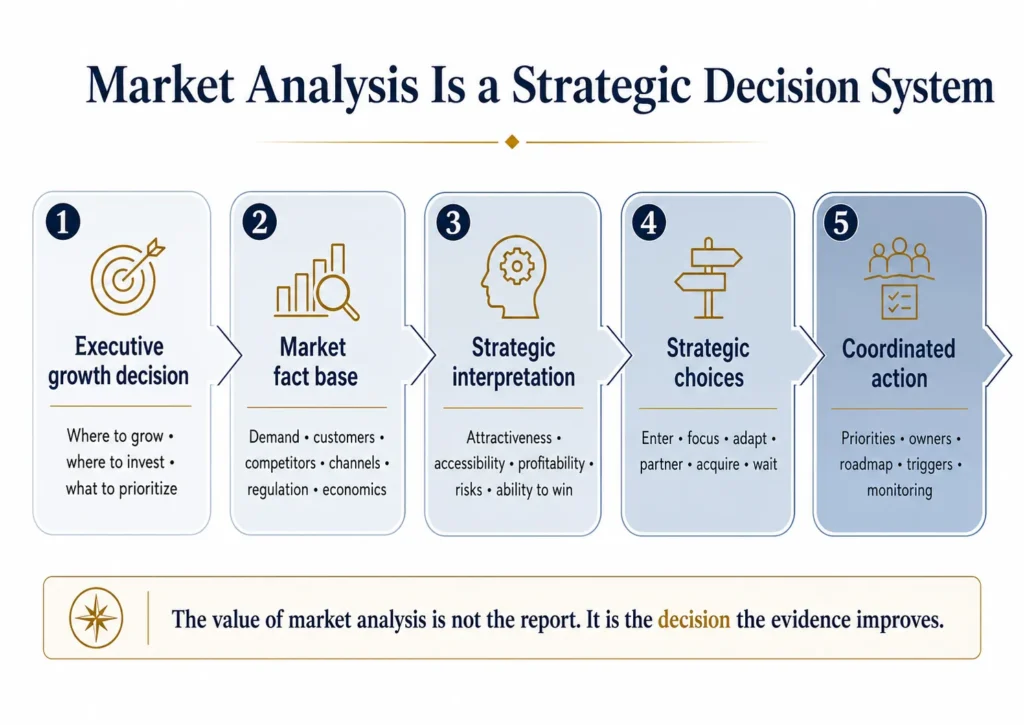
Figure 1. Market analysis creates value when evidence about demand, customers, competition, access, and economics changes your strategic choices and investment priorities.
Which Strategic Decision Are You Trying to Make with the Market Analysis Consulting?
A useful market-analysis engagement begins with your decision—not with a request to collect every available fact about an industry.
We typically support leadership teams facing decisions such as:
Which markets, regions, or segments should you prioritize?
You may be comparing countries, states, cities, industrial clusters, applications, customer groups, institutions, or channels. We help you identify where accessible demand, customer need, economics, strategic fit, and execution feasibility reinforce one another.
Should you enter the market?
You may need to decide whether to enter now, prepare for later, use a partner, focus on selected segments, acquire access, or decline the opportunity. We test the assumptions that determine whether the investment is justified.
Why is growth underperforming?
A market may be growing while your business is not. The cause may be customer selection, value proposition, pricing, service, availability, channels, sales focus, portfolio fit, competitor strength, or execution constraints. We help you distinguish the symptoms from the underlying strategic problem.
Which customers and applications deserve focus?
Broad category growth can conceal major differences in urgency, purchasing criteria, willingness to pay, margin, switching barriers, and cost-to-serve. We identify the value pools where your offer has the strongest fit.
Which channel or partner model should you use?
You may need to choose among direct sales, distributors, dealers, integrators, importers, representatives, institutions, digital channels, or a hybrid model. We assess customer access, economics, control, capabilities, conflicts, investment, and scalability.
How should you price and structure the offer?
Market analysis can reveal willingness to pay, reference prices, substitutes, channel margins, financing needs, service expectations, total cost of ownership, and the conditions that justify a premium.
Should you localize production, inventory, or service?
You may need to compare importing, local inventory, assembly, contract manufacturing, partnership, acquisition, or full production. We connect the operating model with customer value, demand density, cost, flexibility, risk, and investment.
How should you allocate limited resources?
Not every attractive opportunity can be pursued at once. We help your team prioritize markets, segments, accounts, capabilities, and investments according to strategic value and executable advantage.
Market Size Is Only the Starting Point of a Marketing Analysis Consulting
Executives often begin with total market size. That is useful, but insufficient.
A large market can be unattractive because demand is inaccessible, competitors are entrenched, customers are unwilling to switch, margins are weak, service costs are high, or the required capabilities would take too long to build.
A smaller market can be strategically superior because customers have an urgent unmet need, channel access is available, pricing is healthy, regulation is manageable, and your capabilities transfer effectively.
We separate five layers of opportunity:
Total market
The broad category, including all products, customers, applications, regions, and channels that may appear relevant.
Relevant market
The portion that fits your product, technology, strategic scope, and target customer needs.
Accessible market
The demand you can realistically reach through available channels, approvals, customer relationships, service coverage, supply, and commercial capabilities.
Economically attractive market
The portion that can generate acceptable returns after pricing, channel margins, logistics, service, working capital, investment, and cost-to-serve are considered.
Winnable priority opportunity
The customers, segments, applications, or markets where your value proposition and capabilities can outperform the available alternatives strongly enough to create profitable growth.
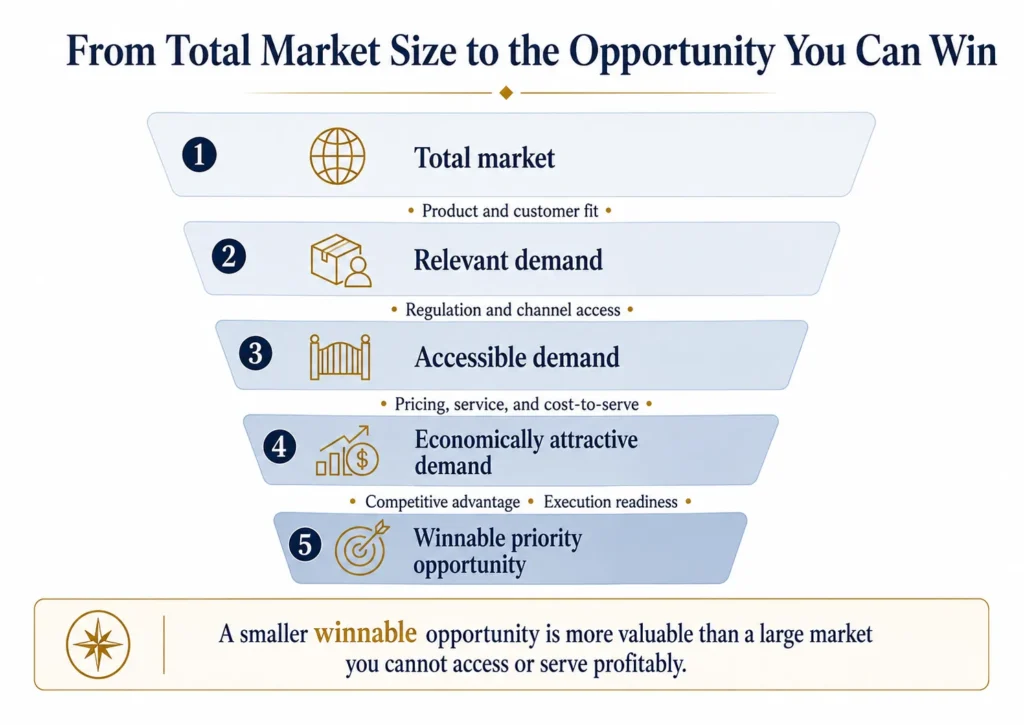
Figure 2. Strategic market analysis narrows theoretical demand into the opportunity your company can access, serve profitably, and win.
What a Strategic Market Analysis Consulting Must Explain
Demand and market structure
How large is demand, where is it concentrated, what is driving it, and how is it likely to change? Depending on the industry, we may analyze units, value, installed base, usage, replacement, projects, institutions, applications, production, imports, or account demand.
Customer needs and purchasing behavior
Who makes the decision? What problem is the customer trying to solve? Which criteria matter most? What creates urgency, trust, willingness to pay, switching, or delay?
Segments, applications, and value pools
Which parts of the market generate the most attractive combination of growth, margin, customer value, accessibility, and strategic fit?
Competitors and substitutes
Which alternatives are customers using? Why do they win? Where are they strong or vulnerable? How could their actions affect the opportunity?
Channels and market access
Who controls the route to market? What capabilities do distributors, dealers, integrators, importers, institutions, or digital channels provide? Where are the coverage gaps and dependencies?
Pricing and economics
What are the effective prices, discounts, terms, service inclusions, channel margins, logistics, working-capital requirements, and cost-to-serve? Which segments can generate acceptable returns?
Regulation and barriers
Which registrations, approvals, standards, tenders, local-content requirements, certifications, or institutional processes affect time, cost, access, and competitive position?
Ability to win
How well does the opportunity fit your brand, product, references, relationships, supply, service, technology, sales model, financial capacity, and decision speed?
Execution requirements
What must you build, acquire, adapt, finance, or partner for before the opportunity becomes realistic and scalable?
We Prioritize Opportunity, Ability to Win, and Execution Feasibility Together in Our Market Analysis Consulting
A market can be attractive and still be wrong for your company. A strong prioritization should combine three perspectives.
Market attractiveness
- Accessible demand and growth.
- Customer need and willingness to pay.
- Margin and value-pool potential.
- Competitive intensity.
- Regulatory and structural risk.
Ability to win
- Value-proposition fit.
- Brand, references, and relationships.
- Channel and partner capabilities.
- Product, service, and supply readiness.
- Relative advantage versus competitors and substitutes.
Execution feasibility
- Required investment and working capital.
- Time to approval and customer access.
- Availability of partners and talent.
- Operational complexity.
- Management attention and scalability.
The strongest opportunity is where these three dimensions reinforce one another. A large market with low ability to win can destroy value. A smaller opportunity with strong fit and efficient execution can become a profitable growth platform.
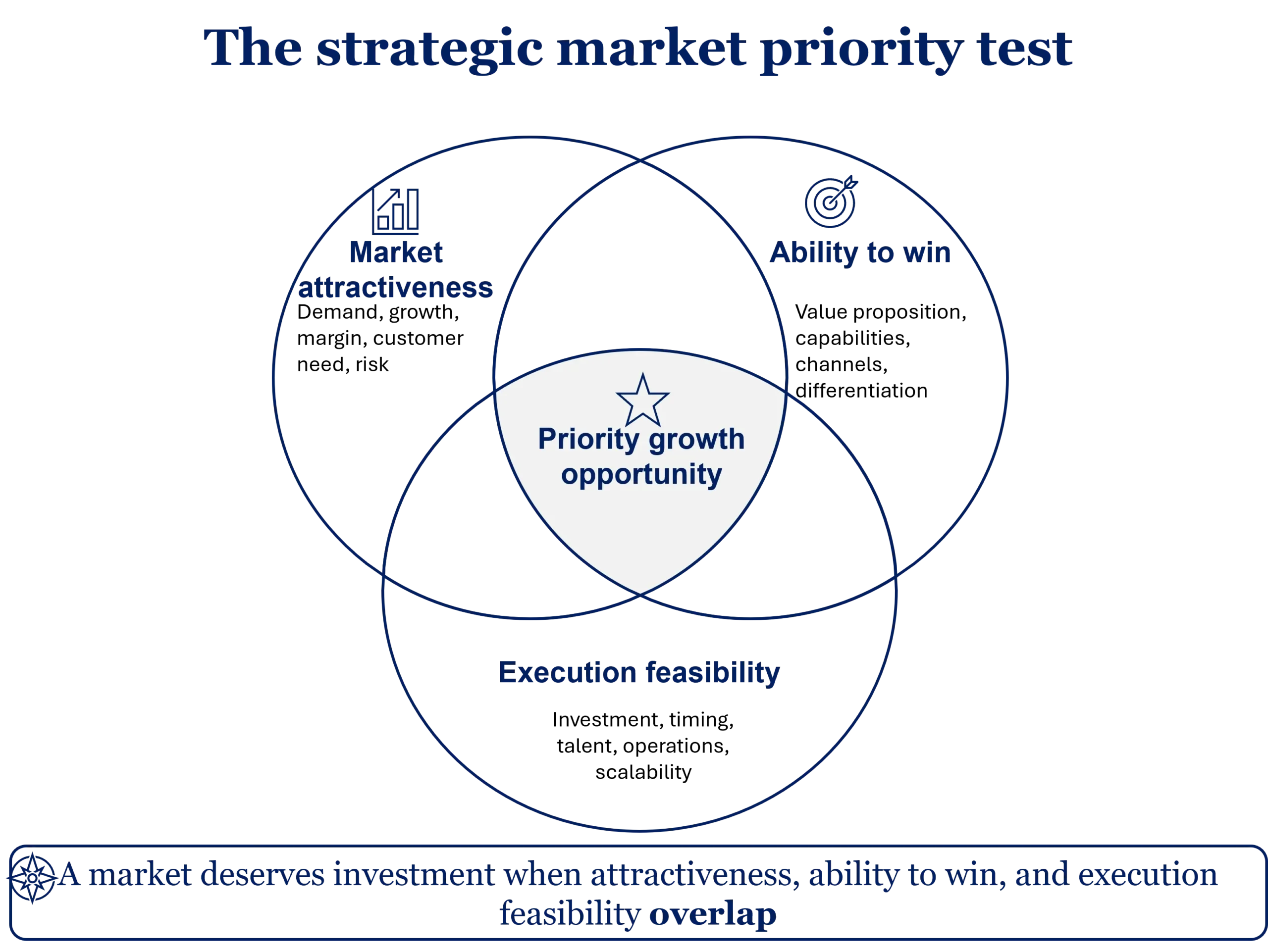
Figure 3. The strongest growth priorities combine attractive demand with a credible advantage and an executable business model.
How Our Market Analysis Consulting Engagement Works
Every project is tailored to your decision, industry, markets, products, and existing knowledge. The precise methods and deliverables vary, but the engagement typically follows six stages.
1. Define the decision and critical assumptions
We begin with the choice your leadership team must make. We clarify the objective, scope, deadline, markets, products, segments, assumptions, internal disagreements, investment horizon, and criteria for success.
This prevents the project from becoming an unfocused research exercise.
2. Translate the decision into intelligence questions
We identify what your team needs to know in order to compare options. Questions may concern demand, customers, segments, pricing, competitors, channels, regulation, supply, service, partners, economics, or execution.
3. Build and triangulate the fact base
We combine relevant secondary research with primary market insight. Depending on the assignment, this may include interviews with customers, distributors, dealers, importers, integrators, suppliers, former industry participants, experts, institutions, regulators, and other knowledgeable sources.
We compare independent sources, test economic and operational consistency, define the market precisely, and distinguish verified facts from informed estimates.
4. Conduct the first analytical wave
We share preliminary findings and challenge the initial assumptions. Markets, segments, or customer groups that looked attractive may become less compelling. Smaller opportunities may emerge as strategically superior.
5. Refine the scope and deepen decision-critical questions
Your leadership team reviews the implications and helps redirect the second wave toward the uncertainties that can still change the decision. This may include deeper customer interviews, partner assessment, pricing, market sizing, account validation, regulatory questions, or business-model economics.
6. Compare strategic options and mobilize action
We translate the evidence into clear choices, trade-offs, risks, recommendations, priorities, owners, triggers, and next steps.
The final discussion is designed to create alignment around what your organization should do differently, not simply to present the research.
Why We Do Our Market Analysis Consulting in Analytical Waves
At the beginning of a strategic market-analysis project, your team rarely knows exactly which questions deserve the deepest research.
Attempting to study every market, segment, competitor, channel, and customer at the same level can waste time and budget. It can also produce an impressive report that gives equal weight to issues that have very different strategic importance.
Our wave-based process improves focus:
First wave: Build the comparative fact base
We test the initial market definitions, estimate the opportunity, identify major differences, and challenge the assumptions behind the decision.
Leadership refinement: Redirect the analysis
Your team reviews the preliminary findings. We agree which opportunities remain attractive and which uncertainties require greater precision.
Second wave: Deepen the priority questions
We concentrate additional interviews and analysis on the markets, segments, customers, partners, economics, and barriers that can change the strategic choice.
This approach makes the analysis more relevant and gives your leadership team a meaningful role before the recommendations are finalized.
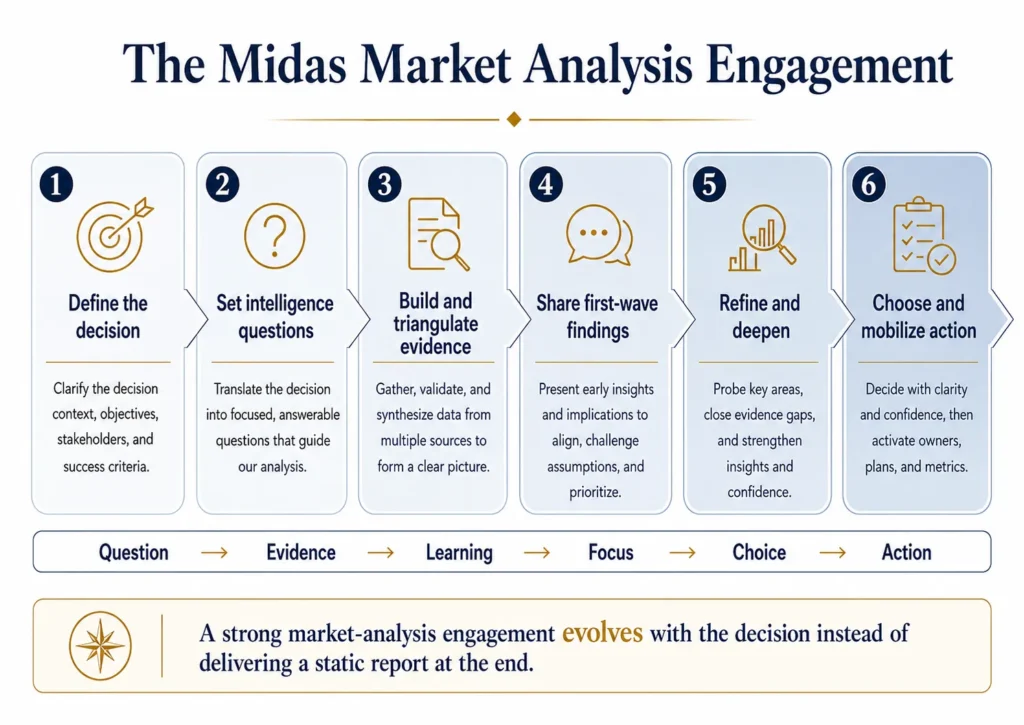
Figure 4. Our engagement begins with your executive decision, evolves through wave-based learning, and ends with aligned strategic choices and action.
What You Receive with Our Market Analysis Consulting
The deliverables are designed around your decision rather than a standard report template. Depending on the scope, you may receive:
- An executive synthesis of the market opportunity and its strategic implications.
- Market definitions, sizing estimates, growth ranges, and demand drivers.
- Country, region, segment, application, customer, institution, or channel prioritization.
- Customer needs, purchasing criteria, willingness-to-pay, and decision-process analysis.
- Competitor, substitute, channel, partner, or ecosystem maps.
- Pricing, channel economics, service, logistics, and cost-to-serve analysis.
- Regulatory, technical, institutional, and market-access requirements.
- Market attractiveness, ability-to-win, and execution-feasibility assessments.
- Market-entry, channel, portfolio, pricing, production, partnership, or acquisition options.
- Risk scenarios, assumptions, early-warning indicators, and management triggers.
- An executive presentation and leadership working session.
- A prioritized roadmap with responsibilities, sequencing, and next steps.
We do not aim to overwhelm your team with every fact collected. We prioritize the evidence and implications that can change your strategic choice.
When Market Analysis Consulting Should Be Combined with Other Services
Some decisions require more than one analytical lens. We frequently combine market analysis with complementary Midas services when the strategic question extends beyond market attractiveness.
Competitor Analysis Consulting
Use competitor analysis when rival objectives, capabilities, vulnerabilities, and likely responses can materially change the opportunity.
Market Entry Consulting
Use market-entry consulting when you need to choose the country, entry mode, investment sequence, partners, operating model, and launch roadmap.
Go-to-Market Consulting
Use go-to-market consulting when the opportunity is attractive and the next challenge is designing customer priorities, channels, sales model, pricing, service, and implementation.
Benchmarking Consulting
Use benchmarking when you need to understand why competitors or reference companies perform better and which capabilities or practices explain the gap.
Value Proposition Consulting
Use value-proposition consulting when customer research reveals that your offer does not create enough differentiation, confidence, or switching motivation.
Business Wargaming
Use business wargaming when your entry, launch, price change, or expansion may trigger significant reactions from competitors, channels, customers, or regulators.
Strategy Consulting
Use broader strategy consulting when leadership must connect market choices with portfolio, capabilities, organization, investment, and long-term advantage.
Why Leadership Teams Choose Midas for Market Analysis Consulting
We focus on the decision, not the volume of research
We begin with what your leadership team must decide and collect evidence according to its ability to change that decision.
We connect market attractiveness with your ability to win
A market can be attractive and still be wrong for your company. We assess opportunity, access, economics, strategic fit, capabilities, and execution readiness together.
We combine secondary and primary research
Published data often describe the market broadly but cannot explain customer decisions, channel influence, real pricing, unmet needs, or implementation constraints. We validate the fact base through direct market interviews where appropriate.
We work interactively with your team
Preliminary findings are discussed before the final recommendation. This allows your executives and specialists to challenge assumptions, redirect the research, and build ownership of the decision.
We make uncertainty visible
We distinguish facts from estimates and hypotheses, explain definitions and limitations, use ranges where appropriate, and identify which indicators should be monitored.
We translate evidence into action
The engagement ends with priorities, strategic options, sequencing, investment implications, responsibilities, and next steps—not simply a description of the market.
We bring extensive experience in market analysis consulting
Since 2000, Midas Consulting has completed more than 200 market-analysis consulting projects across a broad range of industries and has worked throughout Spanish- and Portuguese-speaking Latin America, as well as Spain and Portugal.
Our current website reports a Net Promoter Score of 82.2% (2020-2025), reflecting strong client satisfaction with our consulting work.
“I’ve been partnering with Midas for over ten years. Each project—typically focused on opportunities or market entry in Latin America—has been a success. I highly recommend them.”
— President
“Midas provided fantastic insights, analysis, and recommendations. We were truly impressed by the depth of their research, especially given the short timeframe.”
— Strategy Vice President
“Thanks to Midas, we walked away with a clear, well-organized strategy. The collaboration between different business units and the fresh market insights were outstanding. Kudos!”
— Go-to-Market Manager
Industries We Serve with Our Market Analysis Consulting
We adapt the market definition, research methods, analytical models, and strategic interpretation to the economics and decision processes of your industry.
Selected Strategic Applications of Our Market Analysis Consulting
Prioritizing regional growth
We helped a medicinal-gas-equipment manufacturer compare opportunities across Brazil, Mexico, Argentina, and Colombia. The analysis connected market size, customers, competitors, barriers, channels, and operating requirements to a country-specific growth roadmap. The company doubled regional sales within four years.
Repositioning an industrial offer
We analyzed the rock-driller market in Chile and Peru through customer, competitor, representative, channel, and acquisition-target research. Changes in sales focus and value proposition contributed to a 40% first-year sales increase in each market, according to the published cases.
Finding the real opportunity behind a broad market
We have helped clients narrow large national estimates into priority applications, customer groups, regions, accounts, and channels where access, economics, and strategic fit were stronger.
Determining when not to invest
Market analysis can show that an opportunity is too small, inaccessible, margin-dilutive, operationally complex, or poorly matched to the company’s capabilities. Avoiding or staging the wrong investment can create as much value as identifying a growth market.
Market Analysis Across Latin America
Regional averages can be misleading. Customer behavior, channels, regulation, pricing, purchasing power, service requirements, competition, and execution conditions can vary materially by country.
Explore the market most relevant to your decision:
- Market analysis across Latin America
- Market analysis in Argentina
- Market analysis in Brazil
- Market analysis in Chile
- Market analysis in Colombia
- Market analysis in Mexico
- Market analysis in Peru
Learn More About the Strategic Discipline
This service page focuses on how Midas supports your decision. For a detailed educational explanation of when market analysis is useful, what the process should include, why wave-based research improves focus, and how to interpret its strengths and limitations, visit Market Analysis: The Key to Informed Strategic Decisions.
When you need a structured approach for comparing several markets, segments, or countries, visit our guide on How to Rank the Markets to Enter.
How We Maintain Ethical and Reliable Research Standards
We comply with SCIP’s Code of Ethics, the profession’s gold standard. We comply with applicable laws, accurately disclose relevant identity and organizational information before interviews, avoid conflicts of interest, provide honest recommendations, and promote ethical conduct throughout the engagement.
We do not seek trade secrets, request confidential documents, misrepresent who we are, induce contractual breaches, or facilitate improper exchanges of competitively sensitive information.
We also make analytical uncertainty visible. We define the market carefully, reconcile inconsistent sources, triangulate interviews, distinguish verified evidence from estimates, and use ranges when an exact number would create false confidence.
You can review SCIP’s ethical intelligence guidance and Code of Ethics.
Frequently Asked Questions About Market Analysis Consulting
What is market analysis consulting?
Market-analysis consulting is a decision-oriented service that helps your leadership team understand demand, customers, segments, competitors, channels, regulation, economics, risks, and execution requirements so you can choose where and how to grow.
How is this different from buying a market report?
A market report provides standardized information. Our work begins with your decision, defines the relevant market, develops tailored intelligence questions, combines secondary and primary research, tests your ability to win, and recommends actions specific to your company.
Can you estimate market size in your market analysis consulting when published information is limited?
Yes. Depending on the industry, we can triangulate official data, imports, production, installed base, usage, replacement, projects, account demand, channel activity, pricing, and interviews. We use ranges when an exact estimate is not defensible.
Can you compare several countries or regions?
Yes. We establish common strategic dimensions for comparison while adapting the evidence and interpretation to each market. This helps your team distinguish regional patterns from local realities.
Can you prioritize segments, applications, or customer groups in your market analysis consulting ?
Yes. We compare accessible demand, customer need, willingness to pay, margin, competitive intensity, channel access, strategic fit, and execution feasibility.
Can you assess customer needs and willingness to pay?
Yes. We can investigate purchasing criteria, unmet needs, decision roles, price sensitivity, alternatives, switching barriers, financing, total cost, and the value drivers that support a premium.
Can you evaluate distributors and market-entry partners in your market analysis consulting ?
Yes. We can assess customer access, geographic and segment coverage, inventory, credit, technical capability, service, regulatory knowledge, competing brands, commitment, economics, and scalability.
Can you analyze pricing and profitability?
Yes. We can examine effective prices, discounts, terms, channel margins, logistics, service, working capital, cost-to-serve, and willingness to pay where relevant and ethically obtainable.
Can you evaluate local production versus importing in your market analysis consulting ?
Yes. We can compare importing, inventory, assembly, contract manufacturing, partnership, acquisition, and full production according to demand, cost, capacity, flexibility, customer value, risk, and investment.
How do you account for uncertainty?
We use ranges, scenarios, confidence levels, assumptions, and indicators rather than pretending that one estimate or forecast is certain. The goal is stronger preparedness, not false precision.
Do you conduct interviews in your market analysis consulting ?
Yes, when primary research is useful and appropriate. Interviews may involve customers, distributors, suppliers, specialists, former industry participants, institutions, regulators, and other knowledgeable sources.
What happens during the project?
You receive preliminary findings before the final delivery. This allows your team to challenge conclusions, refine priorities, and redirect deeper research toward the questions that can still change the decision.
How long does a market analysis consulting project take?
The timing depends on the number of markets, segments, interviews, and strategic questions. We scope the work around your deadline and can deliver preliminary findings in phases.
What do you need from our team?
We typically need access to the executives and specialists who understand the decision, your existing knowledge and hypotheses, relevant internal information, and timely feedback on preliminary findings.
About Midas Market Analysis Consulting
Midas Consulting is the corporate author and provider of this market-analysis service.
We help C-level executives and leadership teams make stronger decisions through market analysis, competitor analysis, strategic intelligence, market entry, go-to-market strategy, benchmarking, value proposition development, win-loss analysis, business wargaming, and strategy consulting.
Our work combines regional experience, local market research, strategic interpretation, and practical collaboration with your team. Since 2000, we have completed more than 200 market-analysis projects for organizations across a broad range of B2B, B2C, industrial, consumer, technology, healthcare, and regulated markets.
Our market-analysis practice is led by Adrian Alvarez, PhD, Managing Partner of Midas Consulting, Wharton Alumnus, MBA Professor at Universidad Argentina de la Empresa (UADE), and Competitive Intelligence Fellow. His experience strengthens the firm’s methodology, but the service, recommendations, and page authorship belong to Midas Consulting as an organization.
Last reviewed: August 2026
What Growth Decision Are You Facing?
You may be evaluating a new market, prioritizing countries or segments, trying to understand why growth has slowed, selecting a distributor, reviewing pricing, considering local production, planning a product launch, or deciding where to allocate investment.
You do not need a generic industry report or one impressive market-size number. You need to understand where demand is accessible, what customers value, how strong the economics are, what it will take to win, and which action your organization should take next.
In an initial conversation, we will discuss your decision, the markets, products, segments, and channels involved, what your team already knows, the deadline you face, and which uncertainties could materially change the strategy.
We can then propose a tailored market-analysis engagement with a clear scope, wave-based research plan, collaboration model, deliverables, timing, and investment.