
Market analysis in Argentina to grow!
In Argentina, a market can appear to be growing while real demand, purchasing power, and profitability are moving in a very different direction.
Nominal sales may rise because of inflation. Import values may change because of currency movements rather than volume. Customers may delay purchases, reduce specifications, switch to substitutes, extend payment terms, or prioritize availability over preference. A category that looks attractive at today’s prices may become less compelling once inventory is replaced or regulations change.
That is why market analysis in Argentina should not stop at a market-size estimate or one forecast. It should help you understand what is really driving demand, how customers are adapting, which economics can be sustained, and what conditions must be true for your company to grow profitably.
At Midas Consulting, we combine secondary research, direct market insight, economic interpretation, and strategic scenarios so you can make stronger decisions about entry, pricing, portfolio, channels, supply, investment, and growth in Argentina.
Argentina’s trade opening shows why this kind of market understanding matters. In the Midas Import Competition Monitor 2026, we analyzed 151 business decisions made as companies responded to increased import competition in Argentina. We found companies investing to defend local production, reconfiguring their operations, changing their sourcing strategies, regionalizing, importing, reducing capacity, or exiting the market. Forbes Argentina used our research to examine how these changing market conditions are reshaping business decisions.
The result is not a prediction that assumes the environment will remain stable. It is a decision framework that shows where the opportunity is attractive, what could change it, and how your strategy should adapt.
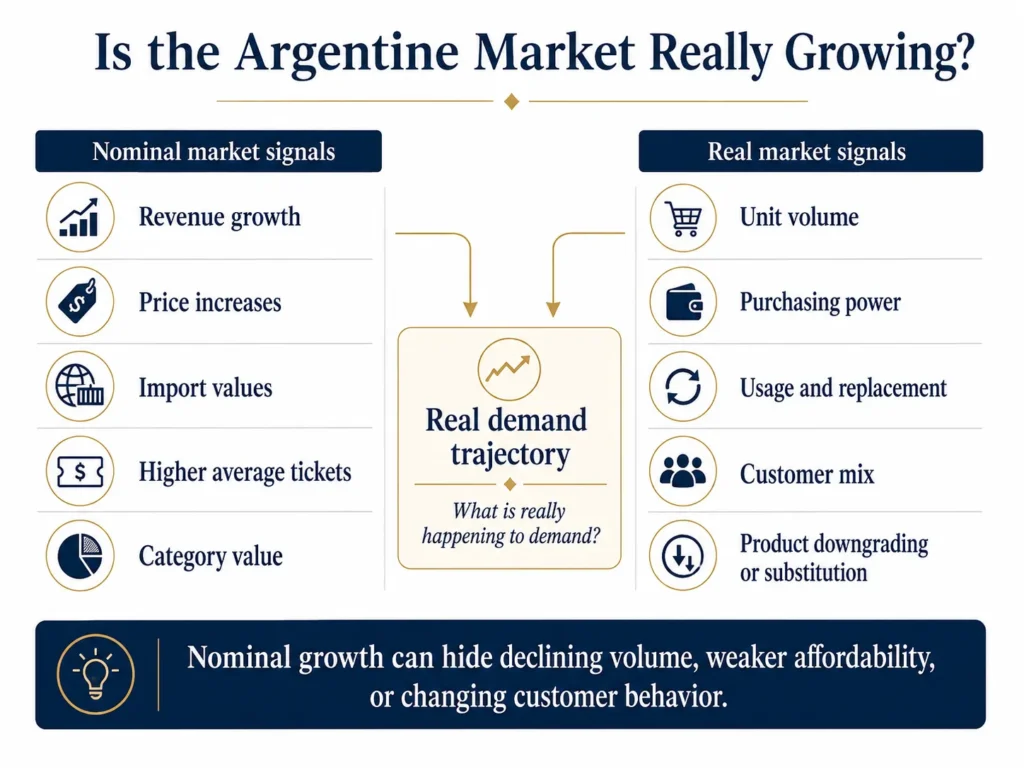
Figure 1. Market analysis in Argentina must distinguish nominal value growth from real changes in volume, affordability, usage, and customer behavior.
The Strategic Market Analyisis Question In Argentina Is Not Only “How Large Is the Market?”
A headline market estimate may be numerically correct and still be strategically misleading.
Your leadership team needs to understand:
- How much of reported growth reflects price rather than volume.
- Which customers still have the budget and willingness to buy.
- Whether demand is recurring, delayed, substituted, or disappearing.
- How frequently customers replace products or equipment.
- Which segments are trading down, postponing purchases, or changing specifications.
- Whether imported supply can be replaced at current economics.
- How taxes, freight, financing, credit, and working capital affect the effective opportunity.
- Which regulations and administrative requirements can delay access.
- Whether your channel can manage inventory, price changes, credit, and service.
- What happens to the opportunity under different economic and policy conditions.
The objective is to convert an unstable market picture into a set of decision-relevant ranges, scenarios, and management choices.
Five Layers of the Opportunity You Need to Test
1. Real demand
We examine what customers are actually buying, using, replacing, postponing, or abandoning. Depending on the industry, volume may need to be estimated through units, installed base, consumption, applications, customer activity, imports, production, tenders, or project demand rather than nominal revenue alone.
2. Affordability and willingness to pay
Demand can exist without being commercially accessible. We assess how customers respond to price increases, financing needs, budget constraints, payment terms, substitution, and the total economic value of the offer.
3. Replacement and supply economics
Current prices may be supported by inventory purchased under earlier cost or currency conditions. We test what the market looks like when products, components, or raw materials must be replenished at current replacement cost.
4. Market access and execution
An attractive category can remain inaccessible if approvals, imports, channels, service, financing, inventory, or commercial coverage are insufficient. We assess what your company must build or secure before the opportunity becomes realistic.
5. Strategic resilience
We test whether the opportunity remains attractive under plausible changes in inflation, exchange rates, regulation, imports, demand, competition, and customer behavior.
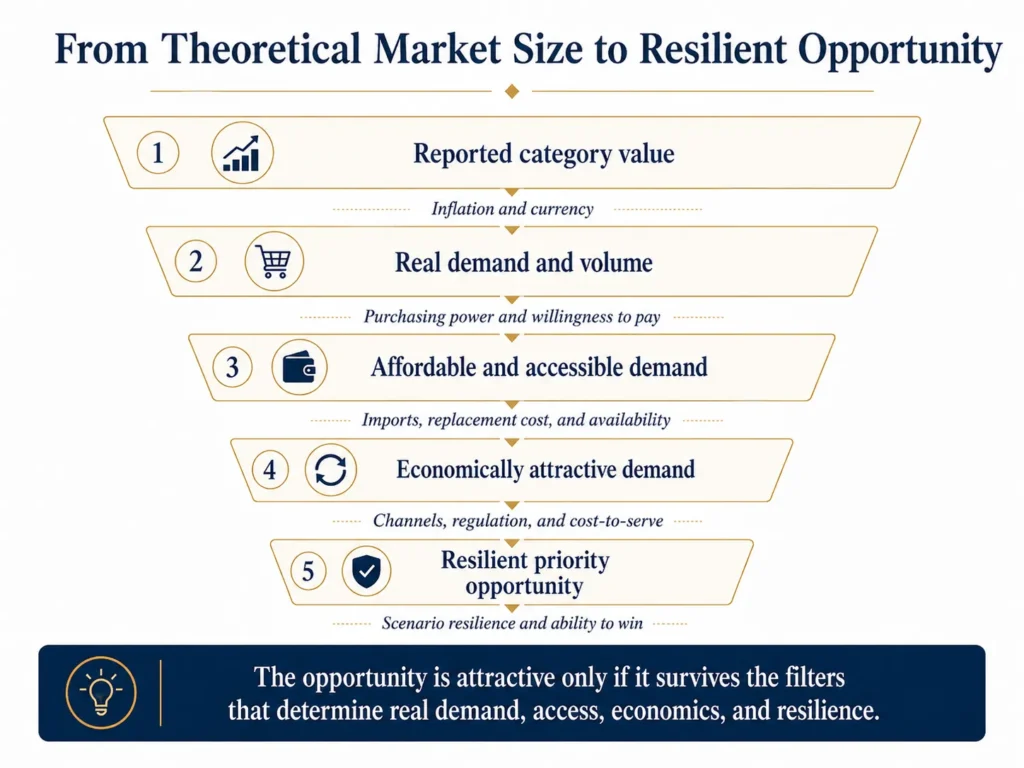
Figure 2. A useful Argentina market analysis narrows reported category value into the opportunity your company can access, serve profitably, and sustain under changing conditions.
How Inflation Changes the Questions You Need to Ask in Market Analysis in Argentina
Inflation affects far more than price. It can alter customer timing, product mix, credit, inventory, supplier behavior, channel margins, working capital, and the meaning of historical comparisons.
Separate value from volume
Nominal revenue should be decomposed wherever possible into price, unit volume, customer mix, product mix, and channel effects. Otherwise, a growing category may conceal declining consumption or customer losses.
Understand the customer’s budget cycle
Customers may accelerate purchases before an expected increase, delay them because budgets have not adjusted, or split orders to preserve cash. One month or quarter may therefore misrepresent underlying demand.
Assess trading down and substitution
Customers may shift to lower specifications, smaller formats, local alternatives, refurbished equipment, extended maintenance, or informal substitutes. These changes can alter market structure before official category definitions reflect them.
Evaluate payment conditions as part of price
The effective commercial offer includes payment timing, financing, credit risk, discounts, indexation, currency exposure, and service commitments. Two nominally similar prices may create very different economics for the customer and supplier.
Use replacement economics for forward decisions
Historical prices and margins may be supported by stock acquired under earlier conditions. Investment decisions should consider what happens when inventory is replenished and the channel must finance the next cycle.
Customer Behavior Can Change Before the Data Shows It
In volatile markets, customer interviews and channel evidence become especially important because published information often describes the past.
We investigate questions such as:
- Which needs remain essential despite budget pressure?
- Which purchases can be delayed without immediate operational consequences?
- What causes customers to accept a price increase?
- Where are customers reducing specifications or switching brands?
- Which products or services lower total cost or operating risk?
- How do procurement, finance, operations, and technical stakeholders differ in their priorities?
- Which customers are increasing investment while others contract?
- How are distributors changing inventory, credit, and account priorities?
This allows your strategy to respond to emerging behavior rather than rely only on lagging category data.
Imports, Local Supply, and Replacement Economics
The market opportunity can change considerably depending on how products, components, equipment, or inputs reach Argentina.
We assess:
- Local production versus imported supply.
- Dependence on imported components or raw materials.
- Lead times, customs, logistics, and availability.
- Inventory depth and replenishment cycles.
- Currency and financing exposure.
- The ability of distributors or customers to fund stock.
- Potential product reformulation, localization, or substitution.
- The effect of supply changes on customer preference and competitor position.
An opportunity may look attractive while existing inventory is available and become less profitable when the next shipment arrives. Conversely, a company with reliable supply or local capability may gain access even when its product is not initially preferred.
Regulation and Policy Should Be Converted into Business Implications
Political or regulatory developments matter only when they change the strategic decision.
Rather than describe policy changes in isolation, market analysis should assess their effect on:
- Market access and approval timing.
- Imports and local production.
- Customer budgets and investment.
- Competition and new entrants.
- Pricing and reimbursement.
- Working capital and cash conversion.
- Channel structure and partner requirements.
- The risk and timing of your investment.
Because the environment can change, the page should avoid treating any current policy as permanent. The analysis should identify what must be monitored and which change would trigger a different management response. This is especially important given the Milei administration’s current deregulation efforts.
Why a Single Forecast Is Not Enough for Market Analysis in Argentina
A one-point forecast can create a misleading sense of precision. In Argentina, strategic choices are often stronger when they are tested against a small number of plausible operating scenarios.
For example:
Stabilization and recovery
Purchasing power and investment improve, imports and supply become more predictable, and deferred demand begins to return.
Uneven normalization
Some sectors and customers recover while others remain constrained. Demand becomes more attractive but highly selective.
Persistent pressure
Affordability, credit, regulation, or supply continue to restrict the market, increasing substitution and competition for fewer accessible accounts.
The objective is not to predict which scenario will occur with certainty. It is to identify which strategy remains attractive across more than one plausible future, which investments should be staged, and which indicators deserve management attention.
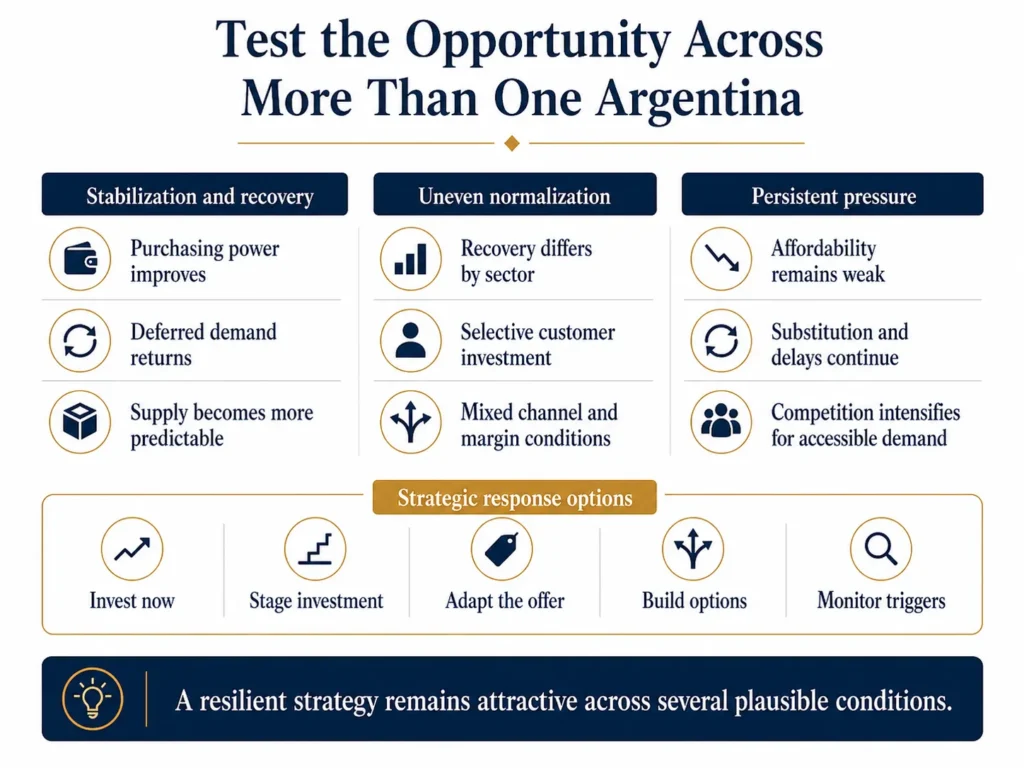
Figure 3. Scenario-based market analysis helps you distinguish robust actions from choices that depend on one fragile forecast.
How Midas Builds a Reliable Argentina Fact Base in Its Market Analysis
No single source is sufficient. Official statistics provide essential context, but they may not answer a narrow industry question or reveal how customer behavior is changing now. Interviews provide current insight, but each source has a limited perspective and its own incentives.
We triangulate evidence from:
- Official economic, demographic, sector, trade, regulatory, and procurement information.
- Company, product, price, portfolio, investment, hiring, and channel signals.
- Interviews with customers, distributors, suppliers, specialists, former industry participants, institutions, and other knowledgeable sources.
- Volume, installed-base, usage, replacement, import, or production indicators where relevant.
- Your team’s commercial, technical, operational, and financial knowledge.
- Comparisons with regional markets when they help test an Argentina-specific assumption.
We define the market carefully, reconcile conflicting estimates, distinguish verified facts from hypotheses, and use ranges when the evidence does not justify false precision.
For the complete research process and wave-based methodology, visit Market Analysis: The Key to Informed Strategic Decisions.
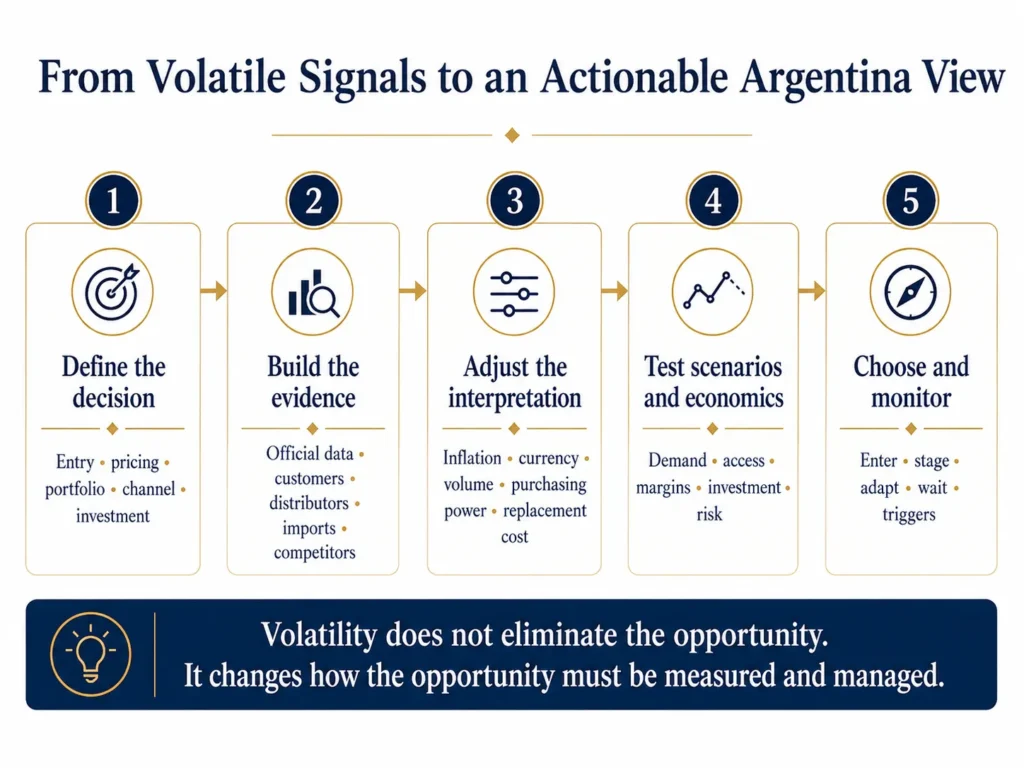
Figure 4. Argentina market analysis becomes actionable when market evidence is adjusted for economic reality, tested under scenarios, and linked to a management choice.
How Market Analysis in Argentina Changes Your Decision
Market-entry decisions
You can determine whether to enter now, stage the commitment, use a partner, focus on selected segments, or wait for specific conditions.
Pricing and commercial decisions
You can connect price with affordability, replacement economics, payment terms, financing, product mix, and customer value instead of responding only to inflation.
Portfolio decisions
You can identify which products remain essential, which require localization or simplification, where customers are trading down, and which offers can justify premium value.
Channel and distributor decisions
You can assess whether partners can manage inventory, credit, regional coverage, technical service, changing prices, and customer relationships under volatile conditions.
Supply and investment decisions
You can evaluate inventory, local production, importing, sourcing, working capital, service capacity, and the sequence required to support growth.
Risk and monitoring decisions
You can define which economic, regulatory, customer, channel, and competitor indicators should trigger a change in strategy.
Case Example: Growing 70% in an Uncertain Argentine Market
The executive challenge
A global producer of medicinal-gas equipment already operated in Argentina but faced high inflation, bureaucratic barriers, changing policies, and difficulty sustaining profitable growth.
The company needed more than a broad market estimate. It needed to understand the real opportunity, customer and channel behavior, regulatory constraints, competitive dynamics, supply implications, and the adjustments required to grow under uncertainty.
How we approached the decision
We combined secondary research with direct interviews involving:
- Equipment manufacturers.
- Medical-gas producers.
- Hospitals and healthcare providers.
- Distributors and logistics partners.
The analysis assessed market size, demand, customer needs, regulatory barriers, competitors, risks, supply conditions, and emerging opportunities.
We translated the findings into an Argentina-specific strategy rather than applying one regional model unchanged.
How the market analysis findings in Argentina supported growth
The company refined its pricing, reduced risk, improved its supply-chain approach, and focused its commercial effort on the opportunities with the strongest fit.
According to the case results, revenue in Argentina increased by 70% over three years.
The Argentina strategy also formed part of a wider Latin American growth program. For the regional case and cross-country roadmap, visit Market Analysis in Latin America.
“Thanks to Midas, we walked away with a clear, well-organized strategy. The collaboration between different business units and the fresh market insights were outstanding. Kudos!”
— Go-to-Market Manager
“Their report and analysis were thorough. They collaborated well with our team, including our tech department. One of the reasons we chose them was their depth of experience, which was evident throughout the project.”
— Global Product Manager
When You Need Market Analysis in Argentina
- Entering Argentina or reassessing a previous entry decision.
- Trying to distinguish nominal growth from real demand.
- Evaluating market size, volume, purchasing power, and affordability.
- Reviewing pricing, financing, terms, or product mix.
- Assessing imports, local production, inventory, or supply options.
- Selecting or evaluating a distributor.
- Preparing a launch or portfolio change.
- Prioritizing segments, applications, customers, or regions.
- Testing whether an opportunity remains attractive under different scenarios.
- Defining indicators that should trigger a change in strategy.
When your decision covers several countries, the Argentina analysis should fit into a consistent regional framework. See our Latin America market-analysis hub.
For the complete consulting offer, engagement model, and deliverables, visit our market-analysis consulting service page.
Why Midas for Market Analysis in Argentina?
We separate nominal value from real market behavior
We examine volume, purchasing power, product mix, customer behavior, and replacement economics rather than treating revenue growth as self-explanatory.
We connect market opportunity with financial and operational reality
We assess pricing, margins, cost-to-serve, imports, inventory, working capital, channels, service, and the investment required to execute.
We use scenarios instead of pretending one forecast is certain
We test the strategy against plausible conditions and identify robust actions, staged commitments, and management triggers.
We combine local depth with regional perspective
Argentina-specific evidence is central, but regional comparison can reveal which dynamics are local and which reflect a broader Latin American pattern.
We use primary research where published information is insufficient
We complement official and commercial information with carefully designed interviews and market validation.
We translate insight into a practical decision
The engagement ends with priorities, choices, risks, assumptions, and next steps—not simply a description of the market.
We bring direct market analysis in Argentina experience
We have analyzed B2B, B2C, technology, industrial, consumer, pharmaceutical, and healthcare markets in Argentina, supporting growth, market-entry, pricing, channel, portfolio, and investment decisions.
Ethical and Reliable Market Intelligence in Argentina
We comply with SCIP’s Code of Ethics, the profession’s gold standard. We comply with applicable laws, accurately disclose relevant identity and organizational information before interviews, avoid conflicts of interest, provide honest recommendations, and promote ethical conduct throughout the engagement.
We do not seek trade secrets, request confidential documents, misrepresent who we are, induce contractual breaches, or facilitate improper exchanges of competitively sensitive information.
We also make uncertainty visible. We explain market definitions, disclose important assumptions, distinguish verified evidence from estimates, and use ranges where exact numbers would create false confidence.
Review SCIP’s ethical intelligence guidance and Code of Ethics.
Frequently Asked Questions about Market Analysis in Argenina
How do you calculate market growth in a high-inflation environment?
We separate nominal value from unit volume, product mix, customer mix, pricing, and other drivers wherever the evidence permits. The appropriate measure depends on the industry and decision.
Can you estimate market size in your market analysis in Argentina when official data is delayed or incomplete?
Yes. We triangulate official information with imports, production, installed base, usage, customer demand, company activity, channel interviews, pricing, and other relevant evidence. We use ranges when an exact estimate is not defensible.
Can you analyze purchasing power and willingness to pay with your market analysis?
Yes. We can assess customer budgets, price sensitivity, substitution, payment terms, financing, purchase delays, value drivers, and the conditions under which customers accept higher prices.
Can you evaluate whether imported products remain economically viable in your market analysis in Argentina?
Yes. We can examine replacement cost, currency exposure, freight, customs, inventory, financing, channel margins, service, availability, and customer value.
Can you compare local production with importing?
Yes. We can compare cost, capacity, flexibility, investment, local content, supply risk, quality, time to market, service, and strategic fit. Specialist legal or tax advice may be required for formal conclusions in those areas.
How do you forecast demand in your market analysis in Argentina when conditions change rapidly?
We use ranges, scenarios, demand drivers, customer evidence, and leading indicators rather than relying on a single historical trend line.
Can you assess distributors?
Yes. We can examine customer access, regional coverage, inventory, credit, technical capability, service, competing brands, commitment, economics, and the ability to operate under changing conditions.
Can you help us decide whether to enter now or wait with your market analysis in Argentina?
Yes. We can compare immediate entry, staged entry, partnership, selected-segment entry, preparation, and waiting options according to opportunity, risk, investment, timing, and strategic resilience.
How do you protect confidentiality and comply with ethical standards?
We comply with applicable laws and SCIP’s Code of Ethics. We disclose relevant identity before interviews, do not misrepresent ourselves, and never seek trade secrets or confidential documents.
How long does a market analysis in Argentina take?
The timing depends on the products, segments, interviews, data availability, and strategic questions involved. We scope the work around your decision and can share preliminary findings in phases.
About the Author
Adrian Alvarez, PhD is Managing Partner at Midas Consulting, Wharton Alumnus, MBA Professor at Universidad Argentina de la Empresa (UADE), and Competitive Intelligence Fellow. He specializes in competitive strategy, market analysis, strategic intelligence, market entry, and executive decision-making under uncertainty in Argentina and Latin America.
He has analyzed B2B, B2C, technology, industrial, consumer, pharmaceutical, and healthcare markets in Argentina. His work has been published in the United States, Argentina, Spain, and Germany. You can access his library of strategic insights and published research here
View professional profile on LinkedIn
Selected Argentine Sources You May Need to Monitor
The right source mix depends on your industry and decision. An Argentina fact base may include:
- INDEC for official economic, demographic, price, trade, and sector information.
- Banco Central de la República Argentina for monetary, credit, exchange, and financial information.
- Argentina’s economic authorities for relevant policy, trade, and productive information.
- ANMAT when healthcare, pharmaceutical, food, medical-device, or other regulated products are involved.
- Customs and trade information, procurement platforms, sector regulators, industry associations, company disclosures, distributor evidence, and primary market interviews as appropriate.
Official information is essential, but it rarely explains current customer behavior, channel economics, competitor intentions, or the operational feasibility of your strategy on its own.
Make the Decision Resilient, not Dependent on One Forecast
You may be deciding whether to enter Argentina, increase investment, revise pricing, change your portfolio, appoint a distributor, localize supply, or wait for greater clarity.
You do not need a market number that looks precise but ignores inflation, affordability, replacement economics, regulation, and execution. You need to understand what is driving real demand, which parts of the opportunity are accessible and profitable, and what should change if conditions evolve.
In an initial conversation, we will discuss your decision, the products and customers involved, what your team already knows, the assumptions you need to test, and which economic or market changes could alter the strategy.
We can then propose a focused Argentina market-analysis engagement with a clear scope, research plan, scenario framework, timing, and deliverables.