Market analysis in Mexico to grow!
Mexico’s national scale can make the opportunity look obvious. The strategic opportunity rarely is.
Demand, customer requirements, competition, channels, production, talent, infrastructure, and service capabilities vary substantially across the country. A supplier may be deeply embedded in northern export-manufacturing networks, strong among industrial customers in Monterrey, well positioned in the Bajío, and comparatively weak in Mexico City or the southeast.
Mexico’s integration with North American and global supply chains adds another layer. Some opportunities are driven by domestic customers. Others depend on multinational manufacturers, global supplier standards, cross-border logistics, certifications, regional account relationships, and investment linked to supply-chain relocation.
That is why market analysis in Mexico should not stop at national market size, population, imports, or a broad nearshoring narrative. It should help you understand which regions and customer ecosystems matter, what those customers require, which competitors and partners control access, what capabilities must be localized, and where your company has a credible right to win.
At Midas Consulting, we combine secondary research, primary market interviews, cluster-level validation, customer and channel analysis, economic assessment, and strategic interpretation so you can make stronger decisions about entry, expansion, production, sourcing, channels, pricing, public and private access, partnerships, acquisitions, and investment in Mexico.
The result is not one national answer. It is a focused growth strategy that shows where to compete, how to access the opportunity, what to localize, and how to sequence commitment.
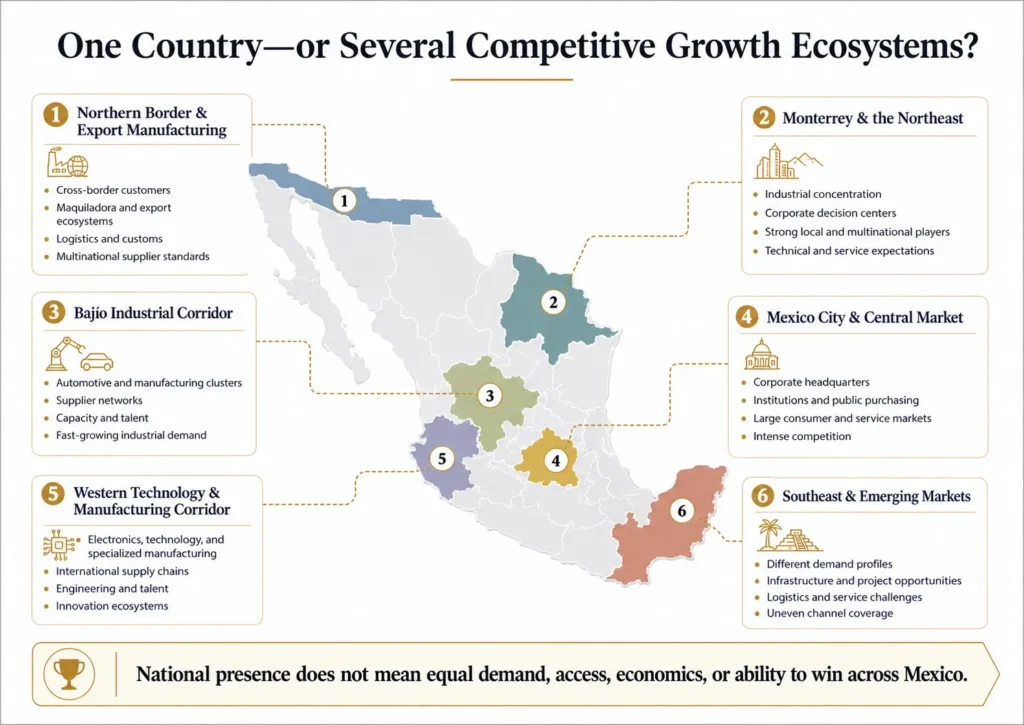
Figure 1. Mexico’s national market conceals different customer ecosystems, supply-chain connections, channel structures, and execution requirements across regions.
The Strategic Market Analysis Question Is Not Simply “How Large Is Mexico?”
Mexico is large enough to deserve attention in many industries. That does not mean every region, customer group, channel, or investment model is attractive for your company.
Your leadership team needs to understand:
- Where demand is concentrated by state, industrial cluster, industry, customer type, application, and channel.
- Which opportunities are driven by domestic demand and which depend on export-manufacturing or multinational investment.
- How customer requirements differ among multinational accounts, Mexican companies, institutions, and smaller regional buyers.
- Which competitors already serve customers across North America and which rely on purely local advantages.
- Whether your current product, service, pricing, and supply model fits the priority clusters.
- Which channels, distributors, integrators, dealers, or direct-sales capabilities provide genuine access.
- What local production, assembly, inventory, service, certification, or technical capability must be established.
- How public and private purchasing change the opportunity.
- What level of investment and management attention is required before the market becomes scalable.
- Which opportunities should be entered now, developed in stages, accessed through partners, or declined.
The objective is to move from Mexico’s theoretical national potential to the specific opportunity your company can access, serve profitably, and defend.
National Market Size Can Hide the Growth Platform That Matters
Industrial demand is concentrated in ecosystems
Automotive, aerospace, electronics, appliances, medical devices, food processing, logistics, energy, construction, mining, technology, and other industries are concentrated in different regions and supplier networks.
Your relevant market may not be all of Mexico. It may be a defined set of industrial parks, OEM networks, institutions, applications, distributors, or customer clusters.
The largest region may not offer the best fit
A large customer base can also mean intense competition, higher service expectations, entrenched suppliers, and expensive commercial coverage. A smaller industrial cluster may offer better access, clearer customer needs, and more efficient execution.
Growth may depend on one customer ecosystem
A category can appear diversified nationally while relying heavily on a limited number of multinational manufacturers, public institutions, distributors, contractors, or regional groups.
A high-growth market can remain difficult to capture
Demand growth does not create an opportunity automatically. Customers may require local references, certifications, engineering support, supplier approval, financing, local inventory, integration, or service capability that your organization does not yet possess.
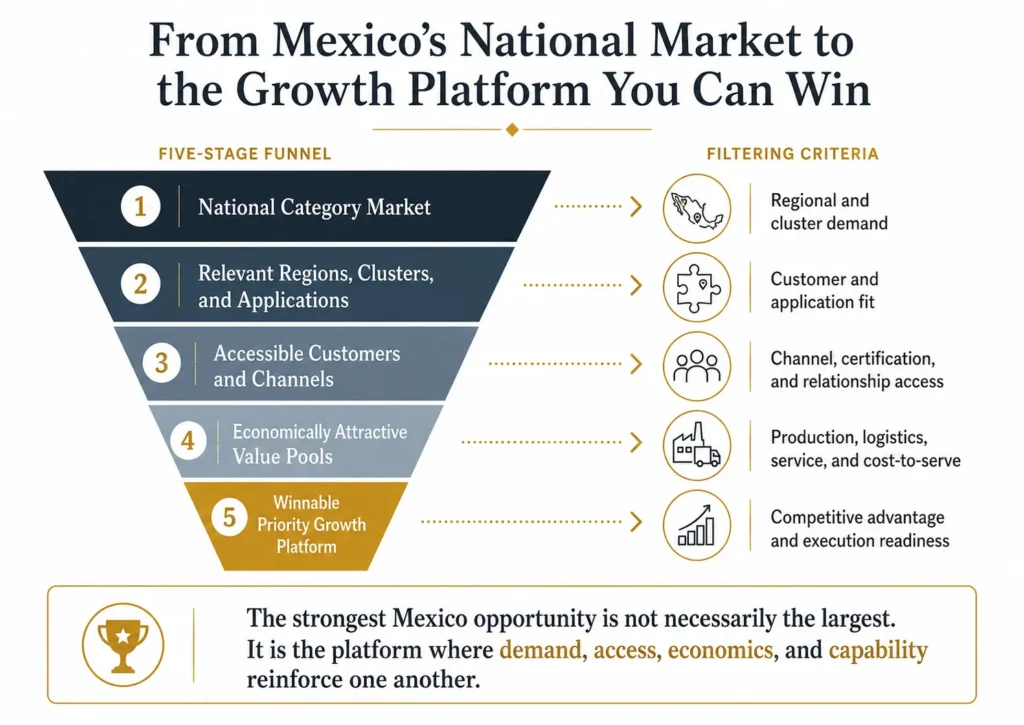
Figure 2. Strategic market analysis narrows Mexico’s national potential into the regional, cluster, customer, and channel opportunities your company can win profitably.
Nearshoring Matters Only When It Changes a Specific Decision
Nearshoring can create new demand, but the term is too broad to guide investment on its own.
A strategically useful analysis asks:
- Which industries and clusters are receiving investment relevant to your offer?
- Which customers are expanding, relocating, or bringing suppliers into Mexico?
- Which competitors already serve those customers in the United States, Canada, Europe, or Asia?
- What local content, quality, certification, engineering, or service requirements will apply?
- Can existing local capacity support the expected demand?
- Where are talent, infrastructure, power, water, logistics, or supplier constraints likely to limit growth?
- Which companies may partner, acquire, or localize to capture the opportunity?
- What must your company build before demand becomes accessible?
The goal is to convert a broad investment trend into a specific map of customers, value pools, capabilities, timing, and competitive implications.
Which Companies Are Actually Positioned to Capture New Demand?
Demand growth creates value only for companies that can convert it into customer relationships and profitable execution.
Competitor and partner readiness may depend on:
- Existing multinational customers.
- Presence in the relevant industrial cluster.
- Local production, assembly, or inventory.
- Certifications, quality systems, and supplier approvals.
- Engineering and technical support.
- Cross-border logistics and account coordination.
- Service capacity and response times.
- Talent and management autonomy.
- Access to capital and willingness to invest.
A company may be strategically well positioned but constrained by capacity. Another may have scale but lack customer approval or local technical capability. A third may need a partner or acquisition to compete credibly.
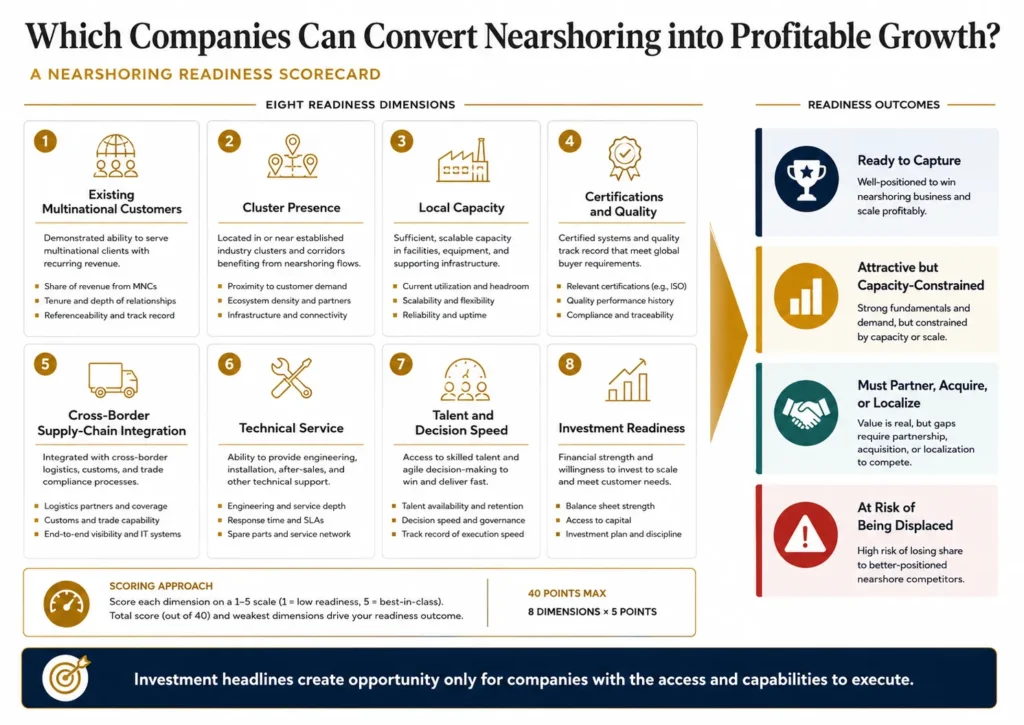
Figure 3. The companies best positioned to capture new industrial demand combine customer access with capacity, certifications, cross-border execution, service, talent, and investment readiness.
North American Integration Changes Customer Expectations
Some customers manage Mexico as part of a North American operating system. They may expect common specifications, supplier approvals, account management, technology, quality, service, reporting, and performance across borders.
We assess:
- Whether the buying decision is local, regional, or global.
- Which relationships and agreements already exist outside Mexico.
- How products, components, inventory, and technical support move across borders.
- Whether one supplier must provide consistent service in several countries.
- Which requirements must be fulfilled locally.
- How customs, currency, logistics, and geopolitical exposure affect supply.
- Whether your Mexico team has enough authority to respond quickly.
A competitor with modest local visibility may be strong because it already serves the customer globally. A local company may outperform a multinational through speed, adaptation, relationships, and specialized execution.
Local Production and Importing Should Be Compared as Strategic Models
Local production can improve access, availability, adaptation, customer confidence, local content, and response speed. It can also create fixed cost, capacity risk, labor and compliance complexity, imported-input dependence, and management burden.
Imported supply may be stronger when volume is limited, products change rapidly, or specialized technology is required. It may be weaker when customers require immediate availability, customization, local service, or supply-chain resilience.
The analysis should compare:
- Importing finished products.
- Local inventory and distribution.
- Assembly or light localization.
- Contract manufacturing.
- Partnership or joint venture.
- Acquisition.
- Full local production.
The right model depends on demand density, customer value, investment, flexibility, cost, risk, and the speed at which the opportunity must be captured.
Channels, Integrators, and Service Partners Can Determine Access
Mexico’s size and industrial diversity often make indirect channels essential. Yet a long partner list does not necessarily mean strong execution.
We assess:
- Geographic and industry coverage.
- Customer ownership and influence.
- Technical sales and integration capability.
- Inventory, credit, and working capital.
- Installation, training, maintenance, and service.
- Regulatory or tender competence.
- Competing brands and conflicts.
- Commitment to invest and develop demand.
- Ability to support multinational and local customers.
A distributor may provide rapid access but limited strategic control. Direct sales may strengthen account management but create fixed cost and service obligations. A hybrid model may be strongest when strategic accounts require direct management and broader coverage can be served through partners.
Multinational and Local Customers May Require Different Offers
Multinational customers may prioritize:
- Global or regional supplier approval.
- Common technical standards.
- Quality and compliance systems.
- Cross-border account coordination.
- Service continuity.
- Supply-chain transparency.
- Scalability across facilities.
Mexican companies may place greater weight on:
- Price and financing.
- Relationships and trust.
- Local responsiveness.
- Flexible commercial conditions.
- Customization.
- Inventory and delivery.
- Practical technical support.
A single national value proposition may fail if it does not reflect these different decision systems.
Public and Private Demand Should Be Separated in Market Analysis in Mexico
In healthcare, infrastructure, education, energy, transportation, security, technology, and other sectors, public or institutional demand can represent an important value pool.
Access may depend on:
- Registrations and approvals.
- Tender procedures and administrative execution.
- Specifications and supplier qualification.
- Local partners.
- Financing and contract conditions.
- Delivery, service, and compliance commitments.
- Stakeholder and institutional knowledge.
Private customers may prioritize total cost, speed, technical support, integration, quality, financing, and relationships differently.
A combined national estimate can hide where your company is genuinely competitive.
How to Prioritize Mexican Regions, Clusters, and Value Pools
A strong prioritization should combine three perspectives.
Market attractiveness
- Accessible demand and growth.
- Customer urgency and willingness to pay.
- Margin and value-pool potential.
- Competitive intensity.
- Structural and regulatory risk.
Ability to win
- Value-proposition fit.
- Existing customer relationships and references.
- Certifications and technical capability.
- Channel, service, and supply readiness.
- Relative differentiation versus competitors.
Execution feasibility
- Required investment and working capital.
- Time to customer approval and commercial access.
- Availability of talent, infrastructure, and partners.
- Operational and cross-border complexity.
- Management attention and scalability.
The best opportunity is where these three dimensions reinforce one another. A large market with low execution readiness can destroy value. A focused cluster with strong customer fit and efficient access can become a scalable platform.
How Midas Builds a Reliable Fact Base for Market Analysis in Mexico
Mexico offers extensive public information, but the evidence may be aggregated, delayed, inconsistent across sources, or unable to explain customer behavior and local execution.
We triangulate:
- Official economic, demographic, industry, investment, trade, regulatory, and procurement information.
- Company, facility, capacity, hiring, certification, pricing, channel, partnership, and service signals.
- Interviews with customers, distributors, integrators, suppliers, specialists, former industry participants, institutions, and other knowledgeable sources.
- State, regional, cluster, customer, and channel-level validation.
- Production, imports, installed base, usage, replacement, tender, and capacity indicators where relevant.
- Your team’s commercial, operational, technical, and financial knowledge.
We define the market carefully, reconcile conflicting estimates, distinguish verified facts from informed hypotheses, and use ranges when the evidence does not support false precision.
For the complete research process and wave-based methodology, visit Market Analysis: The Key to Informed Strategic Decisions.
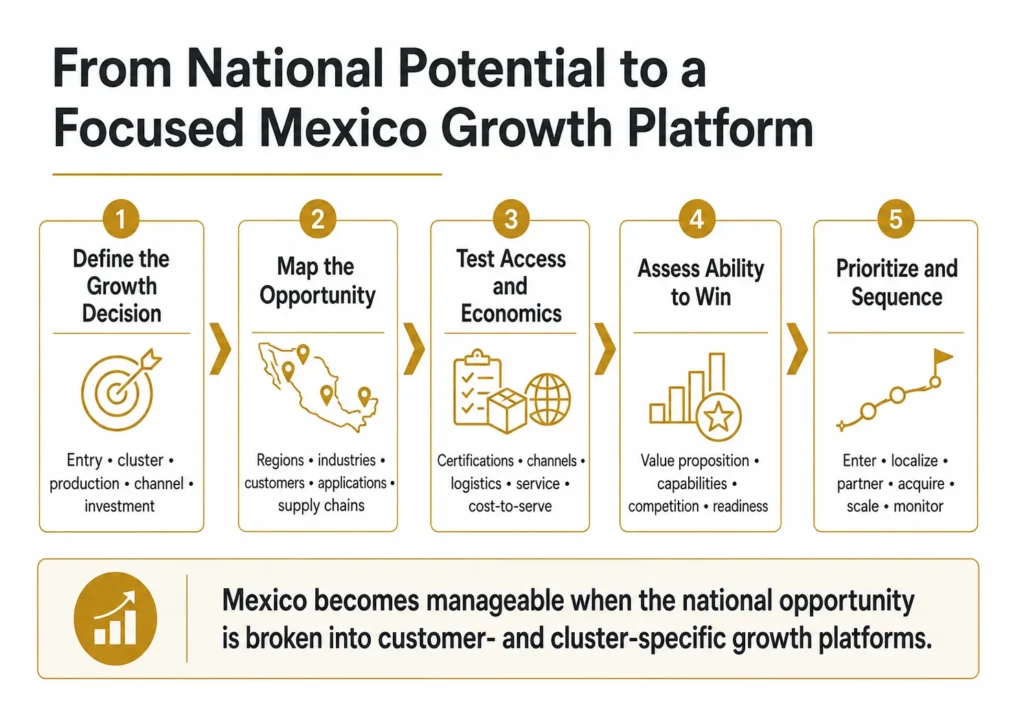
Figure 4. Mexico market analysis becomes actionable when national potential is translated into cluster priorities, executable business models, and a sequenced investment plan.
How Market Analysis in Mexico Changes Your Decision
Regional and cluster prioritization
You can identify which states, industrial corridors, customer ecosystems, applications, and value pools deserve investment.
Market-entry decisions
You can compare national entry, selected-cluster entry, distributor-led entry, direct sales, partnership, acquisition, and staged expansion.
Production and localization decisions
You can assess whether to import, stock locally, assemble, manufacture, contract, partner, or acquire based on demand, scale, flexibility, customer value, and risk.
Channel and service decisions
You can identify where partners provide genuine access, where strategic accounts require direct management, and which technical and service capabilities must be local.
Nearshoring-related investment decisions
You can determine which customers and clusters are relevant, which capabilities are required, and whether the opportunity is immediate, emerging, or dependent on uncertain future investment.
Public and private market decisions
You can distinguish institutional, public, multinational, and local demand and design the route to market accordingly.
Case Example: Doubling Sales in Mexico Through a Market-Specific Strategy
The executive challenge
A global producer of medicinal-gas equipment already operated in Mexico but needed a more effective strategy to accelerate growth, navigate local market complexity, and strengthen its competitive position.
The company required more than a broad national estimate. It needed to understand demand, customer needs, competitors, channels, barriers, risks, and the actions that should differ from its strategies in other Latin American countries.
How we approached the decision
We combined secondary research with direct interviews involving:
- Equipment manufacturers.
- Medical-gas producers.
- Hospitals and healthcare providers.
- Distributors and logistics partners.
The analysis assessed market size, competitive dynamics, critical success factors, barriers, risks, opportunities, customer needs, channels, and operational implications.
How the market analysis findings in Mexico supported growth
We translated the findings into a Mexico-specific growth strategy rather than applying one regional commercial model unchanged.
The company optimized operations, focused on higher-growth segments, and navigated local market complexities more effectively. According to the case results, it doubled its sales in Mexico within four years.
The Mexico strategy also formed part of a wider regional growth program. For the complete multi-country case, visit Market Analysis in Latin America.
“Thanks to Midas, we walked away with a clear, well-organized strategy. The collaboration between different business units and the fresh market insights were outstanding. Kudos!”
— Go-to-Market Manager
“Their report and analysis were thorough. They collaborated well with our team, including our tech department. One of the reasons we chose them was their depth of experience, which was evident throughout the project.”
— Global Product Manager
When You Need Market Analysis in Mexico
- Entering Mexico or reassessing your market-entry model.
- Prioritizing states, industrial clusters, customer ecosystems, or applications.
- Evaluating a nearshoring-related growth opportunity.
- Assessing local production, assembly, imports, sourcing, or inventory.
- Selecting, replacing, or evaluating distributors and integrators.
- Comparing multinational and local customer opportunities.
- Reviewing public, institutional, and private demand.
- Preparing a product launch or capacity investment.
- Testing whether a high-growth market is realistically accessible.
- Building a sequenced national expansion roadmap.
When your decision covers several countries, the Mexico analysis should fit into a consistent regional framework. See our Latin America market-analysis hub.
For the complete consulting offer, engagement model, and deliverables, visit our market-analysis consulting service page.
Why Midas for Market Analysis in Mexico?
We analyze Mexico by ecosystem, not only nationally
We examine demand by region, cluster, industry, customer, application, channel, and supply-chain position.
We connect local opportunity with North American strategy
We assess cross-border customers, supplier relationships, production, logistics, certifications, and account coordination.
We turn nearshoring into decision-specific insight
We identify the customers, clusters, capabilities, constraints, and investments that determine whether your company can capture the opportunity.
We connect market attractiveness with ability to win
We compare demand and economics with your value proposition, capabilities, channels, references, service, and execution readiness.
We use primary research where published information is insufficient
We complement official and commercial information with carefully designed interviews and cluster-level validation.
We translate evidence into a sequenced roadmap
The engagement ends with cluster, customer, channel, localization, and investment priorities, not simply a description of the market.
We bring direct market analysis in Mexico experience
We have analyzed B2B, B2C, industrial, automotive, household-device, technology, consumer, pharmaceutical, and healthcare markets in Mexico.
Ethical and Reliable Market Intelligence in Mexico
We comply with SCIP’s Code of Ethics, the profession’s gold standard. We comply with applicable laws, accurately disclose relevant identity and organizational information before interviews, avoid conflicts of interest, provide honest recommendations, and promote ethical conduct throughout the engagement.
We do not seek trade secrets, request confidential documents, misrepresent who we are, induce contractual breaches, or facilitate improper exchanges of competitively sensitive information.
We also make uncertainty visible. We explain market definitions, assumptions, evidence quality, and confidence ranges so your leadership team can distinguish a defensible conclusion from false precision.
Review SCIP’s ethical intelligence guidance and Code of Ethics.
Frequently Asked Questions About Market Analysis in Mexico
Can you estimate market size by state or industrial cluster with your market analysis in Mexico?
Yes. We can structure the estimate around states, border regions, industrial corridors, clusters, customer ecosystems, applications, or service territories that match the decision.
Can you evaluate nearshoring-related demand with your market analysis in Mexico?
Yes. We assess relevant customer investments, cluster activity, supplier requirements, capacity, certifications, service, talent, competition, timing, and the capabilities required to convert demand into revenue.
Can you compare local and multinational competitors?
Yes. We compare the sources of advantage that matter to customers, including relationships, cost, technology, quality, service, supply chains, speed, financing, and local execution.
Can you assess local production versus importing with your market analysis in Mexico?
Yes. We can compare importing, inventory, assembly, contract manufacturing, partnership, acquisition, and full production according to cost, capacity, flexibility, lead time, customer value, risk, and investment.
Can you evaluate distributors and integrators?
Yes. We assess customer access, geographic and industry coverage, technical capability, inventory, credit, service, competing brands, commitment, economics, and scalability.
Can you analyze multinational and Mexican customers separately in your market analysis in Mexico?
Yes. We compare decision criteria, supplier approvals, service expectations, price, financing, flexibility, local relationships, and cross-border requirements.
Can you analyze public and private demand separately?
Yes. We can compare purchasing processes, registrations, tenders, specifications, partners, pricing, access barriers, and competitor positions.
How do you validate cluster-level or private-company information in your market analysis in Mexico?
We triangulate official and company information with facility evidence, interviews, hiring and investment signals, customer and channel perspectives, and economic logic.
Can you help us decide where to enter first?
Yes. We prioritize regions, clusters, accounts, or value pools using market attractiveness, ability to win, and execution feasibility.
How long does a market analysis in Mexico take?
The timing depends on the number of regions, clusters, customer groups, channels, interviews, and strategic questions. We scope the work around your decision and can share preliminary findings in phases.
About the Author
Adrian Alvarez, PhD is Managing Partner at Midas Consulting, Wharton Alumnus, MBA Professor at Universidad Argentina de la Empresa (UADE), and Competitive Intelligence Fellow. He specializes in competitive strategy, market analysis, strategic intelligence, market entry, and executive decision-making under uncertainty in Mexico and Latin America.
He has analyzed B2B, B2C, industrial, automotive, household-device, technology, consumer, pharmaceutical, and healthcare markets in Mexico. His work has been published in the United States, Spain, and Germany. You can access his library of strategic insights and published research here
View professional profile on LinkedIn
Selected Mexican Sources You May Need to Monitor
The right source mix depends on your industry and decision. A Mexico fact base may include:
- INEGI for official economic, demographic, industrial, and regional information.
- Banco de México for monetary, financial, exchange, and economic information.
- Secretaría de Economía for trade, investment, industry, and business information.
- COFECE for competition and market-structure information.
- COFEPRIS where healthcare, pharmaceutical, food, medical-device, and regulated products are involved.
- State investment agencies, procurement sources, customs and trade information, industrial associations, cluster organizations, company disclosures, channel evidence, and primary market interviews as appropriate.
Official information is essential, but it rarely explains customer requirements, supplier approval, channel quality, cluster execution, competitive intent, or the practical feasibility of your strategy on its own.
Turn Mexico’s Scale into a Focused Growth Platform
You may be deciding which cluster to enter, whether to localize production, how to capture nearshoring-related demand, which distributor to appoint, or why national market potential is not translating into profitable growth.
You do not need a national estimate that hides industrial concentration, cross-border relationships, customer approval, channel gaps, and execution requirements. You need to understand where demand, access, economics, and your capabilities reinforce one another.
In an initial conversation, we will discuss your decision, the regions, industries, customers, channels, and investment options involved, what your team already knows, and which uncertainties could materially change the strategy.
We can then propose a focused Mexico market-analysis engagement with a clear scope, research plan, cluster segmentation, timing, and deliverables.