

Strategic consulting for food and beverage brands and products aiming to accelerate profitable growth.
Food and beverage growth is rarely limited by a shortage of ideas. The harder question is deciding which opportunities deserve your resources, and which ones do not.
You may be evaluating a new country, defending share, redesigning a portfolio, responding to private label, challenging a route-to-market model, repositioning a brand, or preparing for a competitor move. In each case, the strategic challenge is the same: you need to connect consumer demand, category economics, customer power, competitive behavior, and execution before committing resources.
Midas Consulting helps you turn that complexity into clear strategic choices.
For more than 25 years, we have supported companies across Latin America with market strategy, competitive intelligence, market entry, benchmarking, value propositions, brand strategy, and commercial decision-making. Our work is designed to help you understand where profitable growth can come from, what advantage you can build, and how to prepare for the reactions your strategy may trigger.
We work across packaged foods, nonalcoholic beverages, dairy, snacks, confectionery, ingredients, foodservice products, and other consumer categories. The starting point is not a standard methodology. It is the decision you need to make.
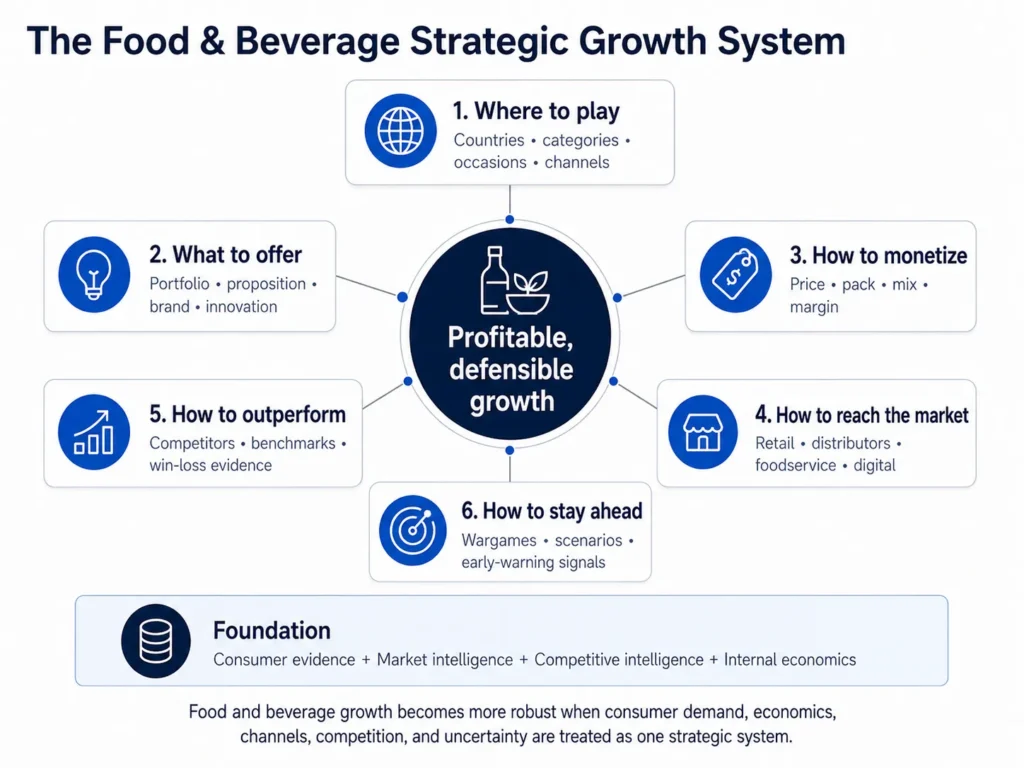
Figure 1. Food and beverage growth becomes more robust when consumer demand, economics, channels, competition, and uncertainty are treated as one strategic system.
Start With the Strategic Decision, Not the Data
Food and beverage companies generate enormous amounts of information: sell-in, sell-out, retailer data, consumer research, pricing, promotions, distribution, digital signals, brand tracking, and competitor observations.
But more information does not automatically produce a better decision.
We begin by defining the executive question clearly. You may need to decide:
- Which countries, categories, consumer segments, channels, or occasions should receive incremental investment.
- Whether apparent category growth is creating attractive economics for your company.
- Which brands and products should be accelerated, defended, repositioned, simplified, or exited.
- How to respond to private-label growth, aggressive price competition, or changing retailer power.
- Whether your value proposition is strong enough to sustain preference and price.
- How to protect accessibility without destroying margin or brand equity.
- Which channel model will produce real sell-out rather than inventory accumulation.
- How a competitor, retailer, distributor, or new entrant is likely to react to your move.
- Which strategic assumptions could fail if economic, regulatory, consumer, or competitive conditions change.
Once the decision is explicit, we determine which evidence can materially change it. That keeps the work focused on action rather than analysis for its own sake.
Where Will Profitable Growth Actually Come From?
A growing category can hide a weakening competitive position. Revenue may rise because of price or inflation while volume, penetration, frequency, mix, or share deteriorate. A new channel can add sales while reducing profitability. A successful launch can create cannibalization rather than incremental demand.
We help you separate growth into the drivers that matter strategically:
- Category growth versus share gain
- Volume versus price
- Penetration versus purchase frequency
- Premiumization versus trade-down
- Mix improvement versus promotional dependency
- Incremental innovation versus cannibalization
- Sell-in versus sustainable sell-out
- Distribution expansion versus productive availability
That distinction matters because the right strategy depends on the source of the growth—not simply the headline growth rate.
Our market analysis consulting helps you size opportunities, understand demand, segment markets, examine channels, and build the fact base behind those decisions.
When geographic expansion is the question, our market entry consulting helps you compare countries, risks, entry models, and implementation priorities.
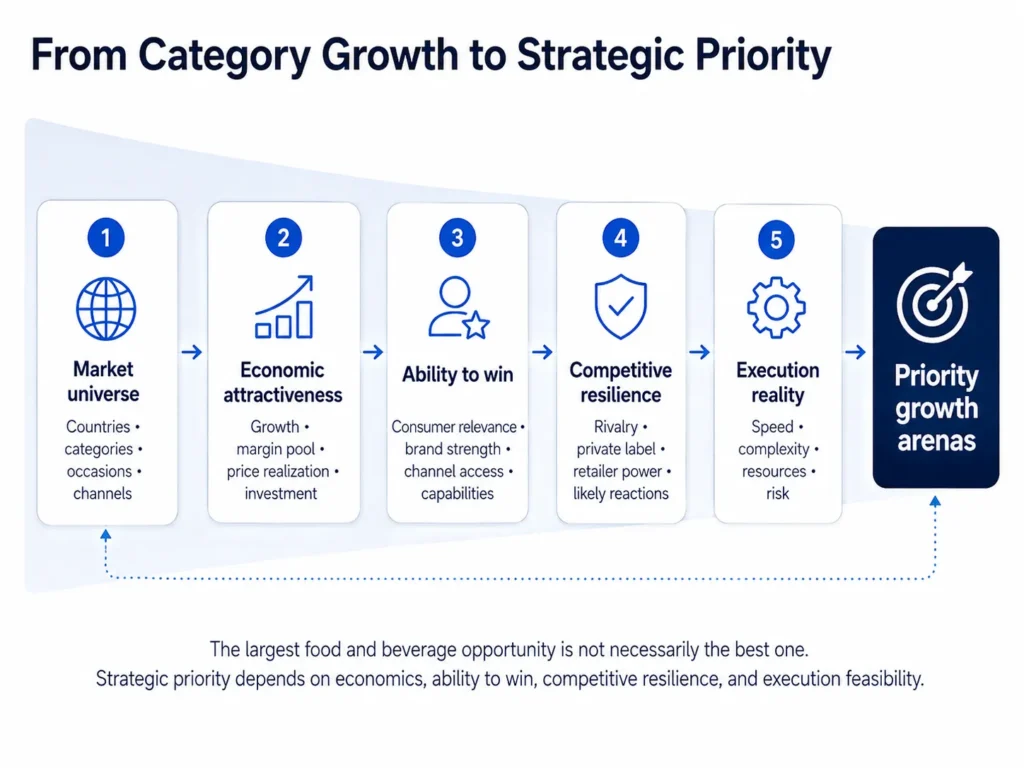
Figure 2. The largest food and beverage opportunity is not necessarily the best one. Strategic priority depends on economics, ability to win, competitive resilience, and execution feasibility.
Choose Where to Play, and What Not to Pursue Yet
The strategic cost of pursuing too many opportunities at once is easy to underestimate.
A company may simultaneously consider new countries, premium extensions, economy packs, health-oriented products, foodservice, e-commerce, modern retail, distributor changes, and acquisitions. Each opportunity can appear attractive on its own. Together, they may stretch management attention, working capital, marketing support, supply capabilities, and commercial execution.
We help you compare opportunities using criteria that reflect your economics and strategic position, such as:
- Market and category growth
- Margin potential
- Consumer or customer need
- Brand permission
- Competitive intensity
- Retailer and distributor economics
- Required investment
- Supply and operational complexity
- Regulatory exposure
- Speed to impact
- Strategic fit
- Execution capability
- Risk and uncertainty
The objective is not to find the biggest market. It is to determine where your company has the strongest risk-adjusted ability to create value.
Make the Portfolio Work Harder with Consulting for Food and Beverage Products
Food and beverage portfolios often accumulate complexity over time. New flavors, pack sizes, price points, limited editions, health-oriented variants, premium extensions, and channel-specific products may each make sense individually while weakening the system as a whole.
A strategic portfolio should make the role of each product clear.
Depending on the category, a product may exist to recruit new consumers, protect an entry price point, serve a specific consumption occasion, defend against private label, create premium mix, strengthen a retailer relationship, enter a channel, or provide a future growth option.
We help you assess portfolio choices through both market relevance and economics. That can include consumer demand, differentiation, revenue, margin, distribution, rotation, repeat purchase, cannibalization, working capital, operational complexity, and strategic role.
The output is not automatically portfolio reduction. It is a clearer allocation of investment behind the products, brands, packs, and innovations that matter most.
Give Customers and Consumers a Stronger Reason to Choose You
Technical product quality, heritage, or distribution strength may not be enough to sustain preference when consumers have more alternatives and retailers have more leverage.
You need to understand which benefits really matter, which claims are credible, which competitors define the reference point, and which differences are valuable enough to influence choice.
Our value proposition consulting helps you translate customer and consumer evidence into a sharper reason to choose your offer.
Our brand consulting helps strengthen the broader strategic meaning, relevance, credibility, and differentiation surrounding that offer.
The strongest propositions usually connect three things: a meaningful need, a distinctive advantage, and proof that reduces the buyer’s or consumer’s perceived risk.
Understand Competitors Before They Shape the Market for You with Our Consulting for Food and Beverage Products
Your strategy will change the environment around you.
A competitor may cut price, accelerate innovation, bundle products, increase trade spending, defend a distributor, target your strongest accounts, imitate your claim, launch a fighter brand, or shift investment toward the channels you are entering.
Retailers may ask for better terms, change assortment, increase private-label support, or use your move to renegotiate with competitors.
That means competitive analysis should go beyond market share and public information.
Our competitor analysis consulting helps you examine competitor objectives, assumptions, portfolio priorities, pricing, channels, capabilities, vulnerabilities, and likely responses.
The goal is to improve your decision before the market forces you to react.
Benchmark the Capabilities Behind the Result
A competitor may have stronger growth, better margins, faster innovation, broader distribution, or stronger retailer execution. The visible result tells you what happened. Benchmarking helps you understand what produced it.
Depending on your decision, we can compare:
- Commercial models
- Sales-force deployment
- Key-account practices
- Revenue-growth management
- Price-pack architecture
- Trade-promotion practices
- Route-to-market models
- Distributor economics
- Innovation processes
- Portfolio governance
- Retail execution
- Category-management capabilities
- Organization and decision rights
Our benchmarking consulting focuses on the capabilities and practices behind performance, not on copying a competitor mechanically.
Learn Why You Win, and Why You Lose with Midas’ Consulting for Food and Beverage Products
Internal explanations for commercial wins and losses can be misleading.
A sales team may attribute a lost retailer negotiation to price when the decisive issue was category support, service, promotion economics, innovation credibility, logistics, or confidence in execution. A distributor may choose another supplier for reasons that were never captured internally.
Our win-loss analysis consulting brings the decision-maker’s perspective into the strategy.
The evidence can help you understand which decision criteria carry the most weight, where competitors are truly stronger, where your commercial process helps or hurts, and which changes can improve future conversion.
Turn Evidence Into Strategic Choices
Good market intelligence should change what you do.
That may mean choosing a smaller number of priority markets, reallocating investment, simplifying a portfolio, defending an entry price point, changing a distributor model, repositioning a brand, increasing support behind a channel, or preparing a response to a likely competitor move.
Our strategy consulting helps you bring market, customer, competitor, and internal evidence together so your team can evaluate alternatives, make trade-offs explicit, align around priorities, and translate decisions into an execution roadmap.
Depending on your situation, the work can help you define:
- Where to play
- How to win
- What not to pursue
- Which capabilities must change
- Which initiatives deserve priority
- Who owns each decision
- Which milestones matter
- Which metrics indicate progress
- Which assumptions need continued monitoring
Stress-Test the Strategy Before the Market Does With Consulting for Food and Beverage Products
Food and beverage strategies can look attractive when assumptions are considered one at a time.
The risk becomes more visible when several assumptions move together.
What happens if consumers trade down while a retailer expands private label? What if a competitor launches a lower-priced format while your distributor reduces focus? What if a labeling change affects the proposition of a priority product? What if economic volatility changes both demand and channel economics?
Midas Consulting’s work on strategic foresight, competitive response, and early-warning systems provides an additional foundation for helping you test those interactions before committing resources.
The objective is not to predict one future. It is to identify the uncertainties that can change the strategy, understand their implications, and prepare responses.
Use Wargames to Anticipate Competitive and Channel Reactions
A business wargame allows your team to simulate how competitors, retailers, distributors, customers, or other market participants may respond to a strategic move.
You can use it to pressure-test a market entry, launch, pricing move, channel redesign, value proposition, portfolio decision, or defensive strategy.
Our wargame consulting helps expose fragile assumptions, likely countermoves, second-order effects, and actions you may want to prepare before implementation.
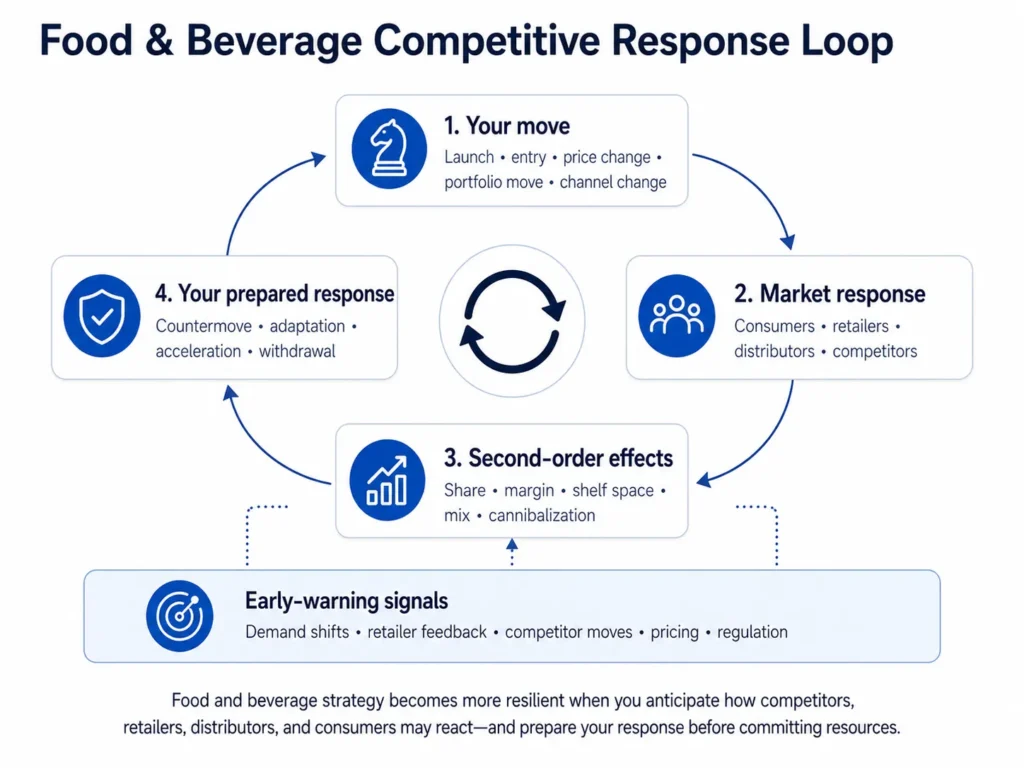
Figure 3. Food and beverage strategy becomes more resilient when you anticipate how competitors, retailers, distributors, and consumers may react, and prepare your response before committing resources.
A Food and Beverage Products Strategy Consulting Can Combine Several Workstreams
Your challenge may require one focused engagement or several capabilities working together.
Market entry consulting. Compare countries, opportunities, risks, entry models, and implementation priorities. Explore market entry consulting.
Strategy consulting. Turn evidence into choices, priorities, ownership, and an implementation roadmap. Explore strategy consulting.
Wargame consulting. Anticipate competitor, retailer, and channel reactions before a major move. Explore wargame consulting.
Benchmarking consulting. Identify the capabilities and practices behind stronger performance. Explore benchmarking consulting.
Competitor analysis consulting. Understand rival strategies, strengths, vulnerabilities, and likely actions. Explore competitor analysis consulting.
Market analysis consulting. Size opportunities, understand demand, segment markets, and build the fact base. Explore market analysis consulting.
Value proposition consulting. Clarify why consumers or customers should choose you and which benefits create preference. Explore value proposition consulting.
Win-loss analysis consulting. Understand the real reasons behind customer decisions and use them to improve commercial performance. Explore win-loss analysis consulting.
Brand consulting. Strengthen relevance, credibility, differentiation, and long-term preference. Explore brand consulting.
The advantage of integrating these capabilities is that your strategy is built as one coherent decision system rather than as a series of disconnected studies.
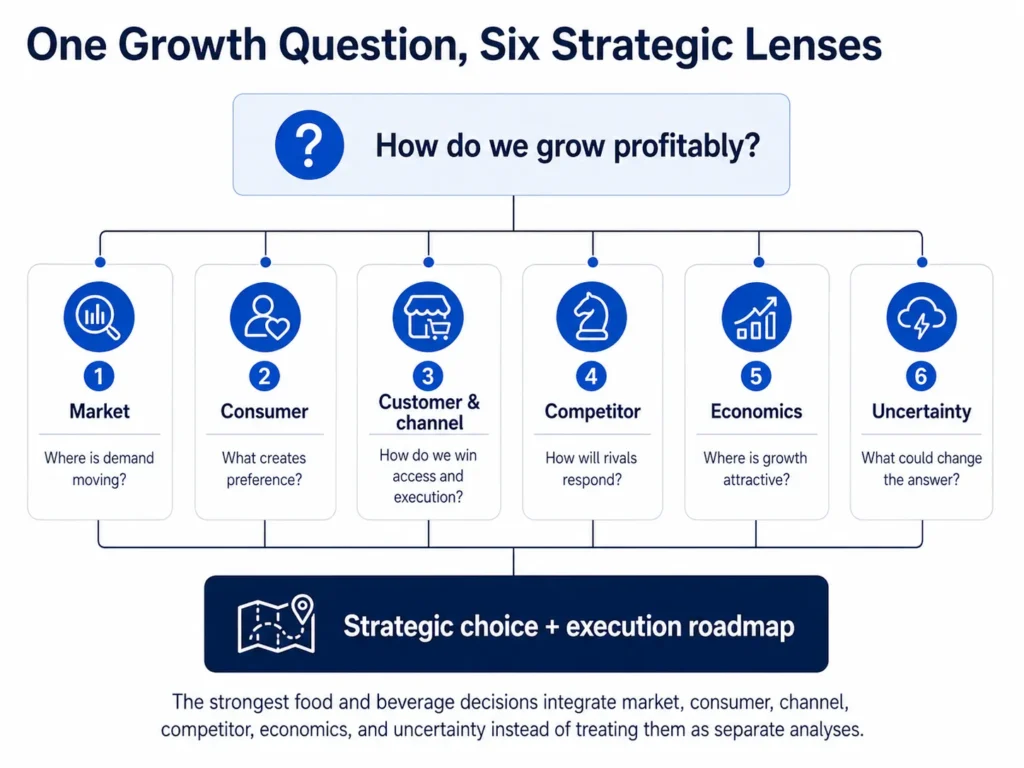
Figure 4. The strongest food and beverage decisions integrate market, consumer, channel, competitor, economics, and uncertainty instead of treating them as separate analyses.
Case Example: From Competitive Reaction to Regained Momentum
A multinational consumer-products company had been losing market share over an extended period in a highly competitive environment.
The challenge was not simply to generate a new list of initiatives. Management needed to understand how major competitors were likely to behave and how the company should respond across different regional conditions.
Midas Consulting structured the work as two connected competitive simulations.
In the first round, participants stepped into competitors’ positions and examined their strategic objectives, portfolio priorities, potential channel actions, pricing responses, and likely attacks on the client’s business.
In the second round, the company evaluated alternative responses, regional strategies, portfolio choices, commercial initiatives, competitive safeguards, and implementation priorities.
The process helped management build greater alignment around the response, improve coordination, and move from reacting to competitors toward anticipating them.
Following the engagement, the company reversed the direction of its market-share decline and regained positive momentum.
Client identity, brands, markets, and commercially sensitive details are withheld. This case reflects the circumstances of one engagement and should not be interpreted as a guarantee of equivalent results.
Build the Evidence Around the Decision with Midas Consulting for Food and Beverage Products
Food and beverage markets are rich in data but uneven in insight.
Depending on the question, we may combine:
- Company sales and margin data
- Category and retail data
- Household or consumer information
- Price and pack analysis
- Store checks
- E-commerce observations
- Distributor interviews
- Retailer interviews
- Foodservice interviews
- Consumer or shopper research
- Former industry executives
- Competitive intelligence
- Public and regulatory sources
- Management input
Important conclusions are triangulated whenever feasible.
We also distinguish between facts, estimates, hypotheses, and assumptions. When the available evidence does not justify one precise number, we prefer a defensible range or scenario to false precision.
Use Credible External Sources to Strengthen the Context
Client-specific strategy should not be built from generic public reports alone. However, credible institutional sources can strengthen the regulatory, nutrition, trade, economic, and market context surrounding a decision.
Depending on the engagement, relevant sources may include the Food and Agriculture Organization of the United Nations (FAO), the World Health Organization (WHO), the Codex Alimentarius Commission, and the World Bank.
These sources provide context. They do not replace direct research with consumers, customers, retailers, distributors, competitors, and other market participants when the decision requires primary evidence.
Why Companies Work With Midas for Food and Beverage Products Consulting
More Than 25 Years of Experience
We have spent more than two decades helping companies make growth and competitive decisions across Latin America.
That regional experience matters because countries differ in purchasing power, retail structure, channel concentration, regulation, competitive intensity, consumer behavior, and route-to-market economics.
Senior Involvement
Senior professionals remain involved in framing the problem, interpreting the evidence, challenging assumptions, and discussing strategic implications with your team.
Strategy Before Methodology
We do not begin by forcing your challenge into a standard framework. We begin with the decision you need to make and then determine which evidence and methods can best support it.
Triangulation Instead of Convenient Answers
When a conclusion matters, we look for corroborating evidence. We make uncertainty and evidence gaps visible rather than presenting estimates as established facts.
Confidentiality
Food and beverage projects can involve sensitive information about pricing, products, retailers, distributors, innovations, competitor responses, partnerships, and future strategy.
We can work under confidentiality agreements and anonymize public examples when disclosure has not been authorized.
Recommendations Designed for Execution
Your strategy must work commercially, financially, operationally, and organizationally.
We focus on decisions, trade-offs, actions, ownership, and practical next steps—not simply on analysis.
What Food and Beverage Products Clients Have Said About Working With Midas Consulting
“Midas delivered practical, high-impact ideas that helped us expand market share in a competitive environment.”
Marketing Manager, Food Company — identity withheld due to confidentiality
“Midas was highly effective, giving us the insights and tools we needed to co-create a robust strategy for complex markets.”
Finance executive, Beverage Company — identity withheld due to confidentiality
“Midas helped us reassess priorities and focus our efforts where they truly mattered.”
Global Market Segment Leader, Food and Beverage Company — identity withheld due to confidentiality
Client feedback collected by Midas between 2020 and 2025 produced a Net Promoter Score of 82.2%. As with any client metric, this should be read in the context of the respondent base and period measured.
When Food and Beverage Products Consulting Creates the Most Value
An external strategic perspective can be particularly useful when:
- You are entering or expanding in a Latin American market.
- Growth is below expectations and the cause is unclear.
- Revenue is increasing but share, volume, or margin is weakening.
- You need to prioritize countries, categories, channels, or occasions.
- Your portfolio has become difficult to manage or insufficiently differentiated.
- Private label or lower-priced competitors are increasing pressure.
- Retailer power is changing your economics.
- Your distributor model is producing sell-in but weak sell-out.
- You need a stronger value proposition or brand position.
- You are preparing a major launch, price move, or route-to-market change.
- You need to benchmark commercial or innovation capabilities.
- Different internal teams hold conflicting views of the market.
- You want to challenge a strategic plan before committing significant resources.
- You need to anticipate competitor, retailer, or distributor reactions.
- Economic, regulatory, consumer, or competitive uncertainty could materially change your assumptions.
When the cost of a wrong decision is high, improving the evidence before execution can be far less expensive than learning only after time, capital, shelf space, or brand credibility have already been committed.
Frequently Asked Questions About Food and Beverage Products Consulting
What types of food and beverage companies do you support?
We support manufacturers, branded consumer-goods companies, ingredient businesses, and related companies when the strategic question involves markets, customers, channels, competition, value propositions, or growth. Relevant categories can include packaged foods, beverages, dairy, snacks, confectionery, frozen or convenience foods, foodservice products, ingredients, and adjacent categories.
Which markets can you cover with your consulting for food and beverage products?
Our core experience is in Latin America, including Argentina, Brazil, Chile, Colombia, Mexico, Peru, Central America, and other regional markets. The appropriate geographic scope depends on your decision.
Can you estimate the size of a food or beverage market?
Yes, when sufficient evidence is available. Depending on the category, we may combine retail and category data, company information, production or trade data, pricing, store checks, channel research, consumer evidence, expert interviews, and other relevant sources.
When the evidence does not support one precise number, we use ranges or scenarios and make the assumptions explicit.
Can you interview consumers, retailers, distributors, or foodservice customers in your consulting for food and beverage products?
Yes. Primary research can include relevant market participants when it adds decision value and access is feasible. The exact respondent mix depends on the category, market, decision, and research design.
Can you evaluate our route-to-market or distributors?
Yes. We can examine channel coverage, customer access, commercial capabilities, economics, sales-force quality, logistics, inventory behavior, conflicts, management commitment, strategic fit, and other factors relevant to the decision.
Can you analyze competitors beyond public information?
Yes, subject to legal and ethical research practices. We can combine public sources, market interviews, customer and channel evidence, benchmarking, commercial observations, and other legitimate competitive-intelligence sources.
We do not seek confidential competitor information through deception or improper means.
Can the engagement combine several consulting services?
Yes. Many strategic food and beverage questions cut across markets, consumers, competitors, channels, brands, value propositions, benchmarking, and uncertainty. We can structure the work as one integrated engagement or as phases with decision gates between them.
How long does a food and beverage consulting project take?
A focused category, competitor, distributor, market, or strategic assessment may require several weeks. A multicountry or integrated program can require longer. We define the scope, milestones, deliverables, and expected timing before the engagement begins.
What information do you need from us?
Useful inputs can include your strategic objectives, brands, products, sales, margins, market share, prices, packs, channels, distributors, retail accounts, promotions, research, innovation pipeline, competitor hypotheses, and decision timetable.
We begin with what is already available and identify which information gaps materially affect the decision.
How do you protect confidential information?
We treat client information as confidential and can work under a nondisclosure agreement. Public case examples, client identities, brands, prices, strategies, and results may be anonymized when disclosure has not been authorized.
Do you guarantee a specific commercial result?
No responsible strategy advisor should guarantee a specific sales, margin, market-share, retailer, launch, or market-entry outcome.
Results depend on consumer response, product quality, pricing, distribution, execution, retailer and distributor commitment, competitor reactions, supply, regulation, and economic conditions. Our role is to strengthen the evidence, choices, preparation, and execution behind your decision.
Ready to Make the Next Food and Beverage Growth Decision With Greater Confidence?
You may be deciding where to invest, which markets to enter, which brands to back, how to defend margin, how to respond to competitors, or how to make a growth plan more resilient.
You do not need to have the entire problem defined before contacting us.
Tell us the decision you are facing, what you already know, and what remains uncertain. We will help you determine which evidence is worth gathering, which assumptions deserve to be challenged, and which strategic choices require management attention.