

Energy products consulting designed to accelerate strategic, profitable growth.
Energy markets are not moving in one direction.
Oil and gas investment remains strategically important in parts of Latin America while renewables, storage, grids, electrification, energy efficiency, digitalization, and new fuels continue to attract capital and reshape customer priorities.
For suppliers, that creates a difficult allocation problem. You may be deciding whether to defend a profitable legacy application, enter a renewable-energy segment, prioritize installed assets over new projects, localize inventory or service, redesign your distributor model, prepare for a tender, or invest behind a technology whose adoption path is still uncertain.
The strategic question is not simply where energy investment is growing. It is where your specific product, equipment, technology, or service can create attractive, defensible economics.
That is where Energy Products Consulting should create value.
Midas Consulting helps you connect asset-level demand, customer economics, qualification barriers, route-to-market realities, competitive intelligence, project timing, and uncertainty so you can make stronger decisions before capital and management attention are committed.
For more than 25 years, we have supported companies selling products, equipment, technologies, and services into energy markets across Latin America and selected international markets.
Our objective is not another broad energy forecast. It is a clearer answer to four questions: Where should you play? How should you win? How will customers, competitors, partners, and regulators react? And what must be true for the strategy to create profitable growth?
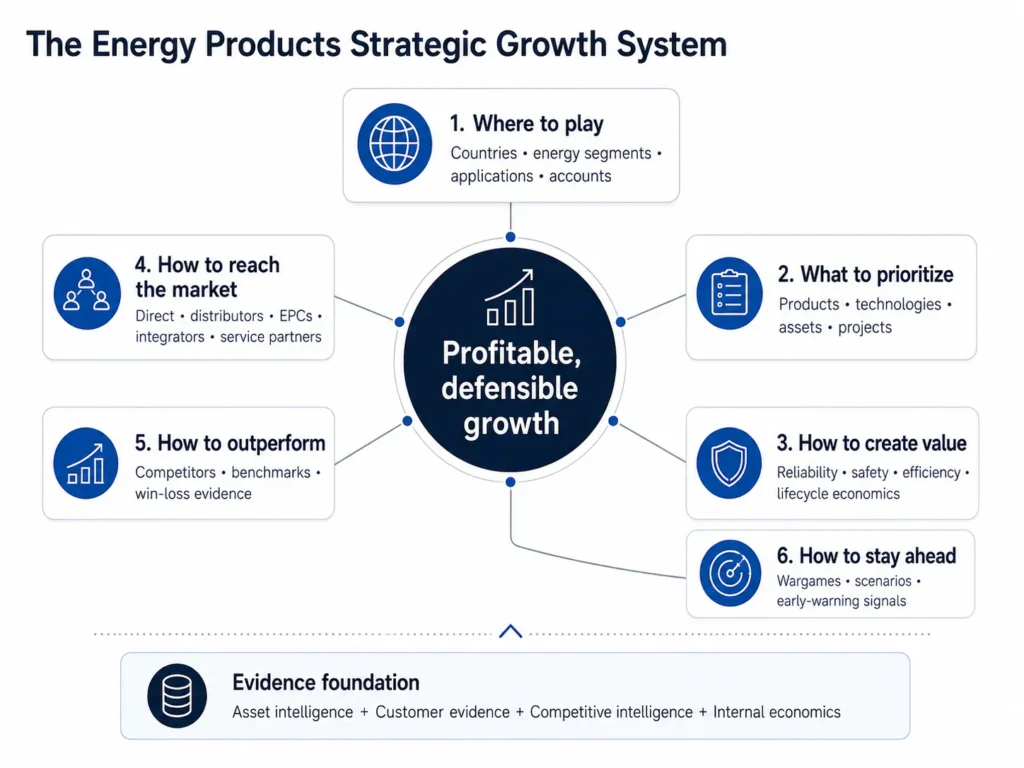
Figure 1: Energy-supplier growth becomes more robust when market priorities, customer value, asset demand, channel access, competition, and uncertainty are managed as one strategic system.
Start With the Strategic Decision
Energy suppliers often have more information than they can use: project announcements, production data, installed capacity, tender lists, drilling activity, renewable targets, asset databases, maintenance schedules, customer pipelines, distributor reports, and competitive intelligence.
The problem is deciding which information should change what you do. We begin Energy Products Consulting engagements by defining the management decision clearly.
- Which countries, energy segments, assets, applications, projects, or accounts deserve incremental investment.
- How much commercial and technical capacity should remain behind oil-and-gas or conventional-power opportunities while renewable, storage, grid, electrification, and digital markets develop.
- Whether announced capital investment will translate into meaningful demand for your specific product.
- Which installed assets create recurring replacement, maintenance, reliability, efficiency, or compliance demand.
- How to defend a price premium when procurement treats technically different products as comparable.
- Which strategic accounts justify qualification, field trials, local inventory, spare parts, technical support, or service investment.
- Whether direct sales, distributors, EPC relationships, integrators, service partners, or hybrid models provide the strongest economics.
- How competitors are likely to respond to a launch, price move, distributor change, local investment, or account attack.
- Which technologies deserve early investment and which should remain strategic options rather than full commitments.
- Which assumptions could fail if commodity prices, project schedules, regulation, financing, grid constraints, technology costs, local-content requirements, or political priorities change.
Once the decision is explicit, we build the fact base around it. That keeps the work focused on choices, trade-offs, and execution.
Where Should You Place the Next Energy Growth Bet?
The largest energy investment opportunity is not automatically the best supplier opportunity. A multibillion-dollar project can create limited addressable demand if your category represents a small share of investment, the specification is closed, or an incumbent is already approved.
A mature operating asset may be less visible but generate recurring demand through maintenance, replacement, reliability upgrades, spare parts, chemicals, software, safety, inspection, efficiency, or asset-integrity programs.
We help you compare opportunities using criteria that reflect your actual product and economics.
- Installed asset base
- Project pipeline quality
- Project probability and timing
- Application relevance
- Replacement and maintenance cycles
- Qualification requirements
- Failure consequence
- Customer urgency
- Technical-service intensity
- Competitive intensity
- Incumbent strength
- Partner access
- Local-content requirements
- Price and margin potential
- Inventory requirements
- Service costs
- Working-capital exposure
- Technology risk
- Regulatory exposure
- Strategic fit
- Execution feasibility
- Uncertainty
The objective is not to follow the largest investment headline. It is to identify where demand, access, differentiation, economics, and timing align.
Our market analysis consulting helps you build the asset, project, demand, customer, channel, pricing, and competitive fact base behind those choices.
When geographic expansion is the decision, our market entry consulting helps you compare countries, energy segments, barriers, entry models, partners, economics, and implementation priorities.
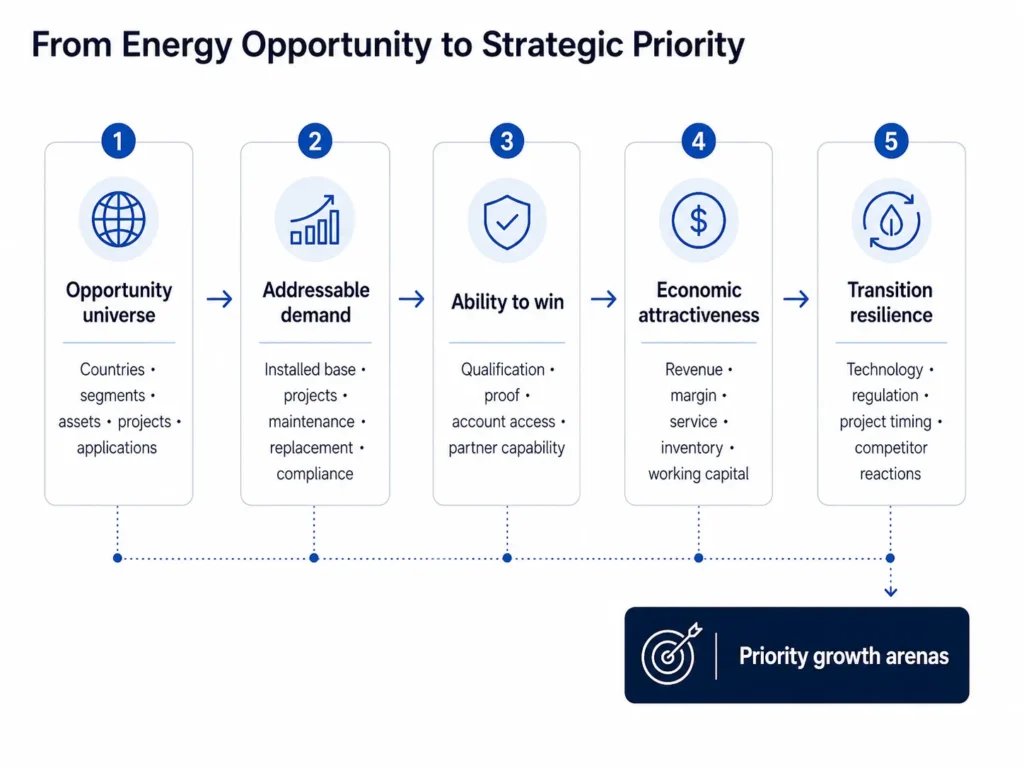
Figure 2: The largest energy investment opportunity is not necessarily the best supplier opportunity. Strategic priority depends on addressable demand, ability to win, economics, transition resilience, and execution feasibility.
Balance Today’s Profit Pools With Tomorrow’s Options through Our Energy Products Consulting
The energy transition creates a portfolio problem, not a single forecast.
Your company may generate attractive cash flows from products serving oil and gas, thermal generation, conventional grids, or established industrial assets while also seeing growth potential in renewables, storage, electrification, efficiency, digitalization, low-emissions fuels, or grid modernization.
A strategy that assumes one technology replaces another on a fixed timetable can be fragile. The more useful question is how to allocate resources across different transition paths.
- Which current applications retain attractive recurring demand
- Which legacy segments face structural decline
- Which emerging technologies already have commercially accessible demand
- Which opportunities depend heavily on subsidies or regulation
- Where customer economics support adoption without policy support
- Which capabilities transfer across energy segments
- Which partnerships provide option value
- Where local inventory or service can serve multiple technologies
- Which investments should be staged
- Which early-warning signals should trigger acceleration, delay, or withdrawal
The objective is not to choose between “old energy” and “new energy” as abstract categories. It is to build a portfolio that remains economically attractive across plausible market transitions.
Translate Energy Investment Into Product-Specific Demand
Sector investment can be a misleading demand proxy. Energy demand for suppliers is generated through different mechanisms.
New capital projects may create demand for major equipment, instrumentation, electrical systems, pipelines, renewable components, controls, software, safety systems, and construction-related products. Existing assets can create recurring demand for parts, filters, lubricants, chemicals, valves, maintenance, inspection, software, reliability improvements, and technical services.
Shutdowns, overhauls, turnarounds, recertification, safety programs, efficiency investments, automation, cybersecurity, emissions monitoring, and asset-integrity initiatives can each generate different buying cycles.
- Announced investment versus probable projects
- Probable projects versus product-relevant investment
- Product-relevant investment versus accessible demand
- Installed asset base versus active replacement demand
- Recurring demand versus one-time project demand
- Emergency demand versus planned purchasing
- High-revenue opportunities versus attractive account economics
Defend Value Before the Tender Becomes a Price War with Midas’ Energy Products Consulting
Energy procurement teams are under pressure to control cost, standardize purchasing, and reduce supplier complexity. That can make technically different products look comparable.
When the conversation is reduced to unit price, suppliers often lose the economic value they create through reliability, uptime, safety, efficiency, service, or reduced operational risk.
- Higher uptime
- Lower production losses
- Fewer failures
- Longer service life
- Lower maintenance frequency
- Reduced shutdown duration
- Lower energy consumption
- Improved process efficiency
- Reduced safety exposure
- Lower emissions
- Faster commissioning
- Lower spare-parts inventory
- More reliable supply
- Faster technical response
- Lower lifecycle cost
The relevant value metric depends on who carries the consequence of failure or inefficiency.
Our value proposition consulting helps you translate technical performance into a credible operational and financial reason to choose your offer.
Our brand consulting can help strengthen the broader credibility, trust, relevance, and differentiation surrounding that promise.
Understand the Complete Energy Buying System
A supplier rarely wins an energy account through one relationship. Engineering may focus on technical compatibility. Operations may prioritize reliability. Maintenance may focus on service life and spare parts. Safety teams may focus on certification and risk. Procurement may focus on price and terms. Finance may focus on lifecycle economics. Management may focus on supply security and strategic resilience.
- Who identifies the need
- Who specifies the solution
- Who qualifies the supplier
- Who owns technical approval
- Who authorizes trials
- Who operates or maintains the product
- Who controls the budget
- Who runs the tender
- Who evaluates safety and compliance
- Who can veto the decision
- Which evidence each stakeholder requires
- Which stakeholder captures the economic benefit
Treat Qualification as a Strategic Investment with Our Energy Products Consulting
A customer can recognize the value of your solution and still be unable to buy it. Supplier registration, technical documentation, quality review, safety requirements, environmental documentation, field trials, site audits, certifications, cybersecurity review, local representation, and reference installations can create meaningful barriers.
Qualification can therefore be part of market selection, not merely an administrative step after the sale.
- Which accounts justify the qualification investment
- Which products or applications face the highest barriers
- Which references can reduce perceived risk
- Which trials provide the most strategic leverage
- Whether a distributor or service partner can accelerate access
- How long approval may take
- Which internal capability gaps must be closed
- Which opportunities should not be pursued yet
Choose the Right Route to Market
Energy routes to market can involve more than a distributor. Depending on the solution, access may require direct sales, EPC relationships, system integrators, technical representatives, service companies, local inventory, installation capability, or specialized partners.
- Direct strategic-account sales
- Local sales offices
- Distributors
- Commercial representatives
- EPC partnerships
- System integrators
- Service partners
- Technology partners
- Local inventory
- Assembly or manufacturing
- Licensing
- Joint ventures
- Hybrid models
The right structure should connect account access, technical credibility, service, speed, control, economics, capital requirements, and long-term strategic value. A partner should not be selected only because it has relationships. It should be able and motivated to support qualification, service, inventory, technical selling, and the value proposition your product requires.
Understand Competitors with Midas’ Energy Products Consulting Before They Redefine the Economics
Energy competitors can alter the market through price, installed-base leverage, service coverage, qualification status, local content, inventory, financing, partnerships, or bundling.
A global competitor may defend a strategic account aggressively. A local supplier may have lower service costs and stronger relationships. A new entrant may use pricing to establish references. A technology substitute may remove the application entirely.
Our competitor analysis consulting helps you examine competitor objectives, installed positions, pricing, service, channels, approved-supplier status, strengths, vulnerabilities, and likely responses.
Benchmark the Capabilities Behind Stronger Energy-Supplier Performance
A competitor may have higher share because of a better product. It may also win because of faster quotation, better tender intelligence, local stock, stronger technical support, approved-supplier status, better EPC relationships, superior service, or more disciplined account management.
- Market and account coverage
- Key-account segmentation
- Tender processes
- Pipeline management
- Pricing authority
- Application engineering
- Qualification support
- Trial management
- Technical documentation
- Lifecycle-value tools
- Local service
- Spare-parts availability
- Inventory strategy
- Distributor economics
- EPC relationships
- Partner governance
- Digital support
- Decision rights and organization
Our benchmarking consulting focuses on the capabilities behind performance so you can identify what is transferable to your own business rather than copying another supplier mechanically.
Learn Why You Win, and Why You Lose thanks to Our Energy Products Consulting
Tender records and sales explanations do not always reveal the real reason an energy opportunity was won or lost. A loss may be attributed to price when the decisive issue was qualification, technical confidence, availability, service coverage, safety documentation, local content, delivery risk, payment terms, or incumbent familiarity.
Our win-loss analysis consulting brings the customer’s perspective into your strategy.
- Which criteria carried the most weight
- Whether price was truly decisive
- Where technical differentiation was credible
- Which competitor strengths influenced the choice
- How qualification or switching risk affected the decision
- Where your tender or commercial process helped or hurt
- Whether partner execution constrained the offer
- Which changes could improve future conversion
Turn Energy-Market Intelligence Into Strategic Choices
Good Energy Products Consulting should change what you do. The answer may be to prioritize operating assets over new projects, concentrate on fewer countries, defend a legacy application longer, invest selectively behind an emerging technology, strengthen local service, change a distributor, reprice low-value accounts, or delay inventory until qualification is clearer.
Our strategy consulting helps you bring asset, project, customer, competitor, channel, technology, and internal evidence together so your team can compare alternatives, make trade-offs explicit, and translate the decision into an execution roadmap.
Stress-Test the Strategy Before the Energy Market Does with Midas’ Energy Products Consulting
Energy strategies can look convincing when each assumption is considered independently. The risk becomes more visible when several assumptions move together.
What happens if oil prices fall while a competitor expands local inventory? What if renewable deployment accelerates while grid bottlenecks delay projects? What if interest rates or political risk slow financing? What if a local-content rule changes partner economics? What if gas investment expands while a competing technology reduces demand in another application?
Midas Consulting’s work on strategic foresight, competitive response, and early-warning systems provides an additional foundation for testing those interactions.
Use Wargames to Anticipate Competitive and Market Reactions
A business wargame allows your team to simulate how competitors, operators, EPCs, distributors, regulators, partners, or technology substitutes may respond to a strategic move.
- A country entry
- A major product launch
- A tender strategy
- A pricing move
- A distributor change
- A local-service investment
- A renewable-energy expansion
- A conventional-energy portfolio decision
- A technology partnership
- A defensive response
Our wargame consulting helps expose fragile assumptions, plausible countermoves, second-order effects, and actions you may want to prepare before execution.
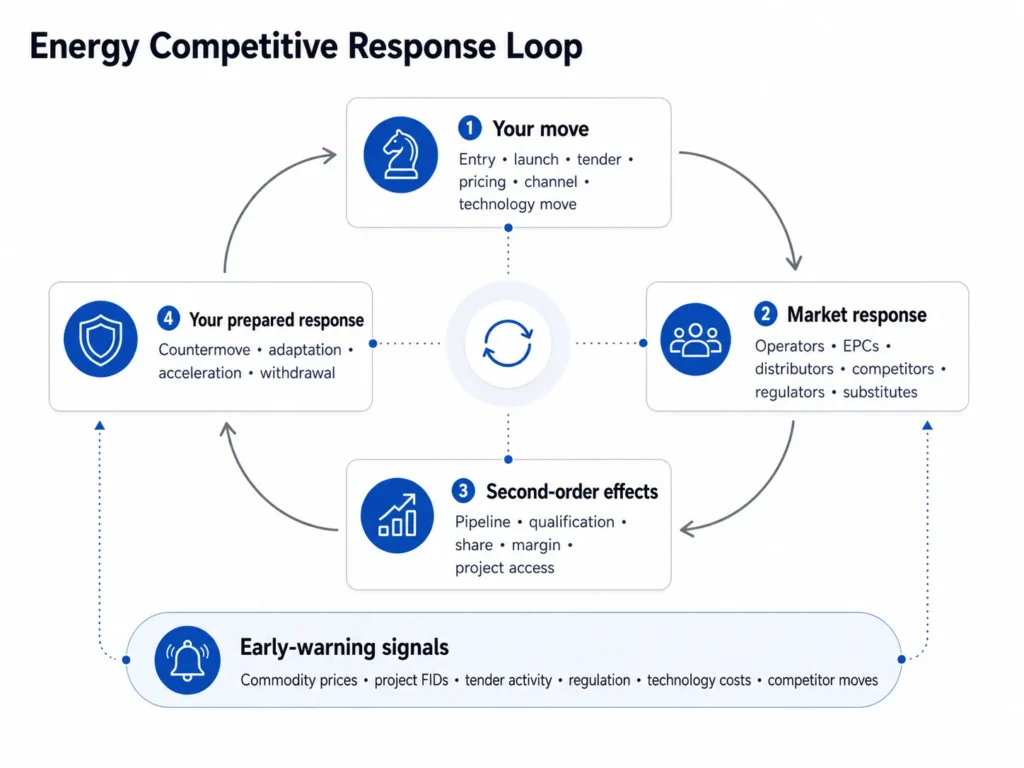
Figure 3: Energy strategy becomes more resilient when you anticipate how customers, partners, competitors, regulators, and technologies may react, and prepare your response before committing resources.
Energy Products Consulting Can Combine Several Strategic Workstreams
Market entry consulting. Compare countries, energy segments, assets, applications, barriers, entry models, partners, economics, and implementation priorities. Explore market entry consulting.
Strategy consulting. Turn asset, project, customer, competitor, channel, technology, and internal evidence into choices and an execution roadmap. Explore strategy consulting.
Wargame consulting. Anticipate customer, EPC, competitor, distributor, regulatory, and technology reactions. Explore wargame consulting.
Benchmarking consulting. Understand the capabilities behind stronger account access, technical selling, service, qualification, pricing, and partner performance. Explore benchmarking consulting.
Competitor analysis consulting. Build a deeper view of rival installed positions, pricing, service, channels, approved status, strengths, vulnerabilities, and likely actions. Explore competitor analysis consulting.
Market analysis consulting. Translate assets, projects, maintenance cycles, and operating demand into product-specific opportunity. Explore market analysis consulting.
Value proposition consulting. Translate reliability, safety, efficiency, availability, and lifecycle economics into a stronger reason for customers to choose you. Explore value proposition consulting.
Win-loss analysis consulting. Understand why operators, EPCs, distributors, or other decision-makers chose you—or chose an alternative. Explore win-loss analysis consulting.
Brand consulting. Strengthen credibility, trust, relevance, and differentiation in categories where procurement can otherwise reduce the decision to price. Explore brand consulting.
The advantage of combining these capabilities is that your energy strategy is built as one coherent decision system rather than as disconnected studies.
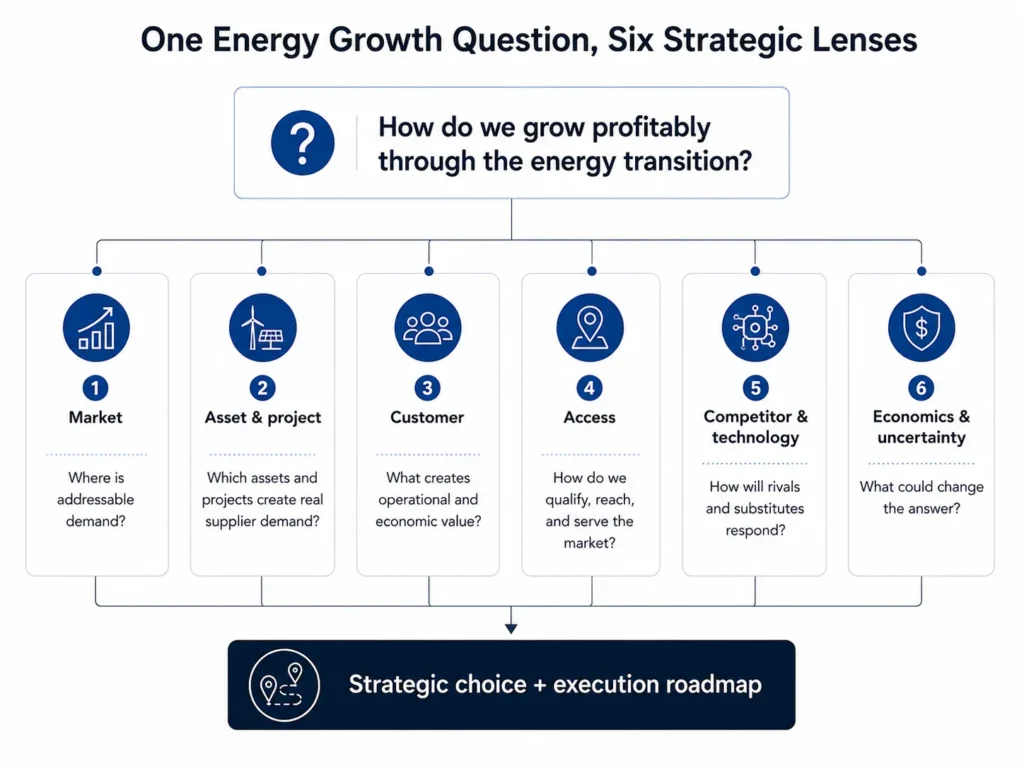
Figure 4: The strongest energy-supplier decisions integrate market demand, asset and project reality, customer value, qualification and access, competitors, technologies, economics, and uncertainty instead of treating them as separate analyses.
Case Example: Preparing for Several Renewable-Energy Futures
An energy-industry supplier was uncertain about how different renewable-energy technologies would evolve and what those changes would mean for its portfolio and strategy.
Management did not need one confident forecast. It needed to understand which technologies could become strategically relevant, which participants would shape adoption, how market development could differ across plausible futures, and which actions would remain attractive if the future unfolded differently from the base plan.
Midas Consulting combined expert perspectives, market intelligence, and scenario-planning methods to identify critical uncertainties, emerging technologies, key market participants, plausible future environments, strategic implications, robust actions, and early-warning indicators.
The engagement produced a set of credible scenarios, contingency options, observable indicators, early-warning signals, and management responses linked to potential market changes.
The strategic value was not a prediction of which renewable technology would win. It was a structured way to make portfolio, partnership, capability, and investment decisions without depending on one fragile view of the future.
Client identity and commercially sensitive details are withheld. This example reflects the circumstances of one engagement and should not be interpreted as a guarantee of equivalent outcomes for another company or market.
Build the Evidence Around the Decision
Energy markets can appear transparent because operators, governments, public companies, regulators, and industry bodies publish substantial information. But supplier-relevant intelligence is often less visible.
Public information may show production, generation capacity, oil and gas prices, renewable investment, drilling activity, and project announcements. It may not show approved suppliers, actual product usage, qualification barriers, distributor margins, tender conditions, service expectations, switching willingness, or competitor strategy.
- Operator disclosures
- Project and investment information
- Production and generation data
- Installed-asset estimates
- Import and export information
- Tender information
- Product and technical analysis
- Operator interviews
- EPC and contractor interviews
- Distributor and service-partner interviews
- Former industry executives
- Engineers and technical specialists
- Competitive intelligence
- Company sales and margin data
- Management hypotheses
Important conclusions are triangulated whenever feasible. We distinguish facts, estimates, hypotheses, assumptions, and unknowns. When the evidence does not support one precise number, we prefer a defensible range or scenario to false precision.
Use Credible External Sources to Strengthen the Context
Client-specific strategy should not be built from generic energy forecasts alone. However, authoritative institutional sources can strengthen the context around investment, generation, fuels, renewables, grids, storage, efficiency, policy, and the regional transition.
Depending on the engagement, useful sources may include the International Energy Agency (IEA), the International Renewable Energy Agency (IRENA), and the Latin American Energy Organization / OLACDE, alongside national energy ministries, regulators, grid operators, hydrocarbon agencies, customs authorities, and statistical agencies.
These sources provide context. They do not replace direct research with operators, EPCs, distributors, contractors, service companies, competitors, and other market participants when the strategic question requires primary evidence.
Why Companies Choose Midas for Energy Products Consulting
More Than 25 Years of Energy-Sector Experience
Midas Consulting has supported companies selling products, equipment, technology, and services into energy markets for more than two decades. That experience matters because supplier growth depends on more than energy demand. It depends on assets, projects, qualification, customer risk, service, partners, procurement, and account economics.
Regional Experience Across Latin America
Latin American energy markets differ materially in resource base, project maturity, regulation, grid structure, local content, investment conditions, procurement, infrastructure, and partner ecosystems. We avoid treating the region as one homogeneous energy market.
Senior Involvement
Senior professionals remain involved in problem definition, research design, strategic interpretation, and management discussions.
Technical and Commercial Integration
We connect product performance with operational outcomes, qualification, procurement, pricing, market access, service requirements, and account economics.
Transparent Limitations
Energy investment plans, project schedules, commodity prices, regulations, technology costs, and adoption rates can change materially. We make evidence gaps, assumptions, ranges, and uncertainty visible rather than presenting artificial precision.
Clear Boundaries Around Specialized Advice
Midas Consulting provides strategic, market, competitive, and commercial consulting. Formal engineering, technical certification, health and safety, environmental, cybersecurity, regulatory, legal, tax, financial, or operational due diligence should be handled or validated by appropriately qualified specialists when required.
Confidentiality
Energy projects can involve sensitive information about accounts, tenders, pricing, qualifications, products, projects, partners, investments, competitors, and future strategy. We can work under confidentiality agreements and anonymize public examples when disclosure has not been authorized.
What Energy-Sector Clients Have Said About Working With Midas
“Midas delivered practical, high-impact ideas that helped us expand market share in a competitive environment.”
Marketing Manager, Energy-Industry Supplier — identity withheld due to confidentiality
“Midas was highly effective, giving us the insights and tools we needed to co-create a robust strategy for complex markets.”
Finance Executive, Energy-Industry Supplier — identity withheld due to confidentiality
“Midas helped us reassess priorities and focus our efforts where they truly mattered.”
Global Market Segment Leader, Energy-Industry Supplier — identity withheld due to confidentiality
Midas reports a Net Promoter Score of 82.2% for client feedback collected during 2020–2025. As with any client metric, it should be interpreted in the context of the respondent base and period measured.
When Energy Products Consulting Creates the Most Value
- You are entering or expanding in a Latin American energy market.
- You need to prioritize countries, energy segments, assets, projects, applications, or accounts.
- You are balancing profitable conventional-energy opportunities with emerging energy technologies.
- Large project pipelines are not translating into enough product-specific demand.
- You need to understand recurring installed-base and maintenance opportunities.
- Tender pressure is weakening margins.
- Your technical differentiation is not translating into a commercial premium.
- Qualification or approved-supplier status is slowing market access.
- Your distributor or service-partner model is not delivering enough account access.
- You need to benchmark technical selling, qualification, service, pricing, or channel capabilities.
- You are preparing a launch, tender strategy, distributor change, local investment, or technology expansion.
- You need a clearer view of competitor strategy or likely responses.
- Several attractive opportunities are competing for the same resources.
- Different internal teams hold conflicting views of the transition.
- You need to challenge a strategy before committing significant capital or management attention.
- Commodity prices, project timing, regulation, technology costs, grid constraints, financing, or policy could materially change your assumptions.
Frequently Asked Questions About Energy Products Consulting
What is Energy Products Consulting?
Energy Products Consulting is decision-oriented strategic consulting for companies that sell products, equipment, technologies, or services into energy markets. It can combine market analysis, asset and project research, market entry, route-to-market strategy, competitive intelligence, benchmarking, value proposition design, win-loss analysis, strategic foresight, wargaming, and strategy development around a specific growth, investment, or competitive decision.
What types of energy suppliers do you support?
We can support companies selling pumps, valves, filtration, chemicals, pipelines, safety products, instrumentation, electrical equipment, software, drilling tools, renewable-energy components, digital technologies, maintenance solutions, and other energy-industry products and services.
Can you estimate the market for an energy-industry product?
Yes, when sufficient evidence is available. Depending on the product, we may combine installed assets, project pipelines, operating cycles, replacement rates, maintenance schedules, application assumptions, production or generation data, imports, pricing, customer interviews, and competitor intelligence. When the evidence does not support one precise figure, we normally use ranges and make the assumptions explicit.
Can you distinguish project demand from recurring installed-base demand?
Yes. New projects can generate major one-time opportunities, while installed assets may generate more predictable demand through replacement, maintenance, reliability, inspection, safety, efficiency, software, and service. We can model and prioritize these demand engines separately.
Can you analyze supplier qualification?
Yes. We can research the strategic implications of vendor registration, technical requirements, quality review, safety documentation, field trials, certifications, approved-manufacturer lists, local representation, cybersecurity review, and other market-access requirements. Formal technical, safety, engineering, regulatory, legal, environmental, or cybersecurity compliance conclusions should be handled by appropriately qualified specialists.
Can you evaluate energy distributors or service partners?
Yes. We can assess account access, technical capability, service coverage, inventory, spare parts, logistics, local presence, competing principals, financial strength, management commitment, partner economics, and strategic fit.
Can you help us defend a price premium?
Yes. Premium defense may require understanding whether the customer values higher uptime, lower failure risk, safety, energy efficiency, lower maintenance, faster service, supply reliability, lower inventory, or lower lifecycle cost. The right value story depends on the application and on which stakeholder carries the economic consequence.
Can Energy Products Consulting include renewable-energy opportunities?
Yes. We can analyze renewable-energy segments, projects, supply chains, technologies, customer needs, partners, competitive dynamics, and market-entry choices when they are relevant to your product. The analysis should focus on the product-specific opportunity rather than assuming that rapid sector growth automatically creates attractive supplier economics.
Can Energy Products Consulting include oil and gas opportunities?
Yes. We can analyze upstream, midstream, downstream, gas, processing, pipeline, refining, maintenance, reliability, service, and related supplier opportunities. The strategic question is where your product can create attractive value and economics, not whether a segment fits a simplistic “legacy” or “future” label.
Can Energy Products Consulting include strategic foresight and scenarios?
Yes. Scenario planning can be particularly useful when your decision depends on technology adoption, commodity prices, project timing, regulation, financing, grid development, energy policy, or competitive reactions. The purpose is not to predict one future. It is to identify robust actions, contingent options, decision triggers, and early-warning signals across plausible futures.
Can an engagement combine several Midas services?
Yes. Energy decisions frequently cut across market analysis, market entry, competitors, qualification, channels, value propositions, benchmarking, win-loss evidence, foresight, wargaming, and strategy. We can structure the work as one integrated program or as phases with decision gates between them.
How do you protect confidential information?
We treat client information as confidential and can work under a nondisclosure agreement. Sensitive information about customers, tenders, pricing, products, partners, qualifications, projects, competitors, and future strategy can be anonymized in public examples when disclosure has not been authorized.
Do you guarantee a specific commercial result?
No responsible strategy advisor should guarantee a specific sales, margin, market-share, qualification, tender, partner, investment, acquisition, or market-entry result. Performance depends on product performance, technical approval, customer investment, pricing, execution, partner commitment, service, availability, competitor actions, regulation, technology, and economic conditions. Our role is to strengthen the evidence, choices, preparation, and execution behind your decisions.
Ready to Make the Next Energy Growth Decision With Greater Confidence?
You may be deciding where to invest, which energy segments to prioritize, how to defend margin, which assets or projects deserve attention, how to improve qualification, how to strengthen a partner model, or how to prepare for an uncertain energy transition.
You do not need to have the entire problem defined before contacting us. Tell us the decision you are facing, what you already know, and what remains uncertain. We will help you determine which evidence is worth gathering, which assumptions deserve to be challenged, and which strategic choices require management attention.