
Market analysis in Colombia to grow and succeed!
Colombia can look like one attractive national market from headquarters. In practice, the opportunity may change significantly by city, region, channel, customer type, and institution.
A company may see strong demand in Bogotá and assume the same model will work in Medellín, Cali, the Caribbean Coast, or secondary cities. A category may appear large in formal data while a meaningful share of customer activity moves through independent resellers, regional distributors, parallel products, informal transactions, or institutional channels that are measured inconsistently.
A competitor may appear preferred because its product is better. It may also be winning because its distributor provides inventory, credit, transportation, local relationships, regulatory knowledge, or access to institutions. Those are very different sources of advantage, and they require different strategic responses.
At Midas Consulting, we help you separate national potential from the opportunity your company can realistically capture. We combine secondary research, primary interviews, regional validation, channel analysis, customer evidence, and strategic interpretation so you can decide where to focus, which route to market to use, what to adapt, and what must be true before you invest.
The result is not a generic country report. It is a focused decision about regions, customer segments, channels, institutions, pricing, partners, and growth priorities.
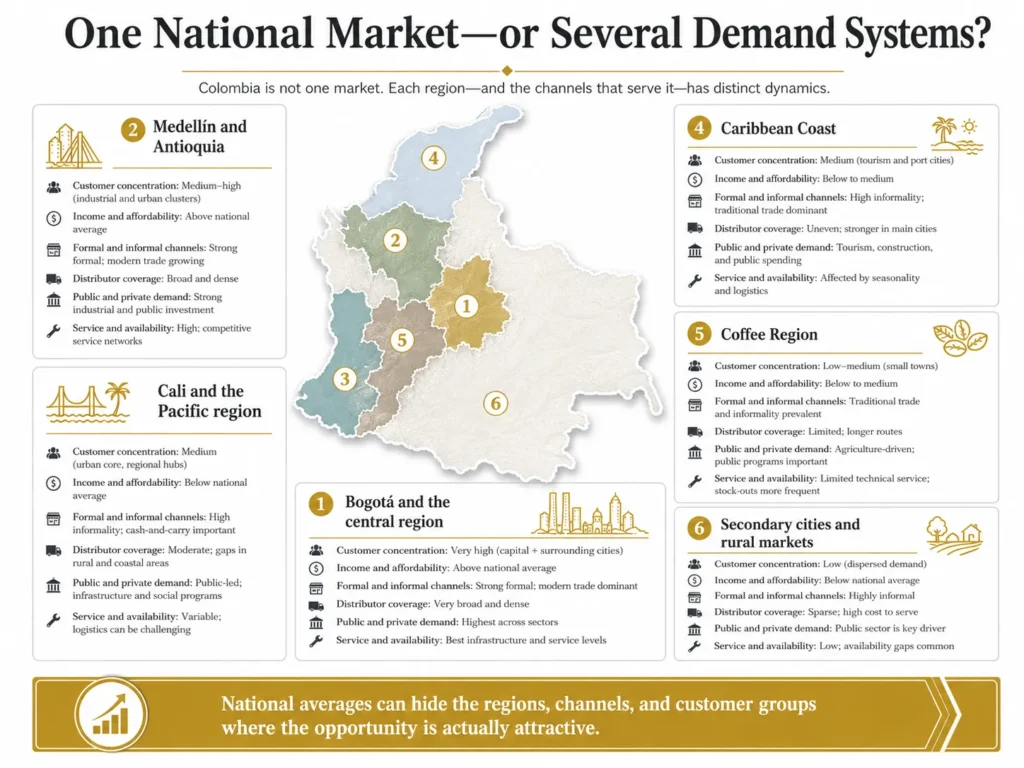
Figure 1. Colombia’s national market can conceal major differences in demand, affordability, channels, institutional access, and execution requirements across regions.
The Market Analysis Strategic Question Is Not “Is Colombia Growing?”
Growth at the national level does not tell you whether the opportunity is attractive for your company.
Your leadership team needs to understand:
- Where demand is concentrated by city, region, industry, channel, institution, and customer group.
- Which parts of reported market activity are formal, informal, direct, distributor-led, institutional, or digital.
- How purchasing power and willingness to pay vary across customer segments and regions.
- Whether customers choose the product because they prefer it or because it is available, financed, approved, or locally supported.
- Which distributors and partners truly control customer access.
- How public, institutional, and private purchasing differ.
- Where regulation, registration, reimbursement, tenders, or administrative requirements create barriers.
- Whether your pricing, product, service, and credit model fit local expectations.
- Which regions are attractive enough to justify direct investment and which should be served through partners.
- What evidence should change the decision to enter, stage, adapt, or stop.
The objective is to identify the accessible and economically attractive demand that your company can serve better than existing alternatives.
National Market Size Can Hide Several Different Opportunities
Bogotá may dominate the visible market
Bogotá concentrates corporate headquarters, institutions, healthcare providers, government purchasing, distributors, professional services, and higher-value customers in many sectors. That concentration makes the capital strategically important, but it can also cause companies to overestimate national reach.
Regional markets may follow different buying patterns
Medellín and Antioquia may offer different industrial and relationship dynamics. Cali and the Pacific region may reflect other logistics, customer, and channel conditions. The Caribbean Coast, Coffee Region, and secondary cities can require different partners, pricing, service levels, and commercial approaches.
A national category may contain distinct value pools
Public institutions, private companies, small businesses, consumers, industrial users, and regional resellers may represent different economics and barriers. Combining them into one number can hide the segment that actually deserves investment.
Secondary markets can be underserved—but costly to reach
A regional gap may create an opportunity, but only if demand density, logistics, partner quality, credit, and service requirements support a profitable model.
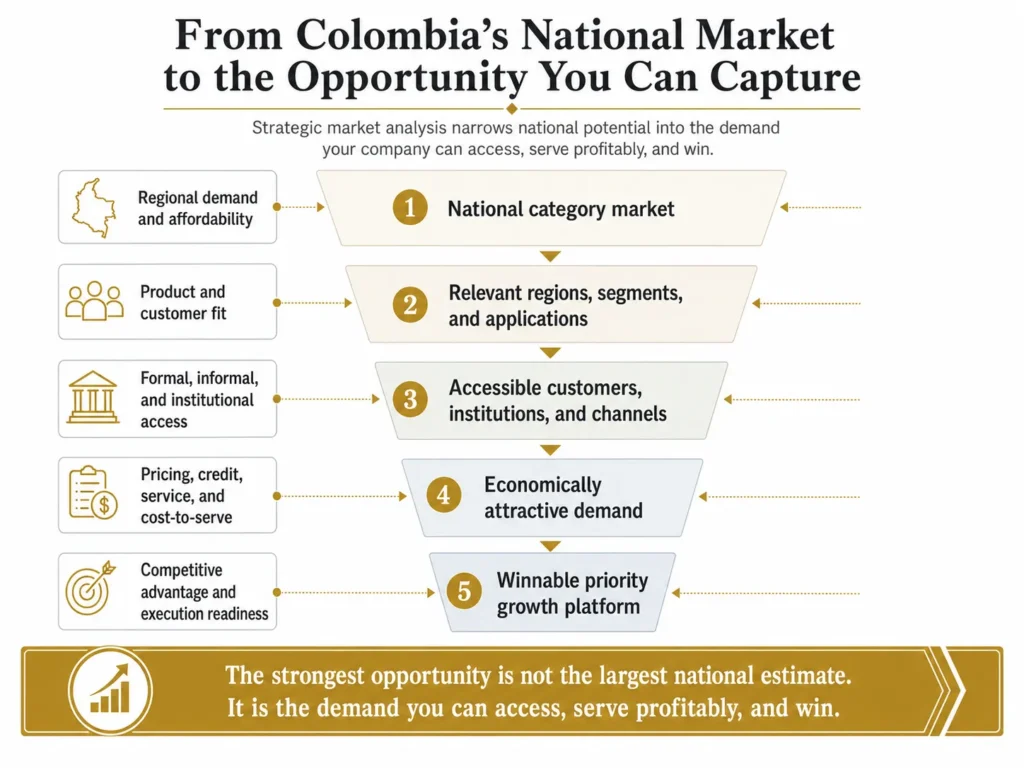
Figure 2. Strategic market analysis narrows Colombia’s national potential into the regional, customer, institutional, and channel opportunities your company can capture profitably.
Formal and Informal Channels Can Change the Market You Are Measuring
Informality should not be treated as one simple market category. Depending on the industry, it may include independent resellers, parallel imports, cash transactions, incomplete invoicing, product substitution, unregistered activity, or sellers operating outside the manufacturer’s authorized channel.
These activities can influence:
- Effective market size.
- Price expectations.
- Availability and customer convenience.
- Product quality and authenticity perceptions.
- Brand reputation.
- Formal distributor margins.
- Regulatory and compliance risk.
- Customer willingness to pay for authorized service and support.
The purpose of the analysis is not to manufacture an exact number for activity that cannot be observed precisely. It is to determine whether informal and alternative channels materially change the attractiveness, pricing, or execution of the opportunity.
Is the Market Buying the Product, or Buying Access?
Observed sales can result from genuine customer preference or superior route-to-market access.
Customer preference may be driven by:
- Product performance.
- Brand trust.
- Better total value.
- Service quality.
- Lower operating cost.
- Product-market fit.
Market access may be driven by:
- Distributor coverage.
- Inventory and availability.
- Credit and payment terms.
- Institutional relationships.
- Regulatory or tender access.
- Local sales and technical support.
If preference drives the result, you may need a stronger value proposition. If access drives the result, the priority may be channel capability, inventory, credit, approval, or institutional entry.
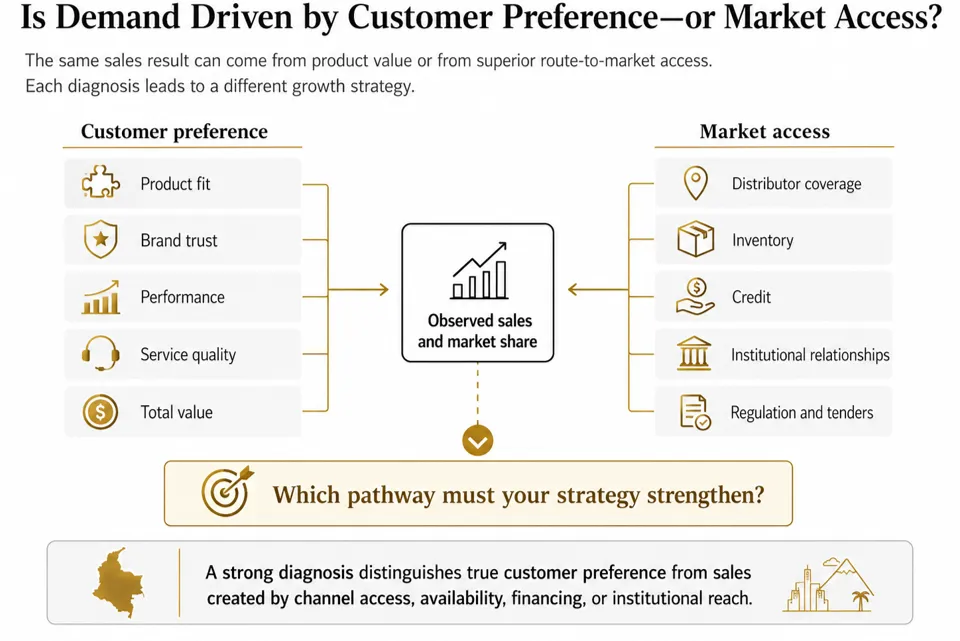
Figure 3. The same sales result can arise from customer preference or superior access, and each requires a different growth strategy.
Distributor Quality Can Determine Whether Demand Is Accessible
A distributor may provide more than sales coverage. It may manage inventory, financing, credit risk, transportation, registrations, technical support, demand generation, institutional access, and relationships in regions your company cannot serve directly.
We assess:
- Geographic and customer coverage.
- Sales quality and account influence.
- Inventory and working-capital capability.
- Credit, collection, and financial discipline.
- Technical, regulatory, and service competence.
- Competing brands and potential conflicts.
- Commitment to invest in the category.
- Dependence on a few customers or employees.
- Ability to scale beyond one city or segment.
A partner may offer rapid access while creating dependence. Direct entry may improve control while increasing cost and time. A hybrid model may be stronger when strategic institutions require direct management and broader regional coverage can be supported through partners.
Public, Institutional, and Private Demand Should Be Analyzed Separately in Colombia
In healthcare, infrastructure, education, technology, industrial supply, and other sectors, institutional purchasing can represent a major value pool. But the rules may differ from private demand.
Institutional opportunity may depend on:
- Registrations and approvals.
- Tender participation and administrative capability.
- Specifications and supplier qualification.
- Reimbursement or budget cycles.
- Stakeholder influence.
- Local partners and contracting structures.
- Delivery, service, and compliance commitments.
Private buyers may prioritize responsiveness, credit, service, flexibility, relationships, and total cost differently.
A company can be strong in one market and weak in the other. A combined estimate can hide that distinction.
Affordability and Credit Can Matter as Much as Need
Customer need does not automatically become accessible demand. Purchasing power, budget timing, financing, payment terms, and credit availability can determine whether the customer buys, delays, reduces specifications, or chooses a substitute.
We investigate:
- Willingness to pay by segment.
- Price sensitivity and trading down.
- Financing and payment preferences.
- Distributor and customer credit constraints.
- Product sizes, formats, and bundles.
- Substitution and lower-cost alternatives.
- The total cost and risk of the customer’s current solution.
The strongest opportunity may not be the segment with the greatest need. It may be the segment where urgency, affordability, access, and your value proposition align.
How Midas Validates Fragmented Market Information in Its Colombia Analysis
Different sources may produce very different estimates of market size, growth, price, or channel share. Selecting one number because it appears precise does not make it reliable.
We define:
- The products and substitutes included.
- The geographic coverage.
- The time period.
- The formal, informal, direct, institutional, and indirect channels included.
- The unit of measurement.
- The assumptions behind each estimate.
We then triangulate:
- Official economic, demographic, sector, trade, regulatory, and procurement information.
- Company, product, price, portfolio, channel, investment, and hiring signals.
- Interviews with customers, distributors, wholesalers, suppliers, specialists, former industry participants, and institutions.
- Regional and city-level validation.
- Import, installed-base, usage, replacement, tender, or production indicators where relevant.
- Your team’s commercial, operational, technical, and financial knowledge.
We distinguish verified facts from informed estimates, show confidence ranges, and make remaining uncertainty visible.
For the complete research process and wave-based methodology, visit Market Analysis: The Key to Informed Strategic Decisions.
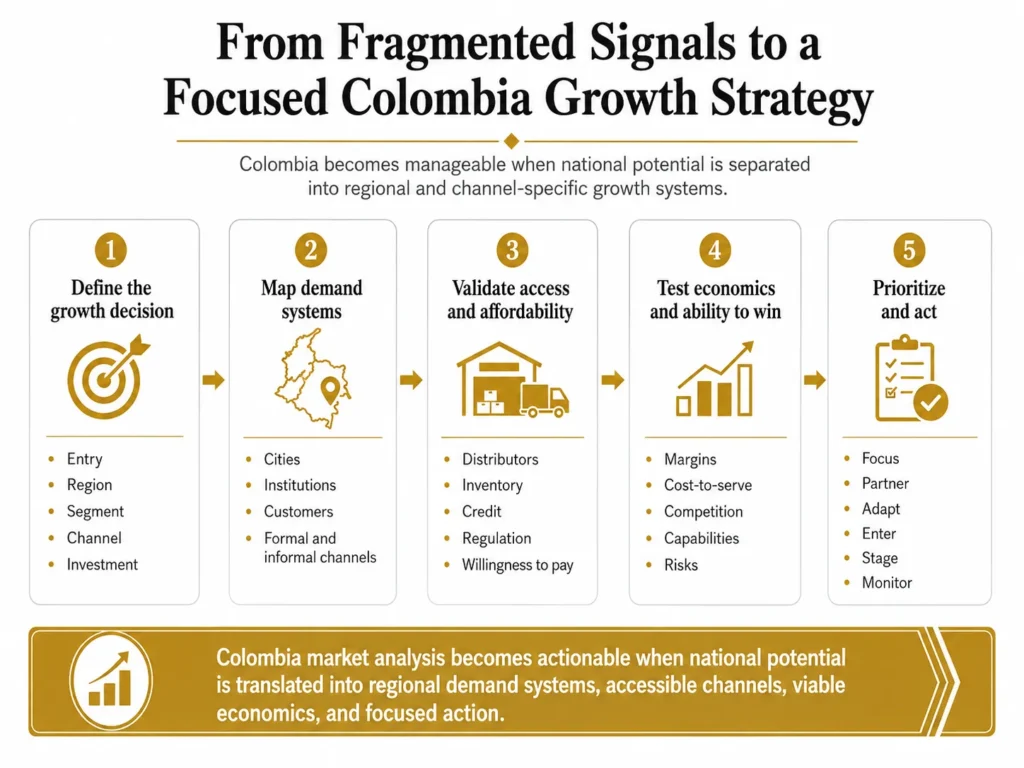
Figure 4. Colombia market analysis becomes actionable when national potential is translated into regional demand systems, accessible channels, viable economics, and focused action.
How Market Analysis in Colombia Changes Your Decision
Regional prioritization
You can determine which cities, regions, industrial clusters, and customer groups offer the strongest combination of demand, affordability, access, and economics.
Market-entry decisions
You can compare national entry, selected-city entry, distributor-led entry, institutional entry, direct sales, partnership, and staged expansion.
Channel and distributor decisions
You can identify which partners truly influence customers, where coverage is weak, and whether you should appoint, replace, support, or supplement a distributor.
Pricing and affordability decisions
You can connect pricing with willingness to pay, credit, payment terms, product mix, channel margins, service, and substitution.
Institutional and market-access decisions
You can determine which registrations, stakeholders, tenders, partners, and commercial capabilities are required to reach public and institutional demand.
Portfolio and value-proposition decisions
You can identify where the product fits, which segments need adaptation, and whether the strongest barrier is value, access, affordability, or execution.
Case Example: Doubling Sales in Colombia Through a Market-Specific Strategy
The executive challenge
A global producer of medicinal-gas equipment already operated in Colombia but needed a more effective strategy to accelerate growth, address local barriers, and improve its competitive position.
The company required more than a broad market estimate. It needed to understand demand, customers, competitors, channels, logistics, critical success factors, risks, and the differences that made Colombia distinct from other Latin American markets.
How we approached the decision
We combined secondary research with direct interviews involving:
- Equipment manufacturers.
- Medical-gas producers.
- Hospitals and healthcare providers.
- Distributors and logistics partners.
The analysis assessed market size, competitive dynamics, customer needs, barriers, risks, opportunities, channels, and the capabilities required to grow.
How the market analysis findings in Colombia supported growth
We translated the findings into a Colombia-specific growth strategy rather than applying one regional commercial model unchanged.
The company optimized operations, focused on higher-growth segments, and navigated local market complexities more effectively. According to the case results, it doubled its sales in Colombia within four years.
The Colombia strategy also formed part of a wider regional growth program. For the complete multi-country case, visit Market Analysis in Latin America.
“Thanks to Midas, we walked away with a clear, well-organized strategy. The collaboration between different business units and the fresh market insights were outstanding. Kudos!”
— Go-to-Market Manager
“Their report and analysis were thorough. They collaborated well with our team, including our tech department. One of the reasons we chose them was their depth of experience, which was evident throughout the project.”
— Global Product Manager
When You Need Market Analysis in Colombia
- Entering Colombia or reassessing your current market model.
- Prioritizing Bogotá, Medellín, Cali, the Caribbean Coast, or secondary markets.
- Reconciling conflicting market-size or growth estimates.
- Assessing formal, informal, institutional, and private demand.
- Selecting, replacing, or evaluating distributors.
- Reviewing pricing, affordability, credit, or product mix.
- Preparing a product launch or regional expansion.
- Evaluating institutional access, registrations, or tenders.
- Trying to understand whether sales reflect preference or access.
- Building a focused and sequenced growth roadmap.
When your decision covers several countries, the Colombia analysis should fit into a consistent regional framework. See our Latin America market-analysis hub.
For the complete consulting offer, engagement model, and deliverables, visit our market-analysis consulting service page.
Why Midas for Market Analysis in Colombia?
We look below national averages
We analyze demand by city, region, institution, customer type, channel, application, and route to market.
We distinguish customer preference from market access
We identify whether demand is driven by product value or by distributors, inventory, credit, relationships, and regulatory access.
We integrate formal and informal market realities
We assess the strategic relevance of alternative channels without claiming false precision or legitimizing unlawful practices.
We connect opportunity with affordability and economics
We examine willingness to pay, credit, pricing, channel margins, logistics, service, and cost-to-serve.
We use primary research where published information is insufficient
We complement official and commercial sources with carefully designed interviews and local validation.
We translate evidence into a focused growth plan
The engagement ends with regional, channel, institutional, pricing, and investment priorities, not simply a description of the market.
We bring direct market analysis in Colombia experience
We have analyzed B2B, B2C, industrial, automotive, consumer, technology, pharmaceutical, healthcare, and household-device markets in Colombia.
Ethical and Reliable Market Intelligence in Colombia
We comply with SCIP’s Code of Ethics, the profession’s gold standard. We comply with applicable laws, accurately disclose relevant identity and organizational information before interviews, avoid conflicts of interest, provide honest recommendations, and promote ethical conduct throughout the engagement.
We do not seek trade secrets, request confidential documents, misrepresent who we are, induce contractual breaches, or facilitate improper exchanges of competitively sensitive information.
We also make uncertainty visible. We explain market definitions, assumptions, evidence quality, and confidence ranges so that your leadership team can distinguish a defensible conclusion from false precision.
Review SCIP’s ethical intelligence guidance and Code of Ethics.
Frequently Asked Questions About Market Analysis in Colombia
Can you estimate market size when formal data excludes informal activity?
Yes. We can develop evidence-based ranges using official information, trade data, company activity, channel interviews, pricing, availability, customer behavior, and other lawful sources. We clearly state assumptions and confidence levels.
Can you compare demand across Colombian cities and regions in your market analysis in Colombia?
Yes. We can structure the analysis around cities, regions, industrial clusters, service territories, institutions, or customer groups that match the decision.
Can you analyze public, institutional, and private demand separately?
Yes. We can compare purchasing processes, stakeholders, tenders, approvals, pricing, access barriers, channels, and competitor positions.
Can you evaluate distributors in your market analysis in Colombia?
Yes. We assess customer access, geographic coverage, inventory, credit, technical capability, service, regulatory knowledge, competing brands, commitment, and scalability.
How do you reconcile conflicting market estimates?
We test whether the sources use the same products, geography, time period, channels, units, and definitions. We triangulate independent evidence and use ranges where exact comparability is impossible.
Can you analyze affordability and willingness to pay in your market analysis in Colombia?
Yes. We can assess price sensitivity, payment terms, financing, credit, product substitution, customer budgets, and the value drivers that justify a premium.
Can you evaluate informal or parallel channels?
We can assess their strategic effect on market size, price, availability, brand perception, and formal-channel economics using legal and ethical research methods.
Can you help us decide whether to enter nationally or regionally in your market analysis in Colombia?
Yes. We compare national, selected-region, institutional, distributor-led, direct, hybrid, and staged-entry models according to opportunity, access, economics, and execution risk.
How do you protect confidentiality and comply with ethical standards?
We comply with applicable laws and SCIP’s Code of Ethics. We disclose relevant identity before interviews, do not misrepresent ourselves, and never seek trade secrets or confidential documents.
How long does a market analysis in Colombia take?
The timing depends on the number of regions, channels, institutions, interviews, and strategic questions. We scope the work around your decision and can share preliminary findings in phases.
About the Author
Adrian Alvarez, PhD is Managing Partner at Midas Consulting, Wharton Alumnus, MBA Professor at Universidad Argentina de la Empresa (UADE), and Competitive Intelligence Fellow. He specializes in competitive strategy, market analysis, strategic intelligence, market entry, and executive decision-making under uncertainty in Colombia and Latin America.
He has analyzed B2B, B2C, industrial, automotive, consumer, technology, pharmaceutical, healthcare, and household-device markets in Colombia. His work has been published in the United States, Spain, and Germany. You can access his library of strategic insights and published research here
View professional profile on LinkedIn
Selected Colombian Sources You May Need to Monitor
The right source mix depends on your industry and decision. A Colombia fact base may include:
- DANE for official economic, demographic, price, labor, and sector information.
- Banco de la República for monetary, financial, exchange, and economic information.
- Superintendencia de Industria y Comercio for competition, consumer, corporate, and intellectual-property information.
- Colombia Compra Eficiente where public procurement is relevant.
- INVIMA for healthcare, pharmaceutical, food, medical-device, and other regulated-product information.
- DIAN and trade sources, sector regulators, regional chambers, company disclosures, industry associations, channel evidence, and primary market interviews as appropriate.
Official information is essential, but it rarely explains informal activity, channel power, customer affordability, institutional relationships, or the operational feasibility of your strategy on its own.
Turn Fragmented Demand into a Focused Growth Decision
You may be deciding whether to enter Colombia, which cities to prioritize, how to structure distribution, whether institutional demand is accessible, or why national market potential is not translating into profitable growth.
You do not need one national estimate that hides regional differences, informal activity, channel access, affordability, and institutional barriers. You need to understand where demand is real, which route to market can reach it, what customers can afford, and where your capabilities give you a credible chance to win.
In an initial conversation, we will discuss your decision, the regions, customer groups, channels, institutions, and products involved, what your team already knows, and which uncertainties could materially change the strategy.
We can then propose a focused Colombia market-analysis engagement with a clear scope, research plan, regional and channel segmentation, timing, and deliverables.