
Market analysis in Chile to grow and succeed!
Chile can look straightforward from the outside: clear institutions, sophisticated customers, strong trade links, and a relatively transparent business environment.
But transparency does not eliminate strategic uncertainty. In many sectors, demand is concentrated among a limited number of accounts, institutions, retailers, mines, distributors, or industrial customers. A market may be attractive in theory but too narrow, too protected, or too expensive to access profitably.
A supplier may have a technically strong offer and still struggle because customers trust the incumbent’s service network, financing, installed base, or channel relationships. A distributor may provide national reach on paper but limited influence in the accounts that matter. A category may appear large enough until switching barriers, service costs, and customer concentration are taken into account.
At Midas Consulting, we help you separate the apparent opportunity from the opportunity your company can realistically capture. We combine secondary research, direct customer and channel interviews, account-level insight, competitor analysis, and strategic interpretation so you can decide where to focus, what to adapt, and what it will take to win in Chile.
The result is not a general market description. It is a focused decision about customers, segments, channels, value propositions, investments, and priorities.
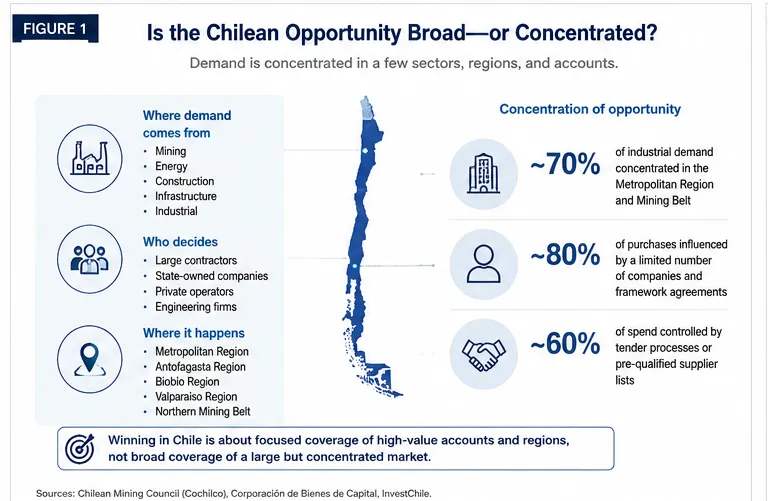
Figure 1. Market attractiveness in Chile often depends on how much demand is concentrated among the accounts, channels, and institutions your company can realistically access.
The Strategic Market Analysis Question Is Not Simply “Is Chile Attractive?”
A stable or sophisticated market is not automatically the right market for your company.
- How much demand is concentrated among a few customers, sectors, institutions, or regions?
- Which accounts determine volume, margin, reputation, or future access?
- How do customers choose suppliers, and what causes them to switch?
- Does the opportunity depend on direct sales, distributors, dealers, integrators, or tenders?
- How do service, spare parts, training, financing, and local references influence purchasing?
- Can the market support the investment required to build trust and coverage?
- How strong are incumbent relationships and installed-base advantages?
- Which segments justify focus, and which are simply too narrow?
- Would partnership or acquisition provide faster access than organic entry?
- What must your company change in order to win?
The objective is to move from a national market estimate to a practical view of accessible demand, account economics, barriers, and competitive fit.
Market Size Can Be Misleading When Demand Is Concentrated
A small number of accounts may shape the entire opportunity
In mining, industrial equipment, healthcare, infrastructure, retail, technology, and other sectors, a limited number of customers can represent a large share of demand. That concentration changes the strategic question. You are not only asking whether the category is attractive. You are asking whether your company can access the decision makers, meet their requirements, and create enough reason for them to change.
National demand may depend on one sector or application
A category may appear diversified at a high level while depending heavily on mining, large retail, institutional purchasing, public procurement, or a small number of industrial applications. The analysis should identify where the real value pools are and whether those pools are accessible to you.
A narrow market can still be highly attractive
Concentration is not always negative. A limited number of high-value customers can reduce the cost of market coverage and create attractive economics—if you can reach them and meet their needs.
A broad national estimate can hide high account risk
If most demand depends on a few accounts, losing or failing to win one relationship can materially alter the opportunity. The market analysis should make that dependence visible before you invest.
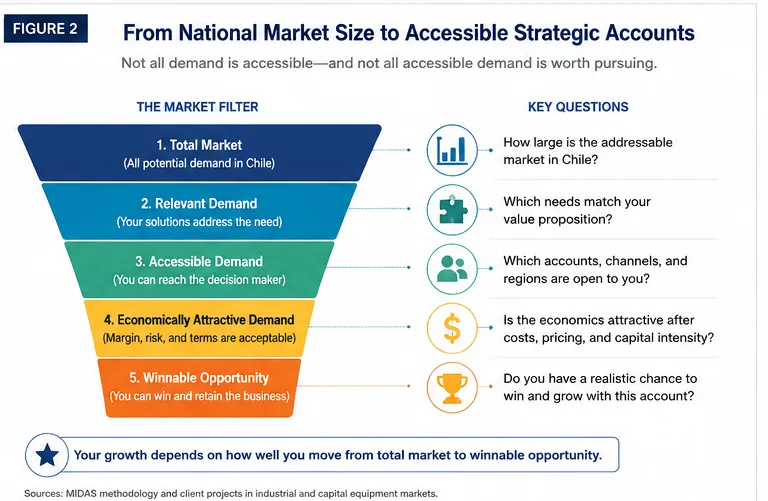
Figure 2. A useful Chile market analysis narrows total category demand into the accounts and segments your company can access, serve profitably, and win.
What Makes Customers Stay, or Move?
Customer loyalty in Chile is often based on more than the product.
Customers may stay with an incumbent because of trusted relationships, installed base, technical familiarity, reliable service, spare parts, proven uptime, financing, certifications, compliance confidence, local references, and low perceived switching risk.
Customers may become open to change when they experience service failures, high total cost of ownership, supply problems, weak commercial responsiveness, inflexible contracts, technology gaps, or a credible alternative that lowers operational risk.
Primary interviews help you understand whether the market is protected by genuine customer value, inertia, switching cost, or dissatisfaction that has not yet produced movement.
Channels Can Create Access, or Hide Dependency
A distributor or dealer may provide geographic reach, inventory, credit, technical support, installation, service, and customer relationships. But a broad partner network does not automatically mean effective access.
- Which customers and industries does the partner truly influence?
- Does the manufacturer or the channel own the relationship?
- Where does the partner have technical and service capability?
- How are inventory, credit, pricing, and demand generation managed?
- Does the partner prioritize your offer or competing brands?
- What coverage exists outside Santiago and major industrial centers?
- How dependent would the business become on one partner?
A strong distributor can accelerate entry. A weak or conflicted partner can make an attractive market inaccessible.
Service and Installed Base Can Define the Economics
In equipment, industrial, healthcare, technology, construction, and other complex markets, service is not a supporting activity. It is part of the product’s value and often part of the entry barrier.
- Installed-base size and age.
- Maintenance and replacement cycles.
- Spare-parts availability.
- Technical skills and response times.
- Customer downtime and operating risk.
- Warranty and service expectations.
- Geographic service requirements.
- Recurring revenue and loyalty created by the service ecosystem.
A market may be attractive in product revenue and unattractive once service obligations are included. The reverse can also occur: a modest equipment opportunity may create valuable recurring service and parts demand.
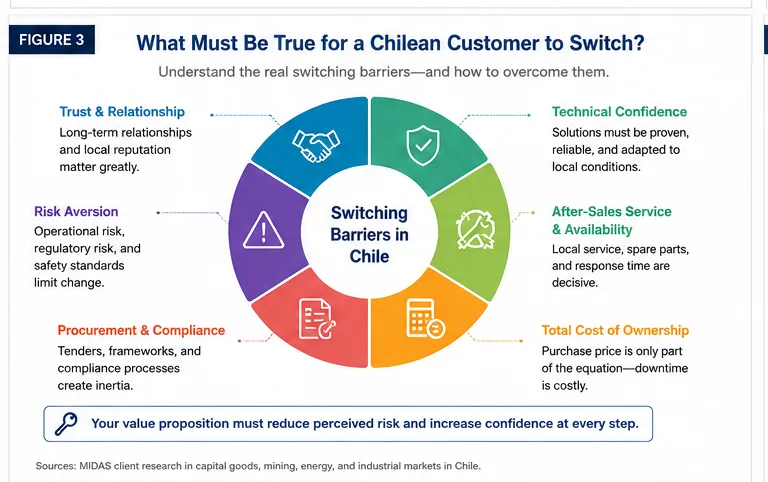
Figure 3. Winning in Chile often requires a value proposition strong enough to overcome switching risk, incumbent relationships, and execution concerns.
Pricing Should Be Evaluated as a Complete Commercial Offer in Market Analysis in Chile
Headline prices may not be directly comparable. The effective offer can include configuration, optional features, warranty, financing, freight, installation, commissioning, training, technical support, maintenance, spare parts, service commitments, account discounts, and trade-ins.
A competitor may appear more expensive while providing lower total operating risk. Another may use financing or service terms to make the offer more attractive without reducing the headline price.
The analysis should normalize the offer so your team can compare customer value and economics rather than non-equivalent prices.
Institutional Quality Does Not Eliminate Market-Access Barriers
Chile’s institutions and regulatory environment can improve transparency and predictability. Yet market access may still depend on certifications, technical standards, registrations, tenders, supplier approvals, local references, and compliance requirements.
Market analysis should translate those requirements into effects on time to market, commercial access, product adaptation, partner needs, investment, working capital, customer confidence, and competitor protection.
How to Prioritize Chilean Segments and Accounts
Market attractiveness
- Accessible demand and growth.
- Account concentration and value.
- Customer urgency and willingness to pay.
- Margin and recurring-revenue potential.
- Competitive intensity and barriers.
Ability to win
- Value-proposition fit.
- Technical performance and references.
- Service and account-management capability.
- Channel and institutional access.
- Ability to reduce switching risk.
Execution feasibility
- Required investment.
- Time to approval and customer access.
- Partner availability.
- Service and inventory requirements.
- Management attention and scalability.
The strongest opportunity is the one where customer need, access, economics, and your ability to execute reinforce one another.
How Midas Builds a Reliable Fact Base for Market Analysis in Chile
Chile offers useful official and corporate information, but public sources rarely explain account-level decision criteria, pricing, channel influence, service performance, or switching motivation.
We triangulate official economic, sector, trade, regulatory, tender, and corporate information with company and product signals, customer and channel interviews, account-level validation, installed-base evidence, and your team’s knowledge.
We define the market carefully, reconcile conflicting estimates, distinguish verified facts from informed hypotheses, and make confidence levels visible.
For the complete research process and wave-based methodology, visit Market Analysis: The Key to Informed Strategic Decisions.
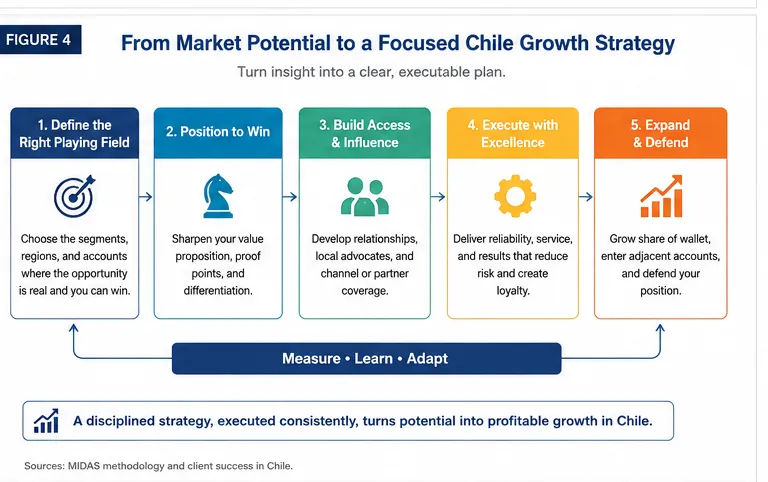
Figure 4. Chile market analysis becomes actionable when national potential is translated into priority accounts, accessible channels, differentiated value, and a focused execution plan.
Case Example: Increasing Sales by 40% in the First Year
A multinational equipment company was a leader in its broader category but struggled to gain traction with rock drillers in Chile. The company needed to understand why product strength was not translating into sales.
We combined secondary research with interviews involving competitors, representatives, customers, and other knowledgeable market participants. The analysis included market size and shares, profiles of thirteen competitors, customer needs, sales and channel dynamics, acquisition candidates, and issues management needed to monitor.
We recommended changes in sales focus and value proposition. According to the case results, the company increased its Chilean sales by 40% in the first year.
“Thanks to Midas, we walked away with a clear, well-organized strategy. The collaboration between different business units and the fresh market insights were outstanding. Kudos!”
— Go-to-Market Manager
When You Need Market Analysis in Chile
- Entering Chile or reassessing a previous entry decision.
- Determining whether the market is large enough to justify focused investment.
- Prioritizing key accounts, institutions, sectors, or applications.
- Trying to understand why customers remain with incumbents.
- Evaluating distributors, dealers, integrators, or direct-sales models.
- Reviewing pricing, financing, warranty, service, or total customer value.
- Assessing installed base, switching barriers, or recurring service demand.
- Preparing a product launch or repositioning an offer.
- Evaluating acquisition candidates or access partnerships.
- Building a focused market-entry or growth roadmap.
When your decision covers several countries, see our Latin America market-analysis hub.
For the complete consulting offer, visit our market-analysis consulting service page.
Why Midas for Market Analysis in Chile?
- We look below the national estimate. We analyze demand by sector, account, institution, application, region, and channel.
- We connect attractiveness with access. We identify what protects incumbents and what could create a credible opening.
- We examine the complete customer value proposition. Product, price, financing, service, warranty, availability, installed base, and switching risk.
- We use primary research where public information is insufficient.
- We translate evidence into focused execution.
- We can recommend against entry or broad investment.
- We bring direct Chile experience.
Ethical and Reliable Market Intelligence
We comply with SCIP’s Code of Ethics, the profession’s gold standard. We comply with applicable laws, accurately disclose relevant identity and organizational information before interviews, avoid conflicts of interest, provide honest recommendations, and promote ethical conduct throughout the engagement.
We do not seek trade secrets, request confidential documents, misrepresent who we are, induce contractual breaches, or facilitate improper exchanges of competitively sensitive information.
Review SCIP’s ethical intelligence guidance and Code of Ethics.
Frequently Asked Questions About Market Analysis in Chile
Can you estimate market size when demand is concentrated among a few accounts?
Yes. We combine account demand, installed base, replacement cycles, imports, tenders, channel activity, interviews, and other relevant evidence. We make account concentration and confidence ranges explicit.
Can you identify which customers should be prioritized in your market analysis in Chile?
Yes. We assess account attractiveness, current supplier position, unmet needs, access, switching barriers, economic value, and probability of movement.
Can you assess distributors and dealers?
Yes. We examine customer access, geographic coverage, technical capability, inventory, credit, service, competing brands, commitment, economics, and strategic fit.
Can you evaluate switching barriers in your market analysis in Chile?
Yes. We assess installed base, training, technical familiarity, service routines, contracts, approvals, data, operating risk, relationships, and customer confidence.
Can you compare competitor offers when configurations differ?
Yes. We normalize configuration, pricing, financing, freight, warranty, service, maintenance, spare parts, and other inclusions.
Can you analyze public and private demand separately in your market analysis in Chile?
Yes. We compare customers, purchasing processes, tenders, specifications, access barriers, pricing, and competitor positions.
Can you determine whether the market is too small to justify entry?
Yes. We assess accessible demand, margins, cost-to-serve, investment, service requirements, concentration, scalability, and strategic fit.
Can you help us translate the analysis into a go-to-market strategy in your market analysis in Chile?
Yes. The findings can support account priorities, value proposition, channel design, pricing, service, sales focus, partner selection, and implementation choices.
How long does a market analysis in Chile take?
The timing depends on the number of sectors, accounts, competitors, interviews, and strategic questions. We scope the work around your decision and can share preliminary findings in phases.
About the Author
Adrian Alvarez, PhD is Managing Partner at Midas Consulting, Wharton Alumnus, MBA Professor at Universidad Argentina de la Empresa (UADE), and Competitive Intelligence Fellow. He specializes in competitive strategy, market analysis, strategic intelligence, market entry, and executive decision-making under uncertainty in Chile and Latin America.
He has analyzed B2B, B2C, industrial, mining, automotive, consumer, pharmaceutical, healthcare, household-device, and technology markets in Chile. You can access his library of strategic insights and published research here
View professional profile on LinkedIn
Selected Chilean Sources You May Need to Monitor
- Instituto Nacional de Estadísticas
- Banco Central de Chile
- Fiscalía Nacional Económica
- Mercado Público
- SERNAC
Focus on the Opportunity You Can Actually Access and Win
You may be deciding whether to enter Chile, which accounts to prioritize, whether to appoint a distributor, how to reposition your offer, or why a technically strong product is not gaining traction.
You do not need a market estimate that ignores customer concentration, incumbent relationships, switching barriers, service requirements, and channel access. You need to know which customers and segments are attractive, why they buy, what protects the incumbent, and what your company must do differently.
In an initial conversation, we will discuss your decision, the sectors, accounts, channels, and products involved, what your team already knows, and which uncertainties could materially change the strategy.