
Elevate Your Market Position with Benchmarking in Argentina!
In Argentina, a company can appear to outperform you because it executes better—or because inflation, currency, inventory timing, financing, regulation, product mix, or channel structure make the comparison look better than it really is.
A competitor may report lower costs because it is selling inventory purchased under earlier replacement conditions. A local player may appear more profitable because it prices faster, carries a narrower portfolio, uses informal or indirect channels, or operates with a different tax and working-capital model. One business unit may show stronger sales productivity simply because it serves denser accounts or measures activity differently.
If those differences are not normalized, your leadership team may set the wrong target, copy a practice that cannot be transferred, or invest heavily to close a gap that is largely structural.
At Midas Consulting, we help you determine which Argentine performance differences are real, what explains them, which practices are transferable, and what your organization should match, redesign, leapfrog, or deliberately leave unchanged.
The result is not a ranking. It is an improvement agenda grounded in comparable economics, operational reality, customer value, and your ability to execute.
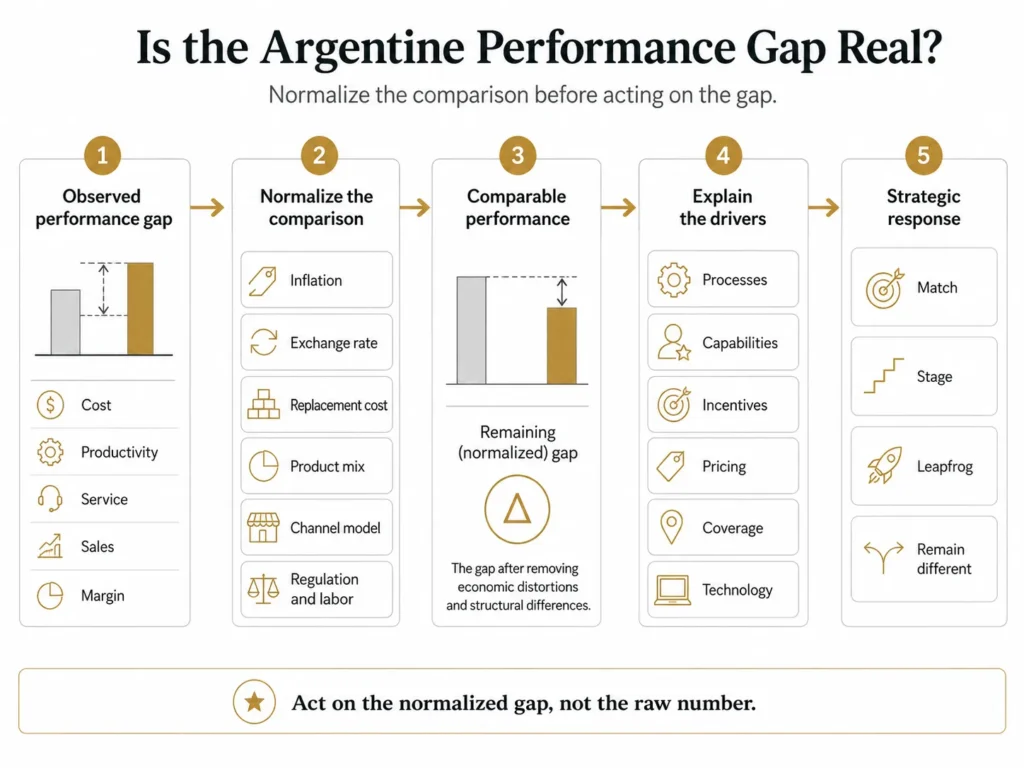
Figure 1. Benchmarking in Argentina becomes useful only after nominal and structural effects are separated from the performance gap management can address.
The Strategic Benchmarking Question in Argentina Is Not “Who Has the Best Number?”
The strongest-looking metric may not represent the strongest business model.
Your leadership team needs to understand:
- Whether revenue growth reflects volume, price, product mix, or inflation.
- Whether margins are based on current replacement costs or older inventory.
- Whether costs are measured consistently across companies or business units.
- How currency exposure, imports, financing, and payment terms affect performance.
- Whether direct, distributor, reseller, or hybrid channels allocate costs differently.
- How customer density, geography, and account concentration affect productivity.
- Whether labor, regulation, taxes, approvals, or informality create structural differences.
- Which processes and capabilities explain the remaining gap.
- Whether the benchmarked practice fits your strategy and organization.
- What performance target remains realistic under more than one economic scenario.
The objective is to move from a nominal comparison to a decision about what your company should actually improve.
Why Raw Benchmarking Comparisons Are Especially Dangerous in Argentina
Inflation can make weak performance look strong
Revenue, average ticket, inventory value, costs, and margins may rise sharply even when unit volume, customer penetration, productivity, or real profitability deteriorate.
A defensible benchmark separates price, volume, mix, customer, and timing effects wherever the evidence allows.
Currency can change both the numerator and the denominator
A cost or productivity metric may look different depending on whether it is measured in pesos, dollars, constant currency, official accounting terms, or replacement economics. The comparison should use the measure that best reflects the decision.
Inventory timing can distort margins
A company selling stock acquired under earlier currency or supplier conditions may temporarily report better margins than a company replenishing at current cost.
Forward-looking benchmarking should test replacement cost, not merely historical cost.
Payment terms and financing are part of the operating model
A competitor may appear to price lower while recovering value through financing, advance payment, shorter terms, limited service, or lower inventory commitments. Another may sustain a premium by financing customers or absorbing working-capital risk.
Different channels hide different cost structures
A direct model carries visible sales, inventory, credit, and service costs. A distributor-led model may transfer those costs while reducing control, margin, customer knowledge, or strategic flexibility.
Regulatory and administrative conditions change execution
Imports, registrations, procurement rules, labor requirements, compliance, and administrative timing can influence staffing, inventory, service, and productivity.
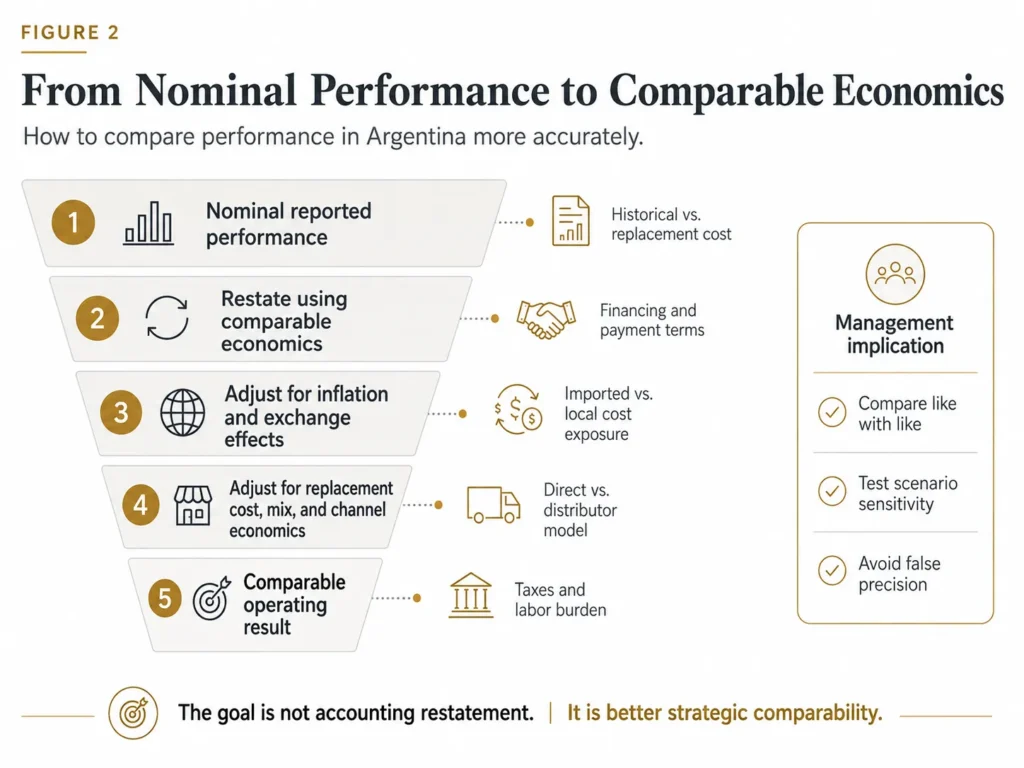
Figure 2. Argentina benchmarking should convert reported results into comparable volume, cost, margin, and productivity measures before management acts.
What Should Be Normalized in Benchmarking Before You Draw a Conclusion in Argentina?
Time period
Monthly, quarterly, and annual comparisons can tell very different stories when prices, purchasing, and inventory behavior change rapidly. The selected period should match the decision and avoid mixing structurally different conditions.
Currency and price basis
Metrics may need to be analyzed in current pesos, constant pesos, foreign currency, physical volume, or replacement-cost terms. No single basis is correct for every decision.
Product and customer mix
A company serving premium products, institutional accounts, industrial customers, consumers, or low-service segments will naturally show different margin, productivity, and service metrics.
Channel model
Direct, distributor, dealer, importer, representative, retail, marketplace, and hybrid models should not be compared without allocating the responsibilities and economics each model carries.
Geography and customer density
Coverage in the Buenos Aires metropolitan area differs from supporting dispersed provincial accounts. Travel, logistics, service time, account size, and local partner capabilities affect the benchmark.
Service and value proposition
A lower-cost model may provide less training, technical support, inventory, warranty, availability, customization, or response speed. Cost should be compared with the customer value and risk the model creates.
Labor and organizational model
Headcount alone is rarely meaningful. Roles, spans, outsourcing, incentives, decision rights, seniority, productivity, and administrative burden should be considered together.
Which Argentine Benchmark Should You Use?
The most visible competitor is not always the most useful reference.
A local competitor
Useful for understanding local speed, pricing, relationships, sourcing, channels, and adaptation. Less useful when scale, technology, quality, or strategic scope differ materially.
A multinational competitor
Useful for comparing brand, systems, processes, regional coordination, talent, compliance, and customer coverage. Its global structure may create both advantages and constraints that do not apply to you.
Your strongest internal country or business unit
Useful when the organization already has a proven practice that may be transferable to Argentina after adaptation.
A company from an adjacent industry
Useful when the decision concerns a capability such as distributor management, digital service, pricing, customer experience, field productivity, onboarding, or innovation.
A future-state operating model
Useful when the current market leader is not the right aspiration and your strategy requires a new capability, technology, or route to market.
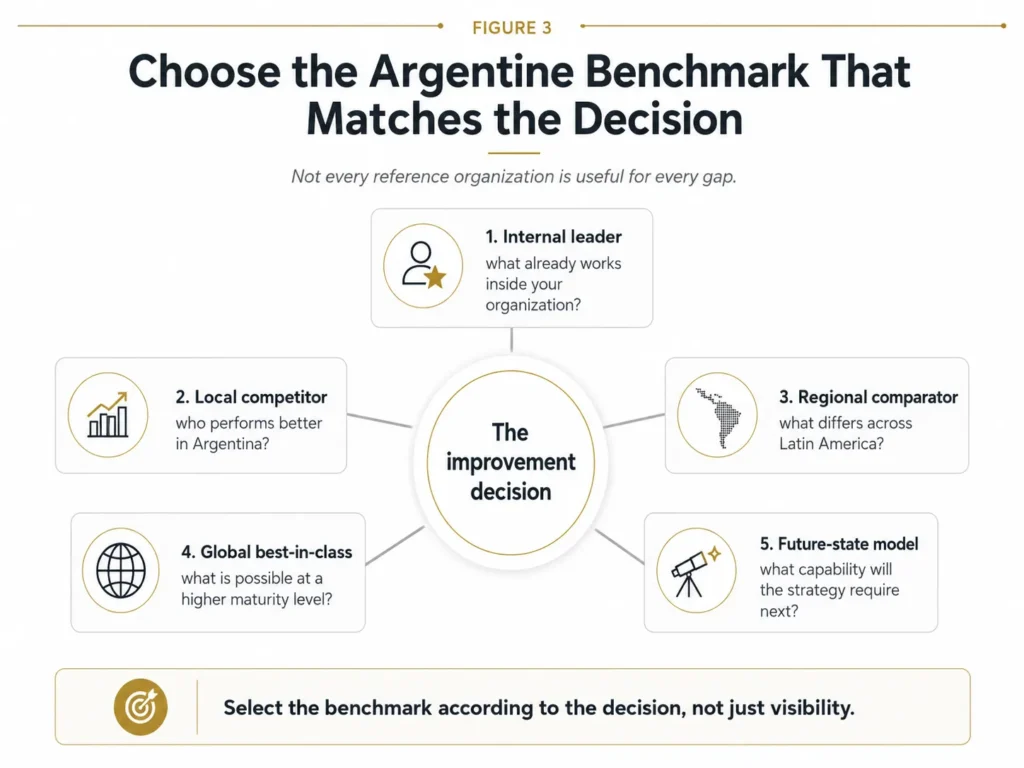
Figure 3. The right reference set depends on the capability and decision you are trying to improve, not on competitor visibility alone.
From Best Practice to an Adaptable Benchmarking Argentine Model
A visible practice rarely explains performance by itself.
A competitor may update prices faster because decision rights are decentralized, data are available daily, commercial teams have greater autonomy, and incentives reward margin rather than volume.
A salesforce may appear more productive because strategic accounts are concentrated, distributors handle smaller customers, representatives spend less time on administration, and service teams absorb technical tasks.
A local producer may show lower delivered cost because it accepts a narrower portfolio, operates at higher utilization, sources selected inputs locally, or carries different quality and service commitments.
Before adopting a practice, ask:
- What problem does the practice solve?
- Which conditions make it successful?
- What capabilities and incentives support it?
- What customer trade-offs does it create?
- Would it remain attractive under different inflation, currency, or import conditions?
- What must be adapted for your strategy, culture, channels, and portfolio?
- Which implementation risks could erase the expected benefit?
The goal is to transfer the principle that creates value, not mechanically copy the visible practice.
Which Benchmarking Gaps Usually Deserve Strategic Attention in Argentina?
Pricing and revenue management
Compare price-update speed, governance, segmentation, discount controls, payment terms, indexation, value communication, and margin protection.
Salesforce and account coverage
Compare roles, territory design, account priorities, field time, productivity, incentives, channel interaction, and administrative burden.
Distributor and channel management
Compare coverage, inventory, credit, service, customer ownership, economics, conflicts, support, and performance management.
Supply, inventory, and availability
Compare sourcing, replenishment, safety stock, working capital, service levels, product rationalization, and response to import or currency disruption.
Cost-to-serve and service model
Compare which customers receive which level of service, how costs are allocated, what activities create value, and where complexity can be reduced.
Organization and decision speed
Compare structures, spans, roles, regional approvals, local autonomy, incentives, information flows, and the time required to act.
Decide Whether to Match, Leapfrog, Stage, or Remain Different a Benchmark in Argentina
Match and implement
Close the gap when it is strategically important, normalized, transferable, and feasible with your current or near-term capabilities.
Stage and build capability
Sequence the change when the gap matters but requires systems, talent, investment, channel redesign, or organizational readiness.
Leapfrog
Use a different technology, route to market, pricing model, service architecture, or operating system when catching up would only reproduce the benchmark’s current limitations.
Adopt selectively
Transfer the elements that create value while preserving the parts of your model that better serve customers or protect economics.
Remain different or stop
Do not close a gap that is structurally irrelevant, weakly connected to customer value, or inconsistent with your strategy.
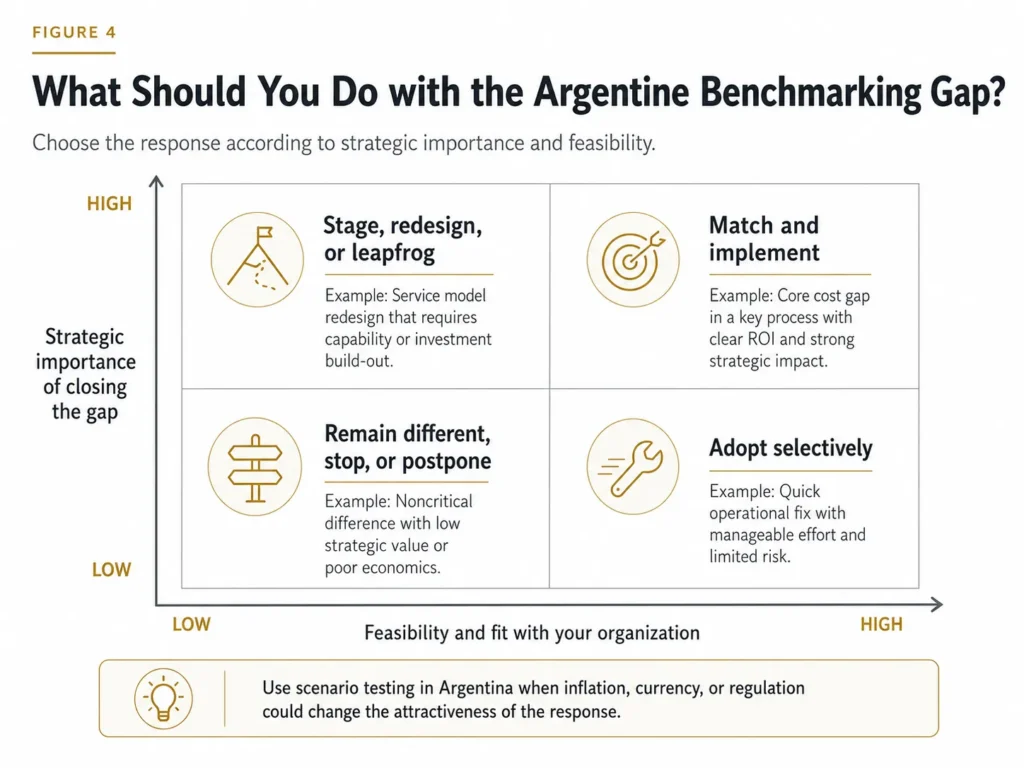
Figure 4. Argentina benchmarking should prioritize gaps according to strategic value, feasibility, economic resilience, and fit with your organization.
How Midas Structures Benchmarking in Argentina
1. Define the improvement decision
We clarify what your leadership team needs to improve, which gap triggered the project, which decisions will use the findings, and how success will be measured.
2. Build a comparable internal baseline
We align definitions, periods, currencies, volume measures, product and customer mix, channels, roles, costs, service levels, and operating assumptions.
3. Select the right benchmark set
We identify the internal units, competitors, adjacent companies, or future-state models that can answer the decision.
4. Reconstruct performance and practices
We combine public sources, interviews, customer and channel evidence, supplier perspectives, company signals, and relevant internal information.
5. Normalize and explain the gap
We separate inflation, currency, replacement cost, scale, mix, channel, labor, regulation, geography, and accounting effects from addressable execution differences.
6. Prioritize and mobilize improvement
We translate findings into targets, strategic choices, quick wins, capability requirements, investments, owners, milestones, and monitoring indicators.
For the complete benchmarking methodology, visit Benchmarking: How to Compare, Learn, and Improve Your Competitive Position.
Case Example: Benchmarking Salesforce Strategy in Argentina
The executive challenge
A multinational diabetes-monitoring company wanted to compare its Argentine salesforce with leading competitors as part of a broader initiative covering Argentina, Brazil, Mexico, and Peru.
A simple headcount or compensation comparison would have been misleading. Account concentration, customer types, channels, inflation, compensation practices, field coverage, and local execution differed materially.
How we approached the benchmarking decision in Argentina
We established common definitions across the four markets and conducted local research involving competitor sales teams, HR professionals, distributors, pharmacy chains, and other knowledgeable sources.
For Argentina, the analysis considered:
- Sales roles and responsibilities.
- Territory and account coverage.
- Compensation and incentive practices.
- Customer and channel structure.
- Productivity and field deployment.
- The effect of local market and economic conditions.
How the benchmarking findings in Argentina changed the strategy
The company adapted its salesforce structure and compensation approach to the Argentine market while preserving a clearer regional logic for roles, priorities, and expected behaviors.
The broader initiative contributed to a 30% sales increase within one year.
For the full multi-country case, visit Benchmarking in Latin America.
“We are extremely pleased with the benchmarking. It helped us reassess our priorities and redirect our resources.”
— Market Segment Leader
“Just to reiterate, this is fantastic. I’m really excited to see such valuable insights and information! Thank you again!”
— Vice President
When You Need Benchmarking in Argentina
- Your Argentine business appears less profitable or productive than another country or competitor.
- Nominal growth makes it difficult to understand real performance.
- You need to compare pricing, margins, costs, or working capital under changing conditions.
- You want to benchmark salesforce structure, coverage, compensation, or productivity.
- You need to evaluate distributor, importer, dealer, or hybrid channel performance.
- Supply, inventory, imports, or replacement costs are affecting competitiveness.
- Your organization needs faster decisions and more local autonomy.
- You want to transfer an internal best practice into Argentina.
- You need realistic targets for a transformation or investment.
- You want to understand whether remaining different is strategically stronger than copying the benchmark.
When the comparison covers several countries, see our Latin America benchmarking hub.
For the full commercial offer, visit our benchmarking consulting service page.
Why Midas for Benchmarking in Argentina?
We normalize inflation, currency, and replacement economics
We do not treat nominal revenue, cost, or margin differences as self-explanatory.
We compare operating models, not isolated KPIs
We connect results with channels, customer mix, service, inventory, financing, roles, incentives, and decision rights.
We explain why stronger performance occurs
The objective is to identify the process, capability, technology, incentive, or choice behind the number.
We help you adapt rather than copy
We identify transferable principles and the conditions your organization must build before adoption.
We test whether the improvement is resilient
We consider whether the benchmarked model remains attractive under plausible changes in inflation, currency, regulation, imports, demand, and financing.
We involve your team before final recommendations
Preliminary findings allow your executives and specialists to challenge assumptions, add context, and shape the implementation priorities.
We bring direct benchmarking in Argentina experience
We have benchmarked commercial, operational, organizational, channel, pricing, and innovation practices across Argentine and regional B2B, B2C, industrial, technology, consumer, pharmaceutical, and healthcare markets.
Ethical, Comparable, and Reliable Benchmarking Intelligence in Argentina
We comply with SCIP’s Code of Ethics, the profession’s gold standard. We comply with applicable laws, accurately disclose relevant identity and organizational information before interviews, avoid conflicts of interest, provide honest recommendations, and promote ethical conduct throughout the engagement.
We do not seek trade secrets, request confidential documents, misrepresent who we are, induce contractual breaches, or encourage sources to violate legal or contractual obligations.
We also protect analytical integrity by aligning definitions and periods, normalizing material structural differences, triangulating findings, distinguishing facts from estimates, and making limitations and confidence levels visible.
Review SCIP’s ethical intelligence guidance and Code of Ethics.
Frequently Asked Questions About Benchmarking in Argentina
How do you benchmark performance in a high-inflation environment?
We separate nominal changes from volume, mix, price, productivity, and sustainable margin. The appropriate basis may include constant currency, physical units, replacement cost, or another decision-relevant measure.
Can you compare benchmarking in Argentina with other Latin American countries?
Yes. We establish common definitions and normalize material differences in inflation, currency, taxes, wages, channels, regulation, geography, customer mix, and business model.
Can you benchmark private competitors in Argentina?
Yes. We combine lawful public sources with interviews, customer and channel evidence, supplier perspectives, field research, company signals, and economic logic.
Can you benchmark pricing and margin management in your benchmarking in Argentina?
Yes. We can compare update frequency, governance, segmentation, discounts, terms, financing, value communication, replacement cost, and margin-protection practices.
Can you benchmark salesforce structure and compensation?
Yes. We can compare roles, headcount, account coverage, field deployment, incentives, productivity, channels, and administrative burden.
Can you benchmark distributors and importers in your benchmarking in Argentina?
Yes. We can compare customer access, inventory, credit, service, geographic coverage, economics, competing brands, commitment, and performance management.
How do you determine whether a gap is structural with your benchmarking in Argentina?
We test whether scale, mix, geography, channels, regulation, labor, accounting definitions, service model, or economic conditions explain the difference before attributing it to execution.
How do you avoid copying competitors in your benchmarking in Argentina?
We identify why the practice works, what capabilities support it, what trade-offs it creates, and how the underlying principle should be adapted to your strategy.
Can benchmarking support an investment or transformation?
Yes. It can establish a defensible baseline, identify realistic targets, reveal capability gaps, and clarify which improvements require systems, talent, capital, or a different operating model.
How long does a benchmarking in Argentina engagement take?
The timing depends on the functions, comparators, interviews, data availability, and strategic questions involved. We scope the project around your decision and can share preliminary findings in phases.
About the Author
Adrian Alvarez, PhD is Managing Partner at Midas Consulting, Wharton Alumnus, MBA Professor at Universidad Argentina de la Empresa (UADE), and Competitive Intelligence Fellow. He specializes in benchmarking, competitive strategy, competitor analysis, strategic intelligence, and executive decision-making under uncertainty in Argentina and Latin America.
He has led benchmarking initiatives across B2B, B2C, industrial, technology, consumer, pharmaceutical, healthcare, and regulated markets. He also served as a Board Member of SCIP during the 2009–2011 period.
His work has been published in the United States, Spain, and Germany. You can access his library of strategic insights and published research here
View professional profile on LinkedIn
Selected Argentine Sources and Benchmarking Reference Standards
- INDEC for official price, labor, trade, production, demographic, and sector information.
- Banco Central de la República Argentina for monetary, credit, exchange, and financial context.
- Argentina’s economic authorities for relevant policy, trade, and productive information.
- APQC process frameworks and external benchmark resources where relevant.
- ASQ benchmarking resources.
- Company disclosures, industry associations, customer and channel evidence, internal data, specialized sources, and primary interviews.
No single source should determine a major conclusion. The value comes from consistent definitions, normalization, triangulation, explanation, and management judgment.
Turn the Normalized Gap into a Practical Improvement Decision
You may be trying to understand why a competitor prices faster, why another country shows better productivity, whether your Argentine cost base is truly uncompetitive, or which internal practice should be transferred.
You do not need another table of nominal metrics. You need to know which gaps remain after economic and operating differences are removed, what explains them, which practices fit your strategy, and what your organization should change first.
In an initial conversation, we will discuss the performance question, function, comparators, internal data, Argentine conditions, and strategic decision the benchmark must support.
We can then propose a focused Argentina benchmarking engagement with a clear comparison architecture, normalization approach, research plan, collaboration model, timing, and deliverables.