

At Midas, brand consulting goes beyond polishing slogans. We help you uncover what truly sets your brand apart, so you can build the preference and loyalty that fuel real growth.
Your brand is not only what customers recognize. It is the set of expectations, beliefs, memories, and experiences that influence whether they consider you, trust you, choose you, pay more for you, stay with you, and recommend you.
That makes branding a strategic management issue, not simply a communication exercise.
The American Marketing Association defines a brand as a distinguishing feature that identifies one seller’s offering from another, while also recognizing the brand as an intangible asset capable of generating economic value.
A company can have high awareness and weak preference. It can invest heavily in campaigns while becoming less differentiated. It can have a compelling corporate message that sales teams, distributors, service partners, and customer experiences fail to deliver. It can lead in one country, segment, or generation and quietly lose relevance in another.
When that happens, the answer is rarely a new slogan alone.
You need to understand what customers truly value, how competitors define the category, which associations your brand actually owns, where the promise loses credibility, and what commercial choices leadership should make.
At Midas Consulting, we connect brand research with strategy. We combine customer insight, competitive benchmarking, market analysis, perceived-value diagnosis, and strategic foresight to help you choose a more relevant and defensible market position.
Then we translate that position into the commercial system: portfolio, innovation, pricing, channels, sales enablement, communication, service, and customer experience.
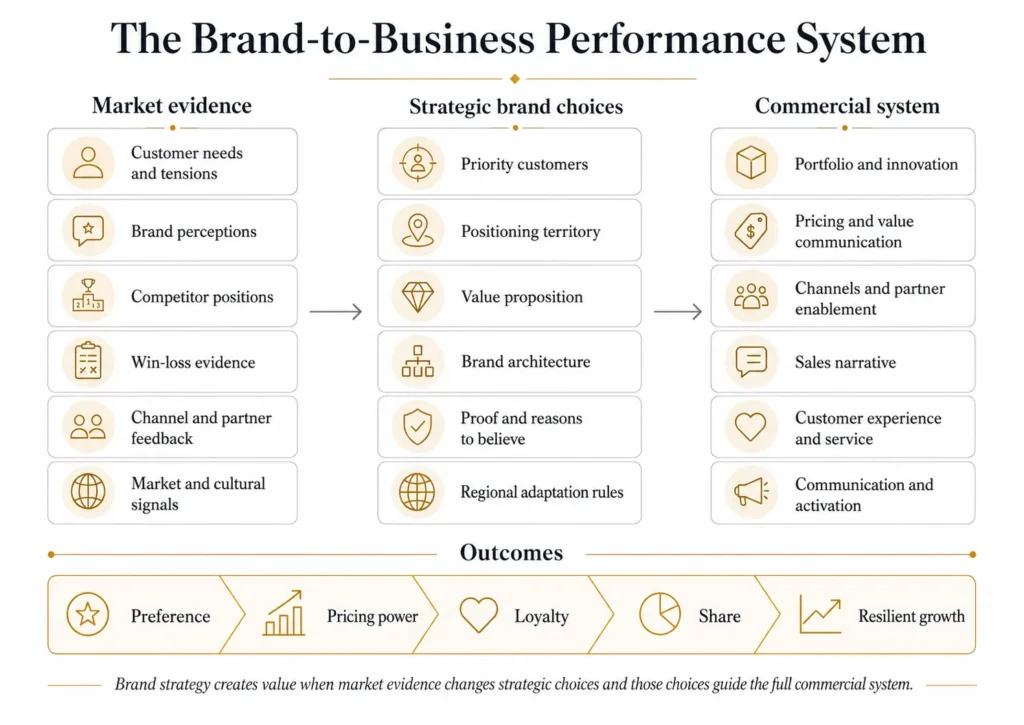
Figure 1. Brand strategy creates business value when customer and competitive evidence informs clear strategic choices, and those choices guide portfolio, pricing, sales, channels, communication, service, and customer experience.
Your Brand May Be Visible Without Being Strategically Strong
Brand weakness does not always appear as low awareness.
It may appear when:
- Customers know you but cannot explain why you are different.
- Your brand is considered but rarely preferred.
- Sales depend increasingly on price, promotions, or personal relationships.
- Competitors copy your visible advantages quickly.
- Your premium is harder to defend.
- You perform differently by country, region, segment, or channel without a clear explanation.
- Your message is consistent but not compelling.
- Customers value attributes your organization barely communicates.
- Your customer experience contradicts the promise.
- Brand metrics generate reports but not decisions.
These are not merely marketing problems. They affect growth, margins, customer acquisition, retention, innovation, distribution, and strategic flexibility.
The Executive Question Is Not “What Should Our Campaign Say?”
The stronger question is:
Which customer value can your organization credibly own, why should customers prefer it over the alternatives, and how should that choice shape the business?
That question forces leadership to make choices about:
- Who the priority customers are.
- Which needs, tensions, or aspirations matter most.
- Which competitors define the frame of reference.
- Where genuine competitive whitespace exists.
- Which advantage is relevant, credible, profitable, and hard to imitate.
- Which parts of the portfolio support or dilute the position.
- What proof customers need.
- How pricing should reflect the intended value.
- How sales, channels, service, and experience should behave.
- What should remain consistent across markets and what should adapt.
Brand Strategy Should Answer Five Board-Level Consulting Decisions
1. Where should the brand compete?
Which markets, customer groups, use cases, occasions, applications, and channels offer the most attractive opportunity?
2. What should the brand stand for?
Which functional, emotional, economic, or strategic value should the brand seek to own?
3. Why should customers believe it?
Which product, service, reputation, evidence, capability, experience, or relationship makes the promise credible?
4. How should the organization deliver it?
What must change across portfolio, innovation, pricing, sales, channels, service, customer experience, and communication?
5. How will the brand remain relevant?
Which customer, competitor, technological, cultural, and market signals should leadership monitor—and how should the strategy respond?
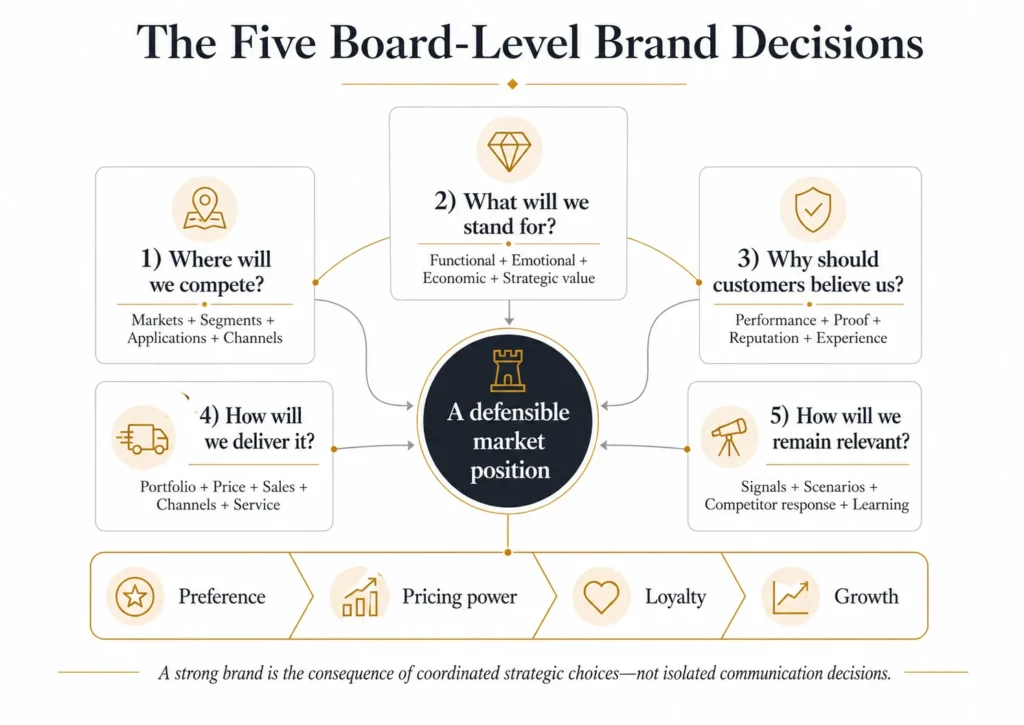
Figure 2. A strong brand results from five coordinated leadership choices: where to compete, what to stand for, why customers should believe the promise, how the organization will deliver it, and how the position will remain relevant.
What Midas Brand Consulting Can Help You Decide
Brand diagnosis and strategic repositioning
We determine how the brand is currently perceived, where it is strong, where it is vulnerable, and whether the existing position remains relevant.
Customer preference and decision drivers
We identify the functional, emotional, economic, professional, social, and risk-related factors that influence consideration, choice, loyalty, and recommendation.
Competitive brand positioning
We compare the territories, claims, proof, experiences, emotional spaces, and reputational assets competitors appear to own.
Value proposition development
We clarify which customer value the brand should promise, how that value differs from alternatives, and what evidence makes it credible.
Brand architecture and portfolio roles
We define how the corporate brand, master brand, product brands, service brands, and sub-brands should work together.
Regional and local adaptation
We specify what should remain strategically consistent and what should adapt by country, region, segment, channel, or application.
Brand and pricing strategy
We assess whether the brand creates enough relevance, differentiation, trust, and perceived value to support the intended price and reduce unnecessary discount dependence.
Brand experience and service alignment
We identify where onboarding, delivery, support, service, sales behavior, distributors, or digital touchpoints reinforce or undermine the promise.
Brand foresight and competitive response
We explore how customer expectations, technology, channels, regulation, social values, and competitor moves could change the future basis of preference.
Our IDB360 Approach: A Complete View of Brand Strength
Midas’s IDB360 approach examines the brand from multiple perspectives instead of relying on one metric.
Depending on the decision, the diagnosis may include:
- Top-of-mind awareness.
- Aided and unaided awareness.
- Brand health.
- Associations and image.
- Relevance.
- Differentiation.
- Credibility.
- Emotional resonance.
- Consideration and preference.
- Net Promoter Score.
- Net Value Score.
- Perceived price and value.
- Loyalty and advocacy.
- Customer-experience consistency.
- Competitive benchmarking.
- Regional, segment, and channel differences.
The value of IDB360 is not the number of indicators. It is the ability to connect them and identify which few changes will create the greatest strategic and commercial impact.
Our approach is consistent with the broader principle that brand evaluation should combine multiple inputs, outcomes, and indicators rather than rely on one isolated metric, as reflected in ISO 20671 on brand evaluation.
Research Should Reduce a Decision, not Expand a Report
Brand studies often fail because they answer too many descriptive questions and too few strategic ones.
Before designing the research, we clarify the decision leadership needs to make.
For example:
- Should we reposition?
- Which customer segment should we prioritize?
- Can we defend a premium?
- Why are younger customers drifting?
- Why does the brand underperform outside the capital?
- Which competitor is changing the category?
- Should we simplify the portfolio?
- How much local adaptation is necessary?
- Which service problem is weakening trust?
- What position could remain defensible over time?
The methodology follows the decision, not the other way around.
This emphasis on evidence rather than marketing convention is also consistent with the work of the Ehrenberg-Bass Institute for Marketing Science, which studies brand growth using observed buying behavior and empirical marketing research.
How We Build the Evidence Base
Depending on the strategic question, we may combine:
- Executive and internal stakeholder interviews.
- Customer and former-customer interviews.
- Qualitative focus groups.
- Quantitative market research.
- Brand tracking and existing-data analysis.
- Competitive benchmarking.
- Win-loss analysis.
- Distributor and channel research.
- Expert interviews.
- Social, digital, and review analysis.
- Customer-journey and experience research.
- Market and category analysis.
- Scenario planning and competitor-response analysis.
We triangulate sources because stated preferences, observed behavior, internal beliefs, and market outcomes do not always tell the same story.
From Research to Strategic Choice
Evidence alone does not produce a strategy. Leadership still needs to choose.
We help you compare potential brand territories using criteria such as:
- Customer relevance.
- Competitive whitespace.
- Credibility.
- Proof availability.
- Economic attractiveness.
- Pricing potential.
- Portfolio fit.
- Organizational capability.
- Local adaptability.
- Future resilience.
The goal is not to select the most attractive phrase. It is to choose the strongest market position your organization can credibly deliver and defend.
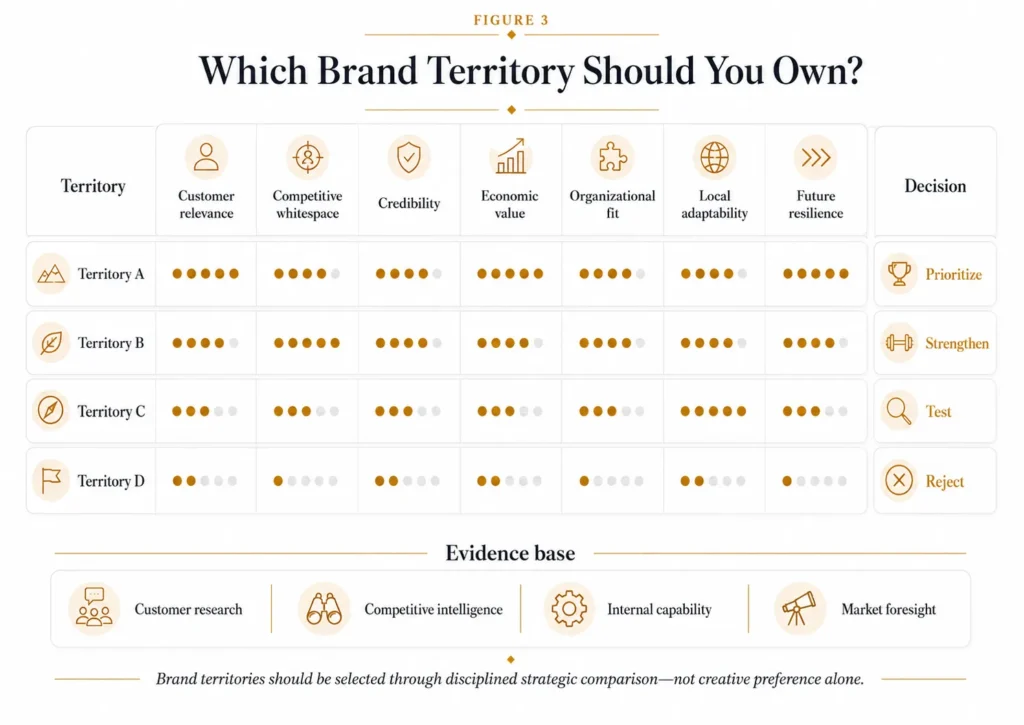
Figure 3. Potential brand territories should be compared against customer relevance, competitive whitespace, credibility, economics, organizational fit, adaptability, and future resilience before leadership commits.
From Positioning to Commercial Execution
A positioning creates value only when the organization behaves differently because of it.
The selected position should guide:
Portfolio
Which products, services, variants, bundles, and sub-brands strengthen the position, and which create confusion?
Innovation
Which unmet needs, proof points, service improvements, or experiences should innovation address?
Pricing
What value supports the price, how should it be communicated, and where are discounts weakening the brand?
Sales
Which customer tension, proof, objections, and competitive contrasts should shape the sales narrative?
Channels and partners
Which partners can deliver the intended experience, and what training, content, service standards, and incentives do they need?
Customer experience
Which moments of truth must demonstrate the promise?
Communication
How should the message make the strategic choice clear, memorable, credible, and locally relevant?
The Brand Must Be Designed for a Market That Responds
Competitors do not remain passive when your brand changes position.
They may:
- Imitate the message.
- Increase promotions.
- Attack your proof.
- Reposition around another benefit.
- Strengthen channels or service.
- Target your most attractive segments.
- Use their reputation to raise switching risk.
- Accelerate innovation.
We therefore stress-test major brand choices against likely competitor responses and changing customer expectations.
This turns brand strategy from a static statement into a more resilient competitive system.
How Midas Consulting Delivers a Strategic Brand Engagement
1. Define the executive decision
We agree on the business issue, strategic choice, scope, markets, stakeholders, hypotheses, and required outcomes.
2. Build the fact base
We integrate existing research, brand metrics, commercial data, customer evidence, competitor intelligence, and internal perspectives.
3. Generate customer and market evidence
We use the qualitative and quantitative methods best suited to the decision.
4. Diagnose the current position
We identify strengths, weaknesses, inconsistencies, perception gaps, competitive threats, and growth opportunities.
5. Develop and compare strategic options
We evaluate potential territories, propositions, architecture choices, and adaptation models.
6. Stress-test the strategy
We assess credibility, organizational fit, economics, local relevance, competitor response, and future resilience.
7. Choose the brand strategy
We define the priority customers, position, value proposition, proof, architecture, and adaptation rules.
8. Translate the choice into the commercial system
We connect the strategy with portfolio, innovation, pricing, sales, channels, service, experience, and communication.
9. Mobilize execution
We define priorities, owners, governance, capabilities, and the implementation roadmap.
10. Measure and adapt
We define leading and lagging indicators and establish a learning cycle.
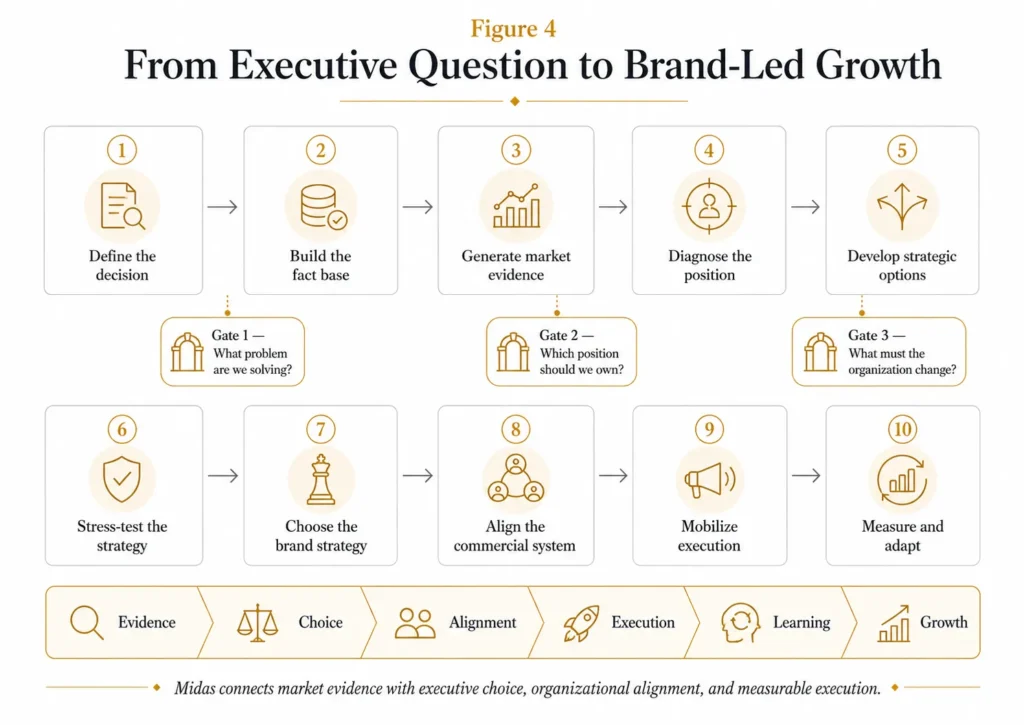
Figure 4. Midas’s ten-stage brand consulting process connects the executive question with market evidence, strategic choice, commercial alignment, implementation, measurement, and continuous learning.
What Your Leadership Team Should Receive from a Brand Consulting Project
Depending on scope, your engagement may include:
- An executive diagnosis of the current brand position.
- Customer, segment, country, regional, and channel comparisons.
- Brand-health and preference findings.
- Functional, emotional, economic, and risk-related decision drivers.
- Competitive brand and positioning maps.
- Perceived-value and pricing implications.
- Customer-experience and service findings.
- Brand-territory options and evaluation.
- A chosen positioning and value proposition.
- Reasons to believe and proof architecture.
- Brand architecture and portfolio recommendations.
- Regional and local adaptation rules.
- Sales, channel, service, and communication implications.
- Competitor-response and future-scenario implications.
- A prioritized roadmap with owners and indicators.
- An executive alignment workshop.
The deliverable should help leadership choose and act, not simply describe perceptions.
Brand Consulting for B2C, B2B, and Institutional Markets
B2C and consumer brands
We help consumer brands understand relevance, emotional connection, value, preference, loyalty, regional differences, channel behavior, and changing expectations.
B2B and industrial brands
We examine shortlisting, trust, technical credibility, risk, service, channel influence, total economics, relationships, and willingness to pay.
Healthcare and pharmaceutical brands
We analyze the different needs and proof requirements of patients, physicians, institutions, payers, distributors, and other stakeholders.
Technology, software, and service brands
We clarify differentiation in categories where features change quickly and customers often evaluate implementation, support, trust, scalability, and future viability.
Corporate and institutional brands
We help organizations align reputation, stakeholder expectations, purpose, service delivery, employer value, and corporate strategy.
Industries We Support with Our Brand Consulting Services
Our work spans consumer, B2B, industrial, technology, service, and regulated markets, including:
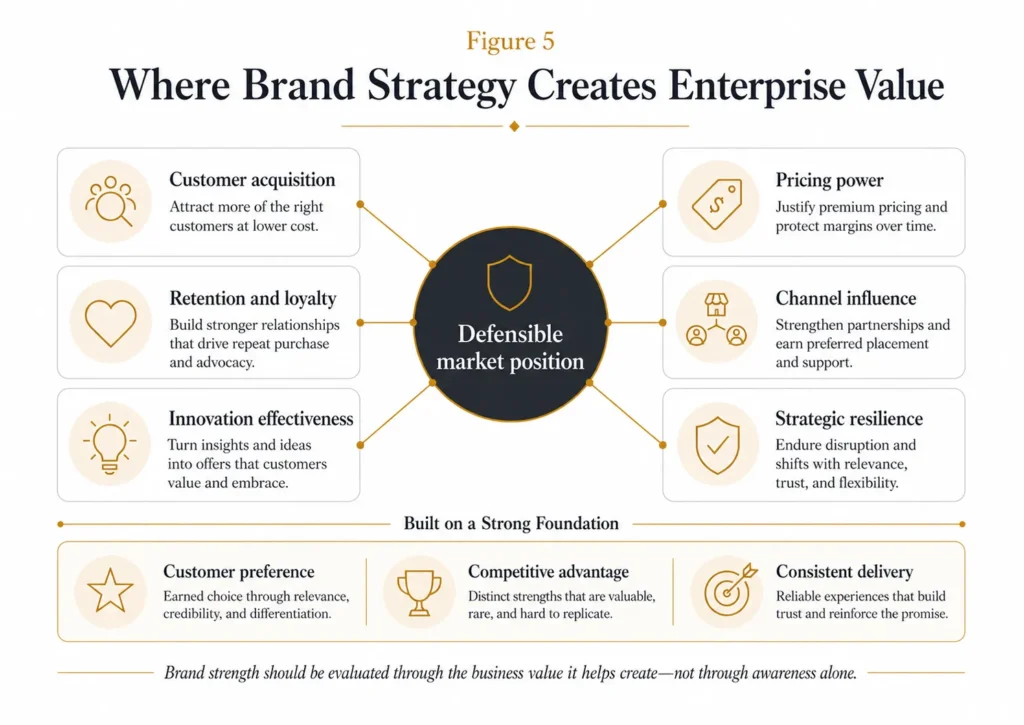
Figure 5. Brand strategy can create enterprise value through stronger acquisition, pricing power, retention, channel influence, innovation effectiveness, and strategic resilience.
When monetary valuation is required, ISO 10668 provides a recognized framework for measuring and reporting the financial value of a brand.
Brand Consulting Across Latin America
Brand meaning, customer expectations, competitors, channels, and service realities vary across Latin America. A strong regional strategy therefore needs a clear strategic core and disciplined local adaptation.
Explore our country and regional perspectives:
- Brand Consulting in Latin America.
- Brand Consulting in Argentina.
- Brand Consulting in Brazil.
- Brand Consulting in Chile.
- Brand Consulting in Colombia.
- Brand Consulting in Mexico.
- Brand Consulting in Peru.
Brand Consulting Works Best with the Right Strategic Connections
Brand decisions often depend on evidence and choices that extend beyond the branding function.
Related Midas services include:
- Value Proposition Consulting to clarify why customers should choose you.
- Competitor Analysis to understand rival positions, capabilities, and likely responses.
- Benchmarking Consulting to compare brand and commercial performance with relevant alternatives.
- Win-Loss Analysis to learn why customers choose you—or do not.
- Market Analysis to clarify demand, segments, channels, and growth pools.
- Strategic Foresight and Competitive Response to stress-test the position against future market and competitor moves.
Why Midas for brand consulting?
We treat branding as a strategic discipline
We connect customer perception with market position, business economics, operating capabilities, and commercial execution.
We combine qualitative and quantitative evidence
We use interviews, focus groups, surveys, benchmarking, competitive intelligence, and commercial data to build a complete fact base.
We challenge internal assumptions
We compare what management believes with what customers, channels, partners, competitors, and market outcomes reveal.
We understand regional complexity
We help companies define what should remain consistent across markets and what should adapt locally.
We connect brand strategy with competitor response
We assess whether a potential position can remain attractive after competitors imitate, attack, discount, or reposition.
We focus on implementation
We translate the brand choice into portfolio, pricing, innovation, sales, channels, service, customer experience, communication, governance, and measurement.
We bring extensive brand consulting experience
Midas has conducted more than 200 brand studies across Latin America and supports companies in consumer, industrial, technology, service, and regulated markets.
Meet the Leader of Our Branding Practice
Víctor Sales Navas, COO, leads Midas Consulting’s Branding Practice and brings more than 34 years of experience across Latin America.
A graduate in Accounting from the Universidad de Buenos Aires, Víctor built his career at leading advertising agencies including Young & Rubicam, ADD, and Gowland. He developed deep expertise in brand strategy, market research, benchmarking, competitive intelligence, and mergers and acquisitions.
He also heads Midas’s Services Practice, advising clients in logistics, ports, consumer goods, and industrial products. Víctor has directed projects throughout the region and successfully led multiple start-ups in Latin America.
He speaks English, Portuguese, and Spanish and is recognized for translating market insight into actionable brand and business strategy.
Last reviewed: August 2026
Frequently Asked Questions About Brand Consulting
What is strategic brand consulting?
Strategic brand consulting helps leadership understand how customers and stakeholders perceive the brand, choose a differentiated and credible market position, and translate that choice into commercial action.
How is this different from an advertising or design project?
Advertising and design express the brand. Strategic brand consulting determines what the brand should stand for, who it should prioritize, why customers should believe it, and how the organization must deliver it.
Can a well-known brand still need consulting?
Yes. High awareness can coexist with weak relevance, limited differentiation, low preference, declining loyalty, or poor pricing power.
Can brand consulting support pricing?
Yes. Research can show whether the brand creates enough relevance, differentiation, credibility, and perceived value to support the intended price or reduce promotional dependence.
Can brand consulting help B2B and industrial companies?
Yes. In B2B markets, brand perception influences shortlisting, risk, technical credibility, service confidence, distributor support, renewal, and willingness to pay.
Can you work with brand consulting across several countries?
Yes. We can build a regional fact base, identify shared and local preference drivers, define the strategic core, and establish country-level adaptation rules.
Can you evaluate our brand architecture with your brand consulting?
Yes. We can assess the roles and relationships of the corporate, master, product, service, and sub-brands and recommend a clearer architecture.
Can you help us reposition with your brand consulting?
Yes. We diagnose the current position, identify and compare potential territories, stress-test the options, and translate the selected position into execution.
Can you evaluate customer experience and service in your brand consulting?
Yes. We can identify where onboarding, sales, delivery, support, service, channels, and digital touchpoints reinforce or weaken the brand promise.
Do you conduct qualitative and quantitative research in your brand consulting?
Yes. The research design depends on the executive decision and may combine interviews, focus groups, surveys, digital evidence, benchmarking, and commercial data.
How do you account for competitors in your brand consulting?
We compare current competitor positions and proof, identify likely moves, and stress-test whether the proposed strategy can remain defensible after competitors respond.
What does a typical brand consulting deliverable include?
It may include the diagnosis, customer and competitor evidence, strategic options, positioning, value proposition, proof, architecture, adaptation rules, commercial implications, roadmap, owners, indicators, and executive workshop.
How do we get started with your brand consulting?
We begin with the executive decision, existing evidence, priority markets and segments, competitive context, and the commercial outcomes you need the work to support.
Build a Brand That Changes Customer Choice, and Business Performance
You may be trying to understand why awareness is not becoming preference, why competitors appear more distinctive, why customers resist your premium, why the brand performs differently across markets, or whether your positioning is still relevant.
You do not need more disconnected metrics or another creative exercise without a strategic foundation.
You need a clear view of what customers value, which position your brand can credibly own, what the organization must change, and how leadership will know the strategy is working.
In an initial conversation, we will discuss your markets, customers, portfolio, current research, competitors, commercial priorities, and the executive decisions the engagement must support.
We can then propose a focused brand diagnosis, repositioning project, portfolio or architecture review, regional study, customer-preference program, or continuous brand-intelligence system tailored to your needs.