
Achieve Market Success with Our Competitor Analysis in Peru
In Peru, a competitor’s visible market performance may tell you more about access than about customer preference.
A supplier may appear strong because its distributor controls inventory, credit, transportation, technical support, and key relationships. Another may dominate Lima but have limited provincial coverage. A smaller importer may be influential in one industrial segment or account despite having little national visibility.
That creates a critical executive question: Is the competitor winning because customers genuinely prefer its offer, or because it is the supplier they can access, finance, approve, or obtain reliably?
At Midas Consulting, we help you separate those effects. We combine structured research, local market insight, and strategic interpretation so you can understand where competitors are truly strong, which channels and relationships create that position, where customers remain underserved, and what action is most credible for you.
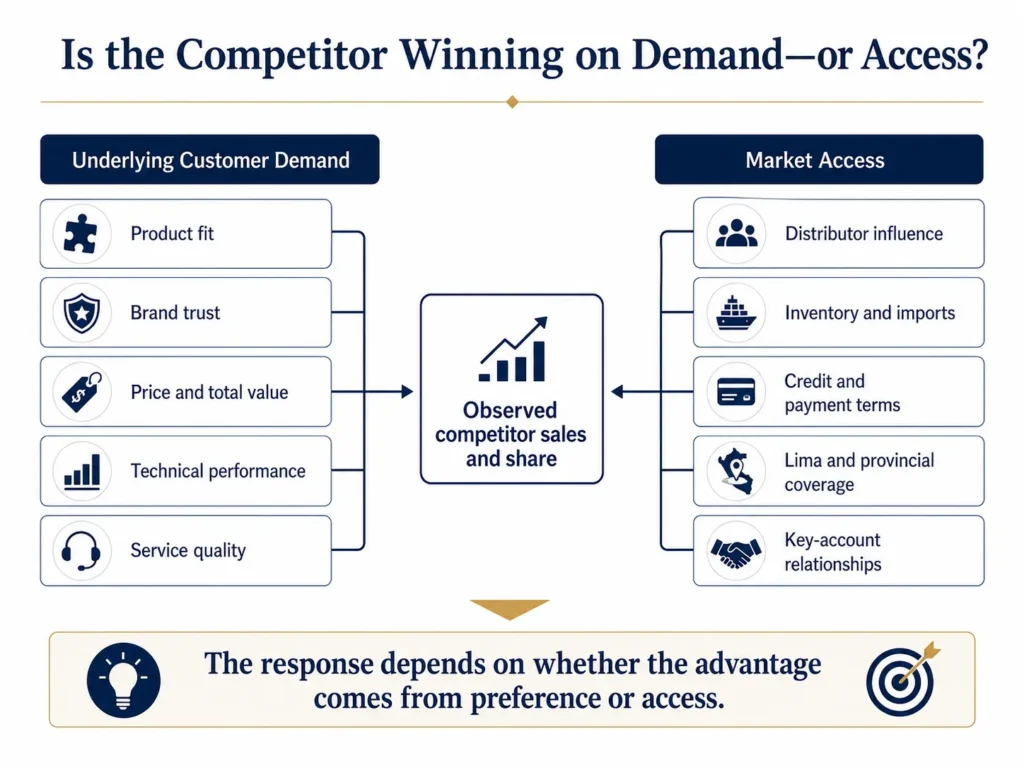
Figure 1. The same market result can arise from genuine customer demand or superior access through distributors, inventory, financing, coverage, and relationships.
Why Competitor Strength in Peru Can Be Easy to Misread
Lima concentration can distort the national picture
Many companies, institutions, distributors, and decision makers are concentrated in Lima. That makes the capital commercially important, but it can also cause executives to overestimate national coverage.
A competitor may be strong in Lima and weak in northern, central, or southern markets. Another may hold better access in mining corridors, agricultural regions, ports, industrial areas, or secondary cities through a specialized local partner.
Your analysis should therefore separate national claims from actual geographic execution.
Distributor strength can be mistaken for brand preference
In many sectors, distributors and importers do far more than deliver products. They may finance inventory, grant credit, manage registrations, provide technical support, maintain customer relationships, coordinate logistics, and influence which brands reach the market.
A competitor’s apparent advantage may belong partly, or mainly, to the distributor. That distinction matters because the strategic response may require a stronger route to market rather than a different product.
Imports and availability can shape customer choice
A company with reliable imports, local inventory, or stronger working capital may gain share when competitors face delays or stockouts. Customers may purchase what is available rather than what they would prefer under normal supply conditions.
The analysis should identify whether the current position is likely to persist if availability changes.
Provincial coverage may be nominal rather than operational
A distributor may claim nationwide reach while depending on resellers, intermittent shipments, or limited technical support outside Lima.
True coverage should be assessed through inventory, sales activity, credit, customer relationships, service, transportation, and the ability to solve problems locally.
Market estimates may exclude important activity
Public data and commercial databases may not capture independent importers, regional resellers, informal transactions, direct sales, project-based purchases, or product substitution consistently.
A useful market estimate should therefore make definitions, coverage, assumptions, and confidence levels explicit.
Key accounts can shape a disproportionate share of the market
In mining, infrastructure, industrial, healthcare, consumer, and other sectors, a limited number of customers or projects can materially affect demand.
A competitor may appear broadly successful when its position depends on a few strategic accounts, tenders, mines, institutions, or contractors. That concentration can create both protection and vulnerability.
The Executive Questions You Need to Answer with Your Competitor Analysis in Peru
- Which competitors are truly strong by region, industry, customer type, channel, and application?
- How much of their performance comes from customer preference versus distributor access and availability?
- Who owns the relationship with the end customer—the manufacturer, importer, distributor, reseller, contractor, or service provider?
- How concentrated is each competitor’s position in Lima, key accounts, projects, or one distributor?
- Where does provincial coverage exist in practice rather than only on paper?
- How do imports, inventory, credit, freight, and working capital affect delivered economics?
- Which customers are underserved because of service, availability, financing, or geographic gaps?
- Which competitors are vulnerable to a distributor change, supply disruption, regulatory issue, or loss of a strategic account?
- Which market-entry, partnership, acquisition, or production options could accelerate access?
- How may competitors respond if you improve coverage, appoint a new partner, enter an account, or acquire a local asset?
The goal is not to produce one national ranking. It is to understand who controls access, where customer demand is strongest, and which barriers you must remove to win.
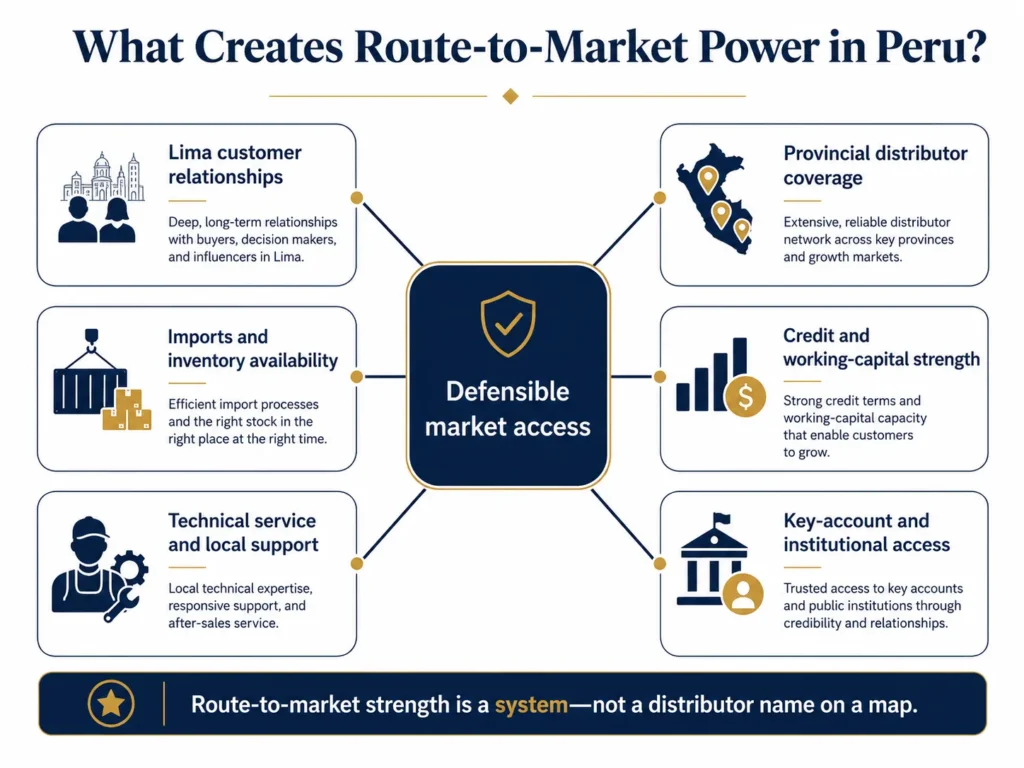
Figure 2. Defensible market access in Peru often comes from a reinforcing system of relationships, coverage, inventory, financing, service, and account access.
What You Need to Understand Beyond the Distributor List
Customer ownership and commercial influence
A partner may process orders without controlling the customer relationship. Another may influence specifications, supplier selection, credit, technical support, and long-term loyalty.
We examine:
- Who identifies and develops opportunities.
- Who negotiates price and commercial conditions.
- Who carries inventory and credit risk.
- Who provides technical support and service.
- Who holds the relationship with decision makers.
- Whether the customer would remain if the manufacturer changed partners.
Lima versus provincial execution
We distinguish presence from capability. Depending on the industry, the analysis may examine northern coastal markets, southern mining regions, central industrial areas, agricultural zones, ports, infrastructure corridors, or secondary cities.
Relevant questions include:
- Where does the distributor maintain inventory?
- How frequently are customers visited?
- Can it provide local technical service?
- What credit and transportation capabilities exist?
- Which resellers or subdistributors are active?
- Where are competitors or substitutes stronger?
Import model, inventory, and delivered economics
Two competitors can have very different economics depending on how they import, stock, finance, and distribute products.
We may assess:
- Finished-product versus component imports.
- Lead times, customs, freight, and port exposure.
- Inventory levels and replenishment frequency.
- Currency, financing, and working-capital exposure.
- Distributor margins and payment terms.
- Service, installation, and delivery commitments.
- Dependence on one supplier, country, or route.
Key accounts, projects, and institutional access
In concentrated sectors, access to a limited number of mines, contractors, hospitals, institutions, retailers, industrial groups, or projects may determine market position.
We examine how competitors gain approval, influence specifications, participate in tenders, manage relationships, and protect recurring demand.
Informal and alternative channels
Depending on the industry, parallel imports, independent resellers, cash transactions, substitutes, and informal commercial practices can influence price and availability.
We assess their strategic relevance without pretending that uncertain activity can be measured with false precision.
How Midas Builds a Defensible Market View in Competitor Analysis in Peru
Reliable market intelligence in Peru rarely comes from one source.
We triangulate evidence from:
- Official, regulatory, customs, trade, tender, company, product, and industry information where available.
- Interviews with customers, importers, distributors, resellers, suppliers, specialists, former industry participants, and other knowledgeable sources.
- Lima and provincial market validation.
- Price, inventory, availability, channel, service, hiring, and partnership signals.
- Your team’s commercial, technical, operational, and strategic knowledge.
- Economic and operational tests that determine whether the reported behavior is plausible.
We define the market carefully, identify what each source includes or excludes, distinguish verified facts from informed hypotheses, and use ranges when the evidence does not support an exact figure.
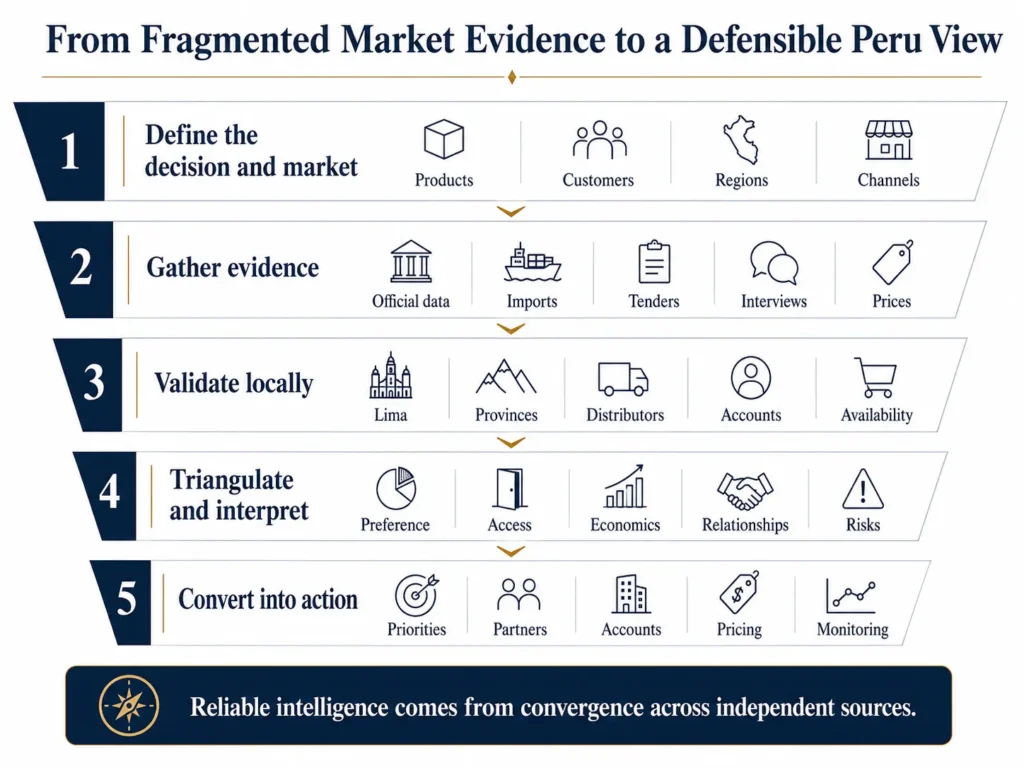
Figure 3. A reliable Peru market view is built by connecting official information with local validation, channel evidence, customer perspectives, and economic logic.
Ethical Intelligence Protects Your Decision
We comply with SCIP’s Code of Ethics, the profession’s gold standard. We comply with applicable laws, accurately disclose relevant identity and organizational information before interviews, avoid conflicts of interest, provide honest recommendations, and promote ethical conduct throughout the assignment.
We do not seek trade secrets, request confidential documents, misrepresent who we are, induce contractual breaches, or facilitate improper exchanges of competitively sensitive information.
This discipline is especially important when the assignment involves a concentrated market, a private company, a potential acquisition, a distributor relationship, or a confidential strategic move.
You can review SCIP’s ethical intelligence guidance and Code of Ethics.
For the complete analytical process, visit our competitor analysis step-by-step guide.
From Market Signals to Competitive Response
Competitor analysis should help you understand the current position and prepare for what may happen next.
Relevant signals in Peru may include:
- Appointment, loss, or consolidation of distributors.
- New inventory, warehouse, or import activity.
- Expansion beyond Lima into priority provinces.
- Changes in credit, financing, or payment terms.
- Hiring in sales, technical, regulatory, supply, or leadership roles.
- New tenders, approvals, projects, or key-account relationships.
- Pricing changes concentrated in one channel or account.
- Acquisition interest, asset sales, partnerships, or owner succession.
- Supply problems, service gaps, or channel conflict.
No single signal proves intent. The value comes from connecting signals with competitor objectives, capabilities, relationships, and constraints.
For a deeper explanation of early-warning indicators and response choices, see Strategic Foresight and Competitive Response: Executive Insights.
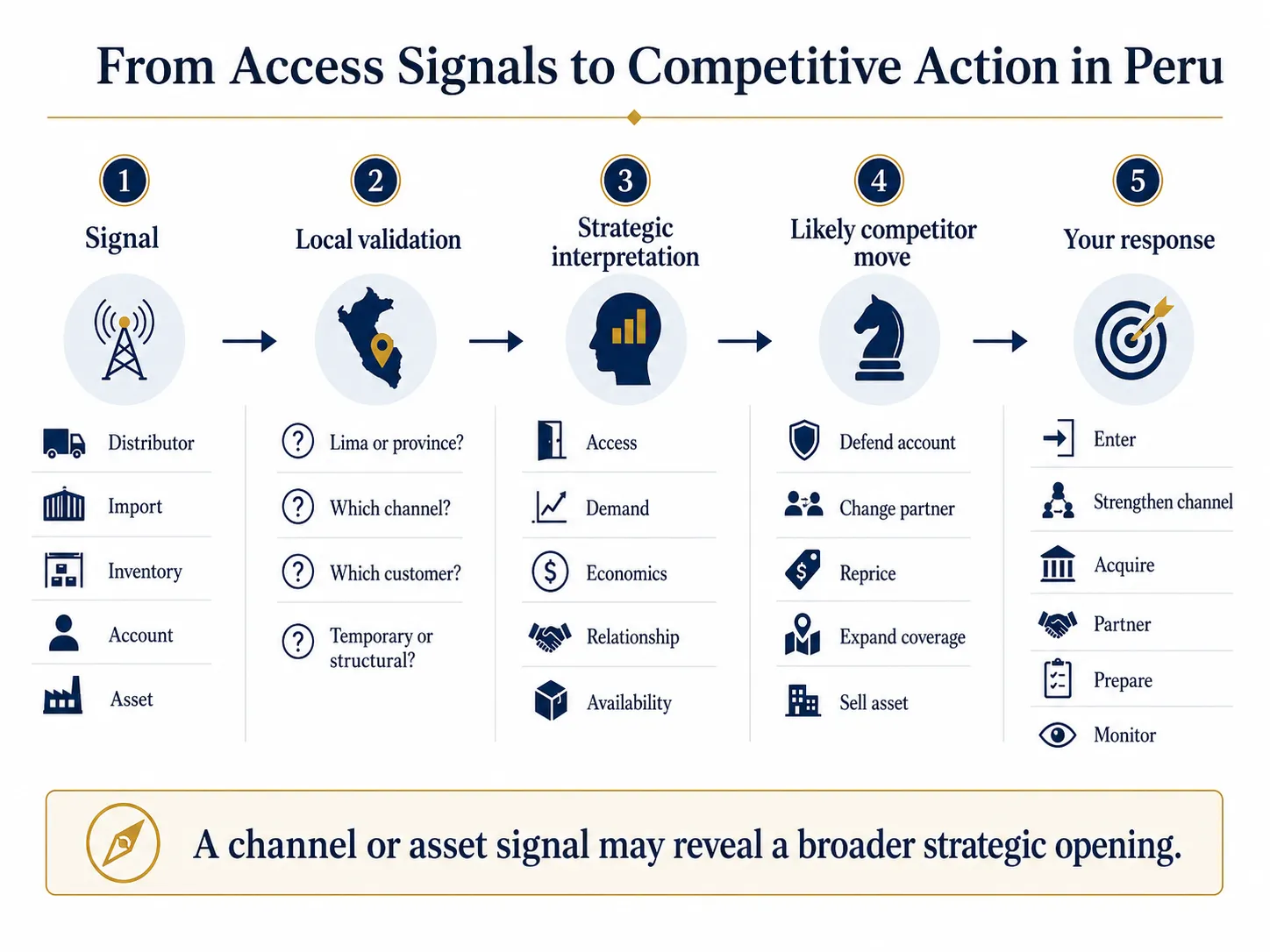
Figure 4. Distributor, inventory, account, and asset signals become actionable when you understand whether they reveal a temporary issue or a structural strategic opening.
How Competitor Analysis in Peru Changes Your Decision
Distributor and partner decisions
You can identify which partners truly control customers, where coverage is weak, whether incentives are aligned, and whether you should appoint, replace, support, or supplement a distributor.
Regional expansion decisions
You can determine which provinces, sectors, and customer clusters deserve direct investment, stronger partners, inventory, service, or targeted commercial coverage.
Pricing and commercial decisions
You can understand how imports, inventory, distributor margins, credit, freight, and service affect effective customer value and choose the right response.
Key-account and market-access decisions
You can identify which relationships, approvals, service capabilities, or availability barriers protect competitors and what would create a credible reason for the customer to change.
Market-entry, acquisition, and asset decisions
You can assess whether organic entry, partnership, distributor acquisition, equipment purchase, production asset, or another route would accelerate market access with acceptable risk.
Competitive-response decisions
You can decide where to enter, defend, partner, acquire, prepare, or monitor while anticipating how competitors and channels may respond.
Case Example: Evaluating a Strategic Production-Line Acquisition Without Market Exposure
The executive challenge
A company wanted to accelerate entry into Peru by acquiring a production line from a local competitor. The asset could eliminate approximately two years of setup time and remove an existing source of competition.
However, approaching the seller created strategic risk. If the owner discovered the identity of the interested company, he could use that information to raise the price, attract alternative buyers, alert competitors, or expose the client’s market-entry strategy.
How we approached the decision
We designed a discreet, ethical investigation to assess:
- Whether the owner was genuinely willing to sell.
- The conditions under which a transaction might be possible.
- The seller’s likely expectations and motivations.
- Whether the opportunity justified further management attention.
- How to protect the client’s identity, reputation, and strategic intent.
We conducted direct research with careful control of the information disclosed. The objective was not to pressure the seller or obtain confidential information. It was to determine whether a viable strategic option existed before the client exposed itself.
How the findings changed the decision
The investigation found that the owner was open to selling, but the required conditions did not align with the client’s expectations.
That insight allowed the company to avoid a costly and distracting negotiation while protecting its identity and market strategy. The transaction was not completed—but the assignment still created value by preserving time, reputation, and strategic optionality.
This case illustrates an important principle: good competitive intelligence does not always confirm that you should proceed. Sometimes its greatest value is helping you avoid the wrong transaction before exposure and commitment increase.
“They are responsive, professional, detail-oriented, and client-focused. I love that Midas prioritizes ‘co-success with the client’ and works hard to meet our needs and solve our problems.”
— Executive Chair
When You Need Competitor Analysis in Peru
- Entering Peru or reviewing your market-entry model.
- Selecting, replacing, or evaluating distributors and importers.
- Trying to understand Lima versus provincial performance.
- Assessing whether competitor share reflects demand or access.
- Reviewing import, inventory, credit, and route-to-market economics.
- Targeting strategic accounts, projects, institutions, or mining customers.
- Evaluating acquisition targets, assets, partnerships, or confidential transactions.
- Responding to pricing pressure, informal channels, or availability gaps.
- Preparing a product launch or regional expansion.
- Anticipating how competitors may respond to your next move.
When your decision covers several countries, the Peru analysis should fit into a consistent regional framework. See our Latin America competitor analysis hub.
Why Midas for Competitor Analysis in Peru?
We distinguish demand from access
We investigate whether competitors win because customers prefer the offer or because they control inventory, distribution, credit, coverage, relationships, or institutional access.
We look beyond Lima
We validate where competitors and distributors can actually sell, deliver, finance, and service customers across provincial markets.
We connect market analysis with strategic transactions
Our work can support organic entry, distributor decisions, partnerships, acquisition screening, asset purchases, and confidential strategic options.
We triangulate fragmented information
We compare multiple independent sources, test definitions and economic logic, and clearly communicate confidence ranges and remaining uncertainty.
We comply with SCIP’s Code of Ethics
We comply with SCIP’s Code of Ethics, the profession’s gold standard. Our methods are legal, transparent, discreet, and designed to protect your company, our sources, and the integrity of the engagement.
We bring direct experience in competitor analysis in Peru
We have led dozens of competitive intelligence and competitor analysis projects in Peru across pharmaceutical, automotive, household-device, industrial, consumer, mining, and other sectors.
When the objective is not simply to map competitors but to decide how to outperform them, our competitor analysis consulting helps you understand their strategies, economics, capabilities, vulnerabilities, and likely responses so you can make better-informed competitive decisions.
“Just to reiterate, this is fantastic. I’m really excited to see such valuable insights and information! Thank you again!”
— Vice President
Frequently Asked Questions about Competitor Analysis in Peru
Can you assess distributor strength in Lima and the provinces?
Yes. We can examine customer access, inventory, credit, technical capability, transportation, service, subdistributors, competing brands, commitment, and actual regional execution.
Can you estimate market size when reliable data is limited in your competitor analysis in Peru?
Yes. We triangulate official information, imports, company activity, channel interviews, customer demand, project activity, pricing, and other relevant evidence. We use ranges when the market does not support an exact number.
Can you distinguish customer preference from product availability?
Yes. We compare customer perceptions, repurchase reasons, service experience, switching barriers, inventory, delivery, credit, and alternative availability to understand what is driving the purchase.
Can you evaluate informal or parallel channels in your competitor analysis in Peru?
We can assess their strategic relevance using lawful market evidence, interviews, price checks, availability, trade patterns, and customer behavior. We avoid false precision and do not endorse unlawful practices.
Can you support acquisition or confidential transaction decisions?
Yes. We can screen targets or assets, assess strategic fit and market position, investigate owner willingness through ethical methods, and help you determine whether an opportunity deserves further diligence.
How do you protect our identity during sensitive research in your competitor analysis in Peru?
We design the disclosure and research approach carefully, comply with applicable law and SCIP’s Code of Ethics, and avoid unnecessary exposure. We do not misrepresent ourselves or seek confidential information.
Can you compare prices across distributors and regions?
When ethically and reliably obtainable, we can compare effective prices, discounts, credit, freight, service, inventory, and regional conditions rather than relying only on list prices.
Can you help us prepare a competitive response in your competitor analysis in Peru?
Yes. We can translate findings into channel, account, pricing, inventory, service, partnership, acquisition, and regional options. Strategic foresight or a business wargame can be added when reactions and countermoves are central.
How long does a Peru competitor analysis take?
The timing depends on the number of competitors, regions, channels, interviews, assets, and questions involved. We scope the work around your decision and can share preliminary findings in phases.
About the Author
Adrian Alvarez, PhD is Managing Partner at Midas Consulting, Wharton Alumnus, MBA Professor at Universidad Argentina de la Empresa (UADE), and Competitive Intelligence Fellow. He specializes in competitive strategy, competitor analysis, strategic intelligence, confidential transactions, business wargaming, market entry, and decision-making under uncertainty in Peru and Latin America.
He has led dozens of competitive intelligence and competitor analysis projects in Peru and more than 100 across Latin America. His work has been published in the United States, Spain, and Germany. You can access his library of strategic insights and published research here
View professional profile on LinkedIn
Selected Peruvian Sources You May Need to Monitor
- INEI for official economic, demographic, and sector information.
- Banco Central de Reserva del Perú for monetary, financial, exchange, and economic information.
- INDECOPI for competition, consumer, intellectual-property, and market information.
- SUNAT for legally available tax, customs, and trade context.
- OSCE and relevant public-procurement platforms where government purchasing matters.
- Sector regulators, company records, industry associations, chambers, distributor information, trade sources, and primary market interviews as appropriate.
Official sources are essential, but they rarely explain distributor influence, customer relationships, actual provincial coverage, transaction willingness, or competitor intent on their own. The value comes from connecting formal evidence with local market behavior.
Understand Who Controls the Route to Market Before You Act
You may be entering Peru, reviewing a distributor, expanding beyond Lima, targeting a strategic account, evaluating an asset, or trying to explain why a competitor with an ordinary offer keeps winning.
Before you react, you need to understand whether the advantage comes from customer preference, access, inventory, financing, regional coverage, relationships, or a strategic asset, and how durable that advantage really is.
In an initial conversation, we will discuss your decision, the competitors, distributors, regions, accounts, and assets involved, what your team already knows, and which uncertainties could materially change the action. We can then propose a focused Peru research and analysis plan designed around your decision, not a generic national report.