
Outpace the Competition with Strategic Benchmarking in Latin America
A regional benchmark can show that one country, competitor, distributor, plant, or sales team performs better. It does not automatically explain why.
A business unit may appear more productive because it serves a denser customer base. A competitor may have lower costs because it operates at greater scale, uses a different labor model, sources locally, carries a narrower portfolio, or serves customers through distributors rather than directly. A country may show stronger margins because taxes, inflation, product mix, payment terms, regulation, and channel economics differ.
If those differences are not normalized, benchmarking can push your leadership team toward the wrong conclusion. You may try to close a gap that is structural, copy a practice that does not fit your organization, or force one regional standard onto markets that require different operating models.
At Midas Consulting, we help you move beyond regional rankings and averages. We compare performance, reconstruct the practices and capabilities behind it, adjust for material country and business-model differences, and identify which lessons your organization should adapt, which gaps require investment, and where remaining different may be strategically stronger.
The result is not a report showing who is first and who is last. It is a regional improvement agenda with clearer priorities, realistic targets, ownership, and a practical path from external insight to measurable performance.
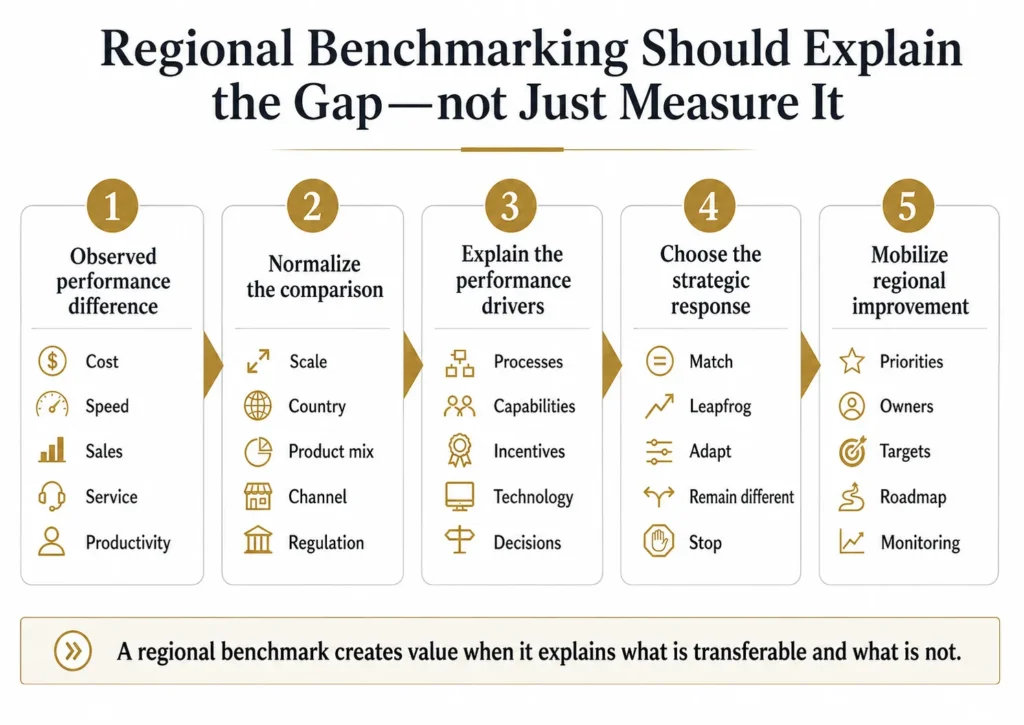
Figure 1. Regional benchmarking creates value when performance differences are normalized, explained, and translated into focused improvement choices.
The Strategic Benchmarking Question in Latin America Is Not “Who Performs Best?”
A league table can stimulate useful questions. It should not be the final answer.
- Where is the real performance gap?
- Are the companies or business units genuinely comparable?
- Which structural differences explain part of the result?
- Which processes, capabilities, incentives, technologies, relationships, or decisions explain the remaining gap?
- Is the stronger practice transferable to your company?
- What would need to change before it could work in your context?
- Which gaps are strategically important enough to justify action?
- Which gaps require investment or a different business model?
- Where can you leapfrog instead of merely catching up?
- Where would copying weaken your differentiation or economics?
The objective is not to make every country or business unit operate identically. It is to create a common understanding of what stronger performance looks like, why it occurs, and how each market should improve.
Why Benchmarks in Latin America Are Easy to Misread
Country economics can distort performance comparisons
Inflation, exchange rates, taxes, wages, financing, payment terms, import exposure, and working-capital conditions can make one market appear more or less efficient than another even when underlying execution is similar.
Market density changes productivity
A sales representative covering a concentrated urban market may serve more customers than one traveling across a dispersed territory. A service operation near an industrial cluster may respond faster than one supporting isolated accounts.
Product and customer mix affect apparent performance
Companies may sell different configurations, serve different account sizes, carry different portfolios, or operate in segments with different margins and support requirements.
Channel models alter the cost structure
Direct sales, distributors, dealers, integrators, importers, and hybrid models allocate commercial cost, inventory, credit, technical support, and customer ownership differently.
Regulation and institutional access change the operating model
Registrations, tenders, public procurement, labor rules, local-content expectations, and compliance requirements can affect cost, staffing, timing, and productivity.
Internal data definitions may not match
Countries may define customers, sales roles, service calls, costs, margins, or productivity differently. A regional comparison built on inconsistent definitions can create false precision.
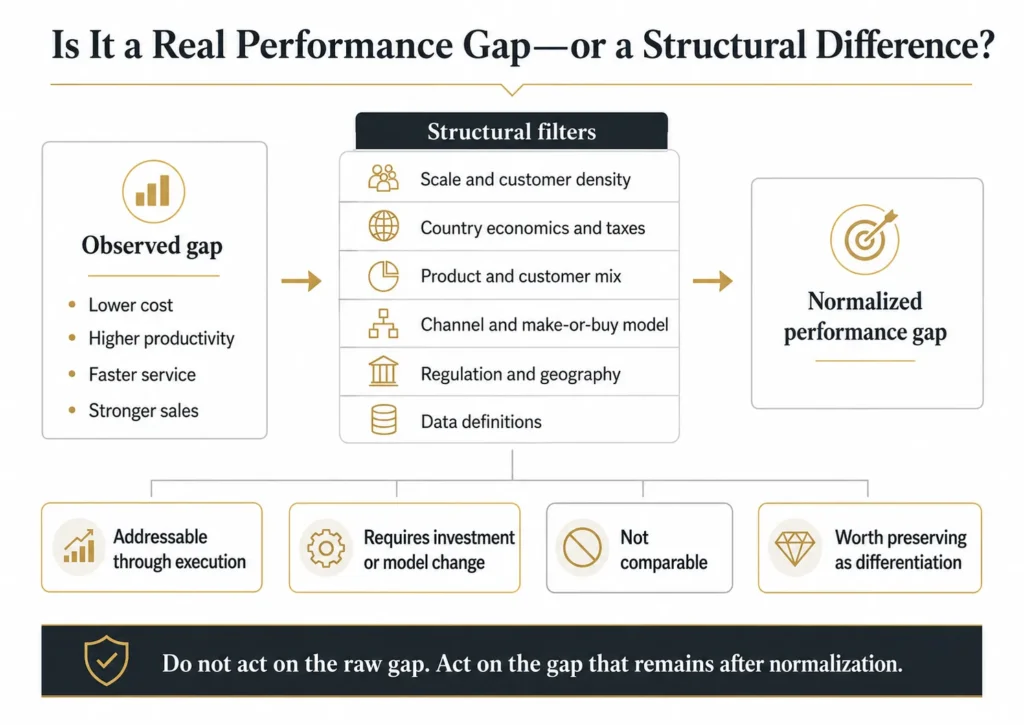
Figure 2. Normalization separates country, scale, mix, and business-model effects from the performance gap your organization can actually address.
What Should Be Standardized Regionally, and What Should Remain Local in Benchmarking in Latin America?
Regional leadership often wants greater consistency. Country teams often argue that their markets are different. Both can be right.
Standardize the improvement question
Countries should use common definitions for the strategic problem, such as sales productivity, cost-to-serve, distributor performance, product-launch speed, customer experience, or pricing effectiveness.
Standardize core metrics where possible
Common KPI definitions, calculation rules, time periods, and data-quality standards are essential for meaningful comparison.
Adapt for local context
Targets, roles, coverage models, incentives, service standards, channel choices, and implementation sequences may need to reflect local customer density, regulation, labor models, product mix, and market maturity.
Scale internal best practices selectively
An internal practice should not be rolled out merely because it worked in one country. The team should understand what enabled the result and whether those conditions exist elsewhere.
The regional objective is disciplined comparability with intelligent local adaptation, not forced uniformity.
Regional Benchmarking in Latin America Is Not the Search for One Average
Averages can conceal the strongest and weakest operating models. The more diverse the regional portfolio, the less useful one average becomes.
We often compare several reference points:
- The strongest internal business unit.
- The relevant regional competitor.
- A global best-in-class company.
- An adjacent industry with a superior capability.
- A realistic near-term target.
- An aspirational future-state model.
The best benchmark is the one that informs the decision, not necessarily the most famous company or the highest number.
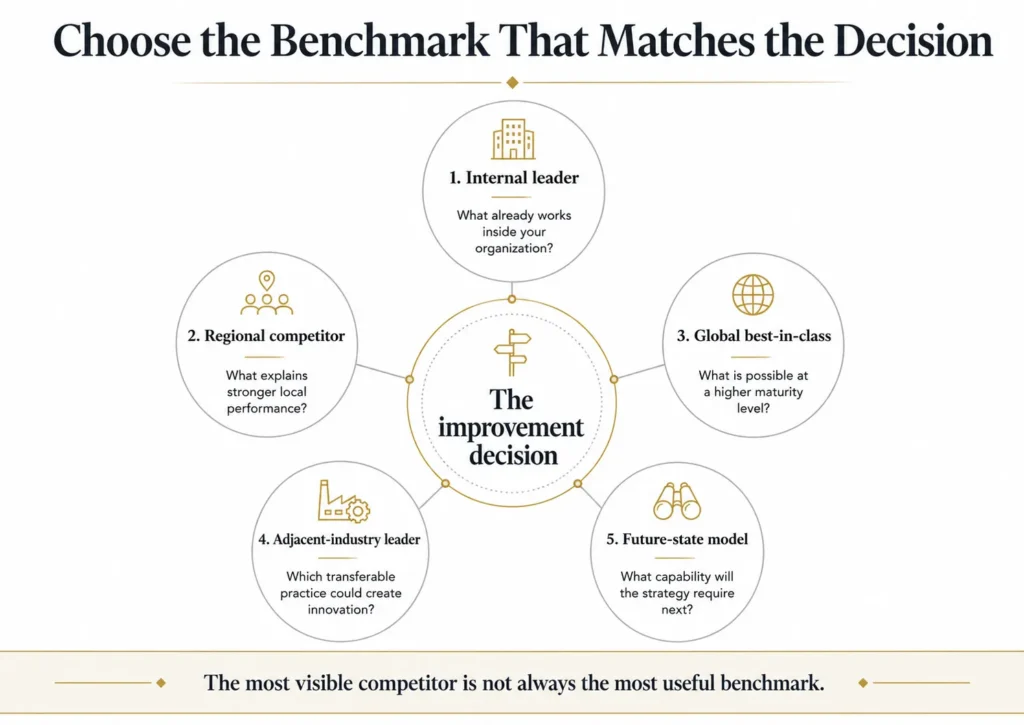
Figure 3. Strong regional benchmarking selects reference organizations according to the improvement decision rather than relying on one obvious comparator.
From Best Practice to Adaptable Principle
Visible practices are often supported by less visible conditions.
A competitor’s faster product-development process may depend on decentralized decision rights, stronger customer feedback, different incentives, a narrower portfolio, or greater tolerance for experimentation.
A more productive salesforce may reflect account concentration, role specialization, stronger distributors, better data, lower administrative burden, or a compensation model that directs effort toward the right activities.
Before adopting a benchmarked practice, your leadership team should ask:
- What problem does this practice solve?
- Why does it work in the benchmarked organization?
- Which capabilities, systems, incentives, or resources support it?
- Which local conditions make it effective?
- What principle can be transferred even if the exact practice cannot?
- What must change in our organization before adoption?
- What unintended consequences could the change create?
The goal is not to become more like the benchmarked organization. It is to use external learning to become stronger in your own strategic context.
Decide Whether to Match, Leapfrog, Remain Different, or Stop
Match the benchmark
Close the gap when the competitor’s advantage creates a basic disadvantage in cost, quality, service, speed, productivity, or customer access.
Leapfrog the benchmark
Choose a different operating model, technology, route to market, customer experience, or capability that can create greater advantage than simply catching up.
Remain different
Protect the difference when copying the benchmark would weaken your positioning, customer value, flexibility, or economics.
Stage the change
Sequence the improvement when the gap matters but requires capability building, investment, systems, or organizational readiness.
Stop or postpone
Do not pursue a gap that has limited strategic impact, weak feasibility, or little relevance to the customers and economics that matter most.
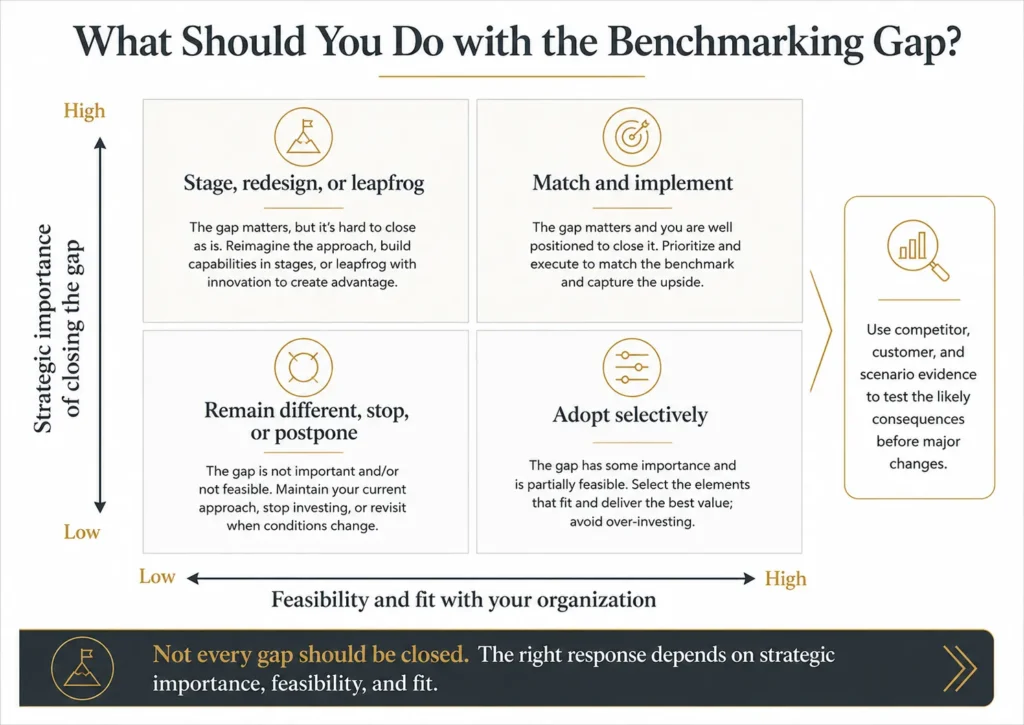
Figure 4. Benchmarking should help your leadership team prioritize which gaps to close, redesign, adopt selectively, or deliberately leave untouched.
How Midas Structures a Multi-Country Benchmarking Engagement in Latin America
1. Define the improvement decision
We clarify what your leadership team needs to improve or decide, which performance gap triggered the project, and how the findings will be used.
2. Build a consistent internal baseline
We align KPI definitions, scope, periods, roles, costs, processes, channels, and relevant contextual information across countries or business units.
3. Select the right reference set
We may compare internal units, direct competitors, regional leaders, global best-in-class organizations, or companies in adjacent industries with relevant capabilities.
4. Reconstruct external practices and performance
We combine public sources, interviews, customer and channel evidence, supplier perspectives, specialized information, and Midas’s regional experience.
5. Normalize and explain the gaps
We adjust for material differences and identify the processes, capabilities, incentives, technologies, decisions, and operating choices that explain stronger performance.
6. Prioritize and mobilize improvement
We translate the findings into targets, options, investment implications, quick wins, capability requirements, owners, milestones, and a regional implementation roadmap.
For the detailed process, visit Benchmarking: How to Compare, Learn, and Improve Your Competitive Position.
How This Page Complements Our Other Benchmarking Resources
This page focuses on the challenge of comparing and improving performance across Latin American countries.
For a broader explanation of how strategic benchmarking creates advantage by explaining the gap and supporting implementation, see Benchmarking That Delivers Real Competitive Advantage.
For the full commercial offer, engagement model, and deliverables, see Benchmarking Consulting: Understand Why Competitors Outperform—and What You Should Do Next.
Case Example: Benchmarking Salesforce Strategy Across Four Latin American Markets
The executive challenge
A multinational diabetes-monitoring company operating in Argentina, Brazil, Mexico, and Peru wanted to understand how its salesforce compared with leading competitors.
A simple headcount comparison would not have answered the decision. Roles, account coverage, compensation, field deployment, channels, market density, customer types, and local execution differed across countries.
How we approached the decision
We developed a consistent multi-country framework and conducted local research in each market.
- Salesforce structures and role definitions.
- Compensation and incentive practices.
- Territory and account coverage.
- Regional and local sales strategies.
- Interviews with competitor sales teams, HR professionals, distributors, and pharmacy chains.
- Comparison of common regional patterns and country-specific differences.
We normalized the comparison so that different market structures were not mistaken for differences in sales effectiveness.
How the benchmarking findings in Latin America changed the strategy
The company adapted its salesforce structure and compensation approach by market while maintaining a clearer regional logic for roles, priorities, and expected behaviors.
The company achieved a 30% increase in sales within one year and strengthened its competitive position across Latin America.
“We are extremely pleased with the benchmarking. It helped us reassess our priorities and redirect our resources.”
— Market Segment Leader
“Just to reiterate, this is fantastic. I’m really excited to see such valuable insights and information! Thank you again!”
— Vice President
When You Need Regional Benchmarking in Latin America
- Performance varies significantly across countries or business units.
- Regional leadership needs common KPIs and more comparable data.
- You need to understand why one market, team, plant, or channel performs better.
- Your company wants to scale internal best practices across Latin America.
- You need to benchmark salesforce, pricing, costs, service, channels, operations, innovation, or organization.
- A competitor appears structurally more efficient or commercially effective.
- You need realistic regional and country-level improvement targets.
- You are considering a major investment or transformation and need an external reality check.
- Internal debates rely on assumptions rather than a shared fact base.
- You need a regional improvement roadmap that allows intelligent local adaptation.
Country-Specific Benchmarking in Latin America
- Benchmarking in Argentina — inflation, currency, replacement costs, regulation, labor, and rapidly changing economics.
- Benchmarking in Brazil — scale, state differences, taxes, logistics, local production, labor, and channel structures.
- Benchmarking in Chile — concentrated accounts, service, installed base, channels, trust, and switching barriers.
- Benchmarking in Colombia — regional fragmentation, formal and informal channels, distributor economics, affordability, and institutional access.
- Benchmarking in Mexico — industrial clusters, North American supply chains, production, certifications, channels, and nearshoring readiness.
- Benchmarking in Peru — Lima concentration, imports, distributors, provincial coverage, account dependence, and service economics.
Why Midas for Benchmarking in Latin America?
- We explain the gap instead of stopping at the ranking.
- We normalize regional comparisons.
- We select benchmarks according to the decision.
- We help you adapt rather than copy.
- We combine local research with regional synthesis.
- We co-create the implementation agenda.
- We bring extensive benchmarking experience. Midas Consulting conducted more than 300 benchmarking projects across Latin America and selected global markets and has more than 25 years of benchmarking-consulting experience.
Ethical, Comparable, and Reliable Intelligence
We comply with SCIP’s Code of Ethics, the profession’s gold standard. We comply with applicable laws, accurately disclose relevant identity and organizational information before interviews, avoid conflicts of interest, provide honest recommendations, and promote ethical conduct throughout the engagement.
We do not seek trade secrets, request confidential documents, misrepresent who we are, induce contractual breaches, or encourage sources to violate legal or contractual obligations.
We triangulate material findings, align definitions and periods, normalize structural differences, distinguish facts from estimates and hypotheses, explain limitations, and review preliminary conclusions with your team.
Review SCIP’s ethical intelligence guidance and Code of Ethics.
Frequently Asked Questions About Benchmarking in Latin America
Can you compare business units across several Latin American countries?
Yes. We establish common definitions and dimensions, build a consistent internal baseline, and normalize material differences before drawing conclusions.
How do you compare countries with different inflation, currencies, or tax structures?
We separate nominal changes from underlying performance and adjust the comparison for the economic variables that materially affect the decision.
Can you benchmark salesforce structures and compensation in Latin America?
Yes. We can compare roles, headcount, coverage, productivity, incentives, account priorities, field deployment, channels, and the logic behind the model.
Can you benchmark private competitors?
Yes. We combine lawful public sources with interviews, customer and channel evidence, supplier perspectives, field research, and economic logic.
How do you prevent benchmarking in Latin America from becoming copying?
We identify why a practice works, what capabilities support it, what problem it solves, and how the principle should be adapted to your organization’s strategy and context.
Can you compare companies from different industries?
Yes. Functional benchmarking can identify useful practices from organizations that excel in logistics, customer experience, innovation, onboarding, service, or digital execution.
Can you identify internal best practices with bechmarking in Latin America?
Yes. Internal benchmarking can reveal which country, team, plant, store, channel, or business unit performs better and which practices can be scaled.
How do you decide which gaps deserve action?
We prioritize gaps according to strategic importance, expected performance impact, feasibility, fit, investment, timing, risk, and organizational readiness.
Can benchmarking in Latin America support a transformation or investment decision?
Yes. Benchmarking can provide an external reality check, define realistic targets, identify capability requirements, and clarify which changes require capital or a different operating model.
How do you protect confidentiality?
Your internal data, objectives, and strategic priorities are treated as confidential. Where appropriate, the engagement can operate under a mutual nondisclosure agreement.
How long does a regional benchmarking in Latin America engagement take?
The timing depends on the number of countries, functions, comparators, interviews, data sources, and strategic questions. We scope the work around your decision and can share preliminary findings in phases.
About the Author
Adrian Alvarez, PhD. is Managing Partner at Midas Consulting, Wharton Alumnus, MBA Professor at Universidad Argentina de la Empresa (UADE), and Competitive Intelligence Fellow. He specializes in benchmarking, competitive strategy, competitor analysis, strategic intelligence, market analysis, and executive decision-making under uncertainty in Latin America.
He has led complex regional benchmarking initiatives across B2B, B2C, industrial, technology, consumer, pharmaceutical, healthcare, and regulated markets. He also served as a Board Member of SCIP during the 2009–2011 period.
His work has been published in the United States, Spain, and Germany. You can access his library of strategic insights and published research here
View professional profile on LinkedIn
Selected Sources and Reference Standards
- Internal operating, financial, commercial, customer, channel, and performance data.
- Company disclosures, industry sources, specialized databases, regulatory information, and public records.
- Customer, distributor, supplier, expert, former-industry-participant, and executive interviews.
- APQC frameworks and process-classification resources where relevant.
- ASQ benchmarking resources.
- National statistical agencies, central banks, regulators, procurement platforms, associations, and country-specific operating evidence.
Turn Regional Comparison into a Focused Improvement Agenda
You may be trying to understand why one country performs better, whether a competitor’s lower cost is transferable, how to scale an internal best practice, or which improvements deserve regional investment.
You do not need another ranking that tells you who is ahead. You need to understand what explains the gap, which differences are structural, what can be adapted, what should remain different, and where leadership should focus resources.
In an initial conversation, we will discuss the performance question, countries, business units, functions, comparators, and internal hypotheses involved, as well as the decisions the benchmark must support.