
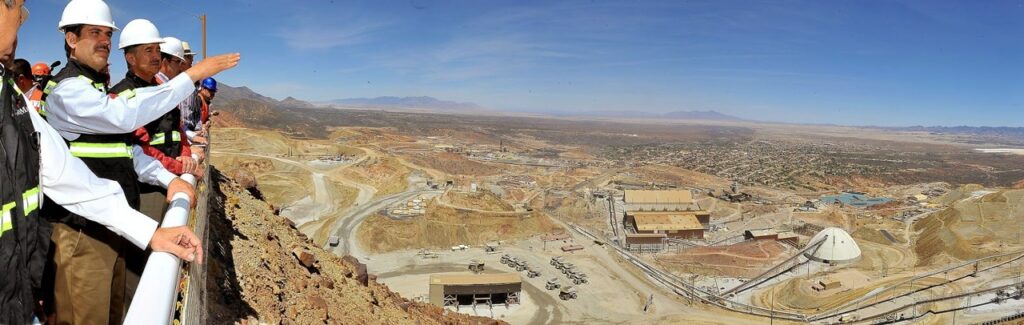
Consulting for mining products aimed at driving high‑margin, strategic expansion.
Mining suppliers rarely lose because the market is too simple. They lose because the decision system around the mine is complex.
You may have a technically strong product, an experienced sales team, and attractive mining investments ahead of you. But profitable growth still depends on difficult choices: which countries and mine sites deserve attention, which applications create the strongest economics, how to displace incumbent suppliers, which partners can support the mine reliably, how to defend a price premium, and how much capital and management attention each opportunity deserves.
Those choices become even harder when commodity cycles, project timing, local-content expectations, mine economics, procurement pressure, technology shifts, sustainability requirements, service demands, and competitor reactions can move at the same time.
Midas Consulting helps you turn that complexity into strategic choices you can act on.
For more than 25 years, we have supported companies selling mining products, industrial equipment, consumables, technologies, and services across Latin America and other technically demanding markets. We connect market evidence, customer economics, competitive intelligence, and execution realities so you can decide where to play, how to win, and what must be true for the strategy to work.
The objective is not another broad mining-market report. It is a clearer allocation of commercial resources, capital, management attention, and strategic effort.
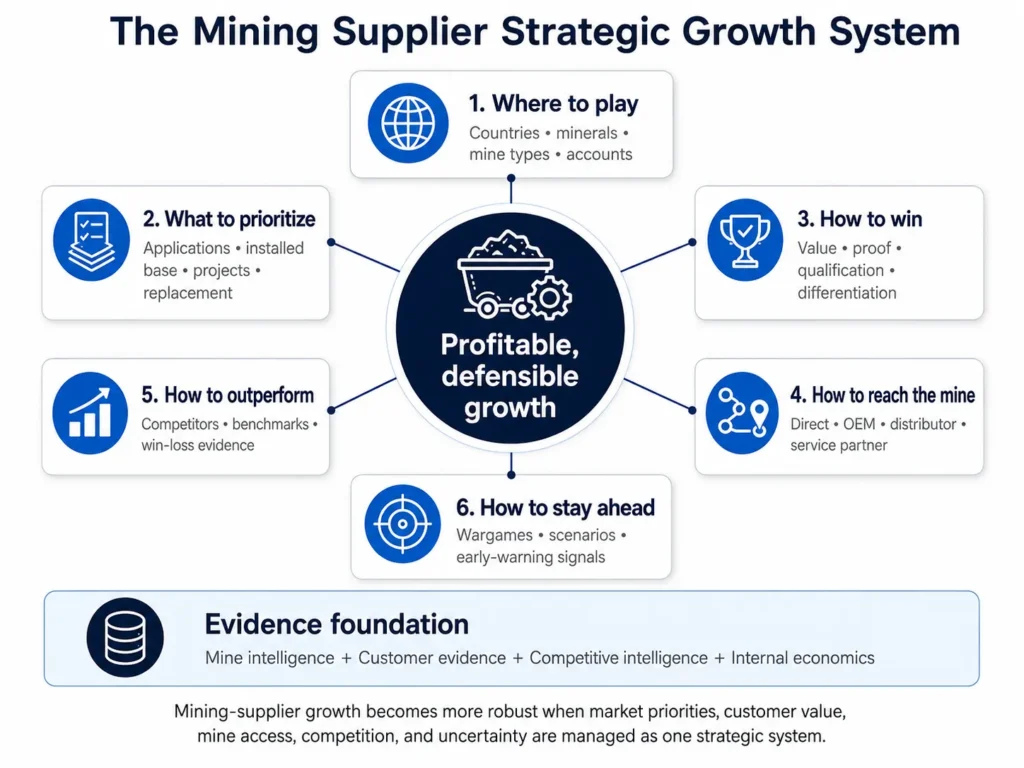
Figure 1: Mining-supplier growth becomes more robust when market priorities, customer value, mine access, competition, and uncertainty are managed as one strategic system.
Start With the Strategic Decision
Mining markets generate large amounts of information: project pipelines, reserve data, equipment fleets, production plans, tenders, installed bases, engineering standards, distributor lists, procurement data, commodity prices, and competitor activity.
But more data does not automatically produce a better decision.
We begin by clarifying the decision your team must make.
You may need to decide:
- Which countries, mining districts, minerals, mine types, or strategic accounts deserve incremental investment.
- Whether the opportunity is in new projects, operating mines, expansions, maintenance, replacement, or productivity improvement.
- Which applications provide the strongest combination of technical fit, customer value, and attractive economics.
- Whether a price premium can be defended through uptime, productivity, safety, energy efficiency, water savings, service life, or lower total cost.
- Which accounts justify local inventory, service capabilities, technical specialists, or field support.
- Whether to sell directly, through an OEM, dealer, distributor, service company, EPCM, or specialized partner.
- How to displace an approved incumbent supplier without underestimating qualification, field trials, or operational risk.
- Which competitive responses are likely if you enter an account, change price, add service, or introduce a new technology.
- How your strategy should change if commodity economics, regulation, local-content requirements, technology adoption, or project timing shifts.
Once the decision is explicit, we build the evidence around it. That keeps the work focused on what you can actually do differently.
Where Should You Allocate Mining-Sector Resources?
Mining growth can look attractive at a regional level and still destroy value when resources are spread too broadly.
A country may have a strong project pipeline but slow execution. A mineral may attract investment while only a small share of the mines actually use your application. A large operating site may be difficult to penetrate because an incumbent is deeply embedded. A remote mine may generate attractive revenue but require service, inventory, and logistics that weaken the economics.
We help you compare opportunities through a decision framework that can include:
- Addressable demand
- Mine and project maturity
- Installed equipment or application base
- Replacement and consumption dynamics
- Customer economics
- Qualification barriers
- Competitive intensity
- Incumbent strength
- Channel and partner access
- Local service requirements
- Inventory and logistics needs
- Margin potential
- Working-capital requirements
- Strategic fit
- Execution feasibility
- Risk and uncertainty
The goal is not to identify the largest mining market. It is to identify the opportunities where your company has the strongest risk-adjusted ability to win profitably.
Our market analysis consulting helps you build the market, customer, demand, channel, and competitive fact base behind those decisions.
When geographic expansion is the question, our market entry consulting helps you compare countries, opportunities, entry models, risks, and implementation priorities.
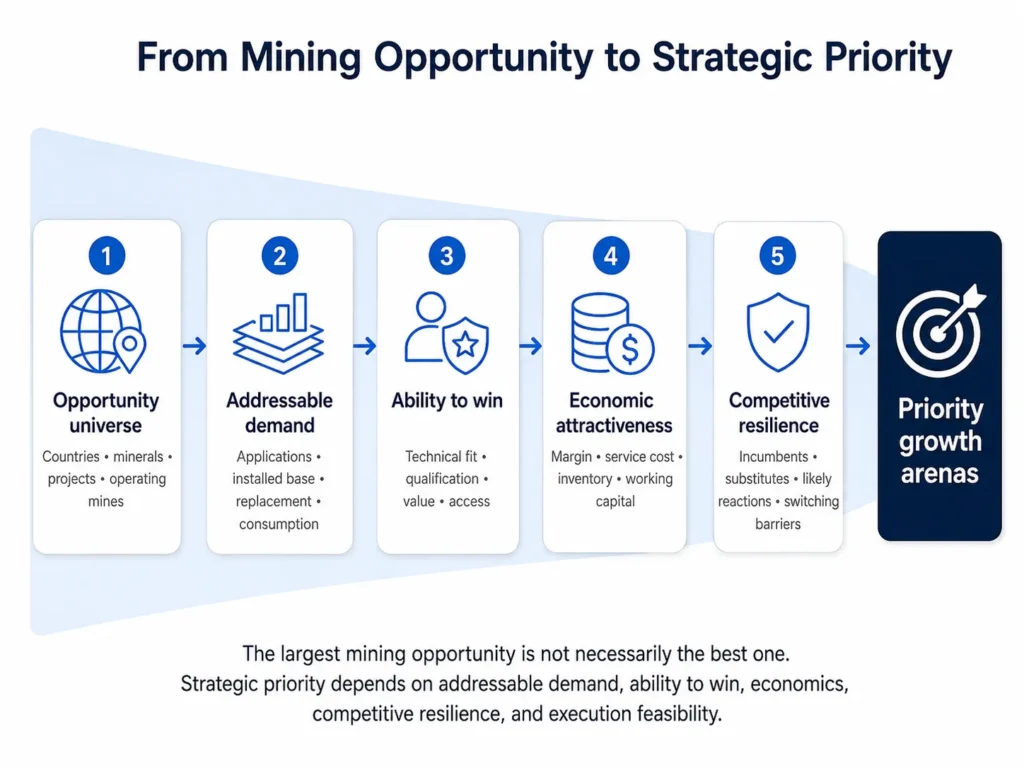
Figure 2: The largest mining opportunity is not necessarily the best one. Strategic priority depends on addressable demand, ability to win, economics, competitive resilience, and execution feasibility.
Understand the Economics at the Account Level with Our Mining Products Consulting
Mining suppliers often evaluate opportunities using market size, revenue potential, or installed base. Those measures are useful, but they are not enough.
The account economics may change dramatically once you include:
- Mine-site qualification costs
- Field trials
- Technical support
- Travel and remote-site access
- Local inventory
- Emergency stock
- Spare parts
- Warranty exposure
- Service technicians
- Distributor or dealer margins
- Credit terms
- Freight
- Import costs
- Working capital
- Account-specific engineering
- Commercial time required to displace an incumbent
A smaller account with high product relevance, easier access, better payment conditions, and lower cost to serve may create more value than a larger but structurally difficult opportunity.
We help you connect market attractiveness with account economics so strategic prioritization reflects profit potential, not only revenue potential.
Translate Technical Performance Into Customer Value through Midas’ Mining Products Consulting
A superior specification does not automatically create preference.
Mining customers evaluate operational risk. A new supplier may need to prove not only that the product works, but that it can work reliably under real mine conditions, that support will be available, that failures will be resolved, and that switching from an incumbent is worth the risk.
That is why a stronger value proposition should connect technical performance to outcomes the mine values.
Depending on the product, that may include:
- More tons moved or processed
- Lower downtime
- Longer component life
- Fewer maintenance interventions
- Lower energy consumption
- Lower water consumption
- Improved safety
- Reduced failure risk
- Faster maintenance
- Lower inventory requirements
- Better asset availability
- Lower total cost of ownership
Our value proposition consulting helps you turn technical evidence into a credible customer promise that purchasing, operations, maintenance, engineering, and management can understand.
Our brand consulting can help strengthen the broader reputation, credibility, relevance, and differentiation surrounding that promise.
Understand Why Mines Change Suppliers, and Why They Do Not thanks to Our Mining Products Consulting
Switching suppliers in mining can be expensive, operationally risky, and politically difficult inside the organization.
An incumbent may benefit from qualification status, installed base, spare-parts familiarity, maintenance practices, long-standing technical relationships, local stock, service response, and internal comfort with the product.
That means a supplier can be technically better and still fail to displace the incumbent.
We help you examine the real switching logic:
- Who experiences the problem
- Who specifies the solution
- Who authorizes the trial
- Who evaluates technical performance
- Who owns the operational risk
- Who negotiates the commercial terms
- Who approves the supplier
- Which proof points reduce perceived risk
- Which incumbent advantages are structural
- Which sources of dissatisfaction create a real opening
This perspective helps you distinguish an attractive theoretical account from one where a credible path to adoption actually exists.
Understand Competitors Before They Shape the Account
Your competitors are not static reference points.
They can change price, extend credit, increase local inventory, strengthen service coverage, bundle products, defend an installed base, accelerate qualification, acquire a distributor, recruit technical talent, or respond aggressively to a strategic account threat.
That means competitor analysis should examine more than product specifications and quoted prices.
Our competitor analysis consulting helps you examine competitor objectives, installed position, account relationships, pricing, service capability, channel structure, supply strengths, vulnerabilities, and likely responses.
The strategic question is not only who the competitor is today. It is what they are likely to do when your move threatens something important to them.
Benchmark the Capabilities Behind Mining-Supplier Performance with Midas’ Mining Products Consulting
A competitor may have stronger share, better account access, faster response times, more reliable local stock, higher service attachment, or better margins.
The visible outcome tells you what happened. Benchmarking helps you understand what produced it.
Depending on the decision, we can compare:
- Account segmentation
- Key-account coverage
- Sales-force deployment
- Technical-sales roles
- Service footprint
- Inventory model
- Spare-parts availability
- Distributor economics
- Pricing architecture
- Contract structures
- Qualification processes
- Field-trial support
- Aftermarket practices
- Digital monitoring or remote support
- Decision rights and organization
Our benchmarking consulting focuses on the practices and capabilities behind performance so you can identify what is transferable to your own business—and what is not.
Learn Why You Win, and Why You Lose
Tender results, salesperson explanations, and procurement feedback do not always reveal the real reason a mining opportunity was won or lost.
A loss may be attributed to price even when the decisive issue was qualification risk, local support, technical credibility, delivery reliability, installed-base familiarity, payment terms, or confidence in the supplier.
A win may be attributed to superior technology when service responsiveness or a distributor relationship actually tipped the decision.
Our win-loss analysis consulting helps bring the customer’s perspective into your strategy.
The evidence can help you improve account strategy, positioning, trial design, pricing, service, distributor management, sales effectiveness, and product priorities.
Choose the Right Route to the Mine thanks to Our Mining Products Consulting
The best route-to-market model depends on what the mine expects before and after the sale.
A low-complexity consumable may be effectively served by a distributor. A highly technical product may require direct engineering support. A critical rotating asset may need local service, spare parts, emergency response, and maintenance capabilities. An OEM relationship may provide access but reduce control over the customer.
We help you evaluate routes such as:
- Direct sales
- Key-account selling
- OEM relationships
- Dealers
- Distributors
- Service companies
- EPCMs
- Specialized representatives
- Local partners
- Hybrid models
The decision should connect customer access, technical competence, service capability, economics, control, incentives, and scalability.
A partner should not be selected simply because it has contacts. It should be able to support the value proposition you intend to deliver.
Turn Mining Intelligence Into Strategic Choices
Good analysis is only valuable if it changes what you do.
That may mean concentrating on fewer mine sites, changing the route to market, investing in technical service, carrying local inventory, changing pricing architecture, developing proof around total cost of ownership, abandoning an unattractive segment, or preparing a more aggressive response to an incumbent.
Our strategy consulting helps you bring the evidence together, challenge assumptions, compare alternatives, make trade-offs explicit, and convert the decision into an execution roadmap.
Depending on your situation, we can help you define:
- Where to play
- How to win
- Which accounts deserve investment
- Which capabilities must be built
- Which partners fit the strategy
- Which opportunities should be delayed or rejected
- Which actions have priority
- Who owns implementation
- Which milestones matter
- Which assumptions must be monitored
Stress-Test the Strategy Before the Market Does with Midas’ Mining Products Consulting
Mining strategies can look convincing when assumptions are considered one at a time.
The real risk appears when several assumptions move together.
What happens if a major project is delayed while a competitor expands local service capacity? What if commodity economics weaken while procurement increases price pressure? What if a local-content requirement changes partner economics? What if a new technology becomes viable faster than expected? What if an incumbent responds to your account entry with aggressive commercial terms?
Midas Consulting’s work on strategic foresight, competitive response, and early-warning systems provides an additional foundation for preparing for those interactions.
The objective is not to predict one exact future. It is to identify which uncertainties could materially change the strategy, what signals would indicate that change is occurring, and what response options you should prepare.
Use Wargames to Anticipate Competitive Response
A business wargame allows your team to simulate how competitors, mining customers, distributors, partners, regulators, or other market participants may respond to a strategic move.
You can use it to pressure-test:
- A country entry
- A major account strategy
- A new-product launch
- A pricing change
- A distributor change
- A localization decision
- A service expansion
- A strategic partnership
- A defensive response
- A major portfolio decision
Our wargame consulting helps expose fragile assumptions, plausible countermoves, second-order effects, and actions you may want to prepare before committing resources.
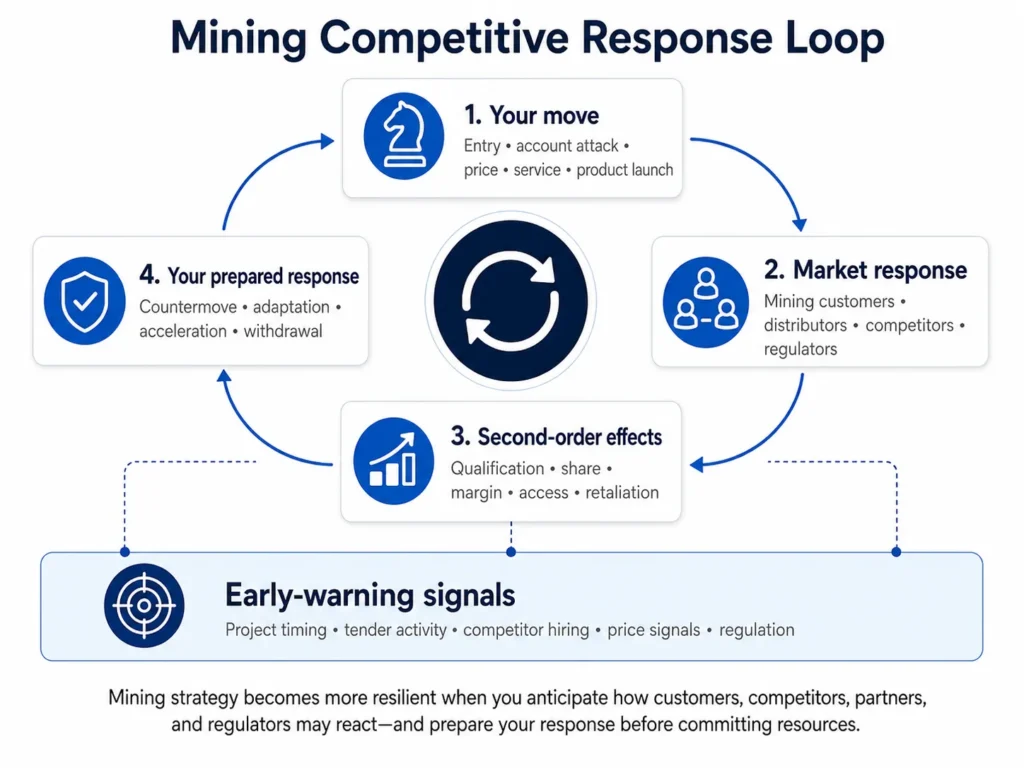
Figure 3: Mining strategy becomes more resilient when you anticipate how customers, competitors, partners, and regulators may react—and prepare your response before committing resources.
A Mining Strategy Can Combine Several Mining Products Consulting Workstreams
Your challenge may require one focused engagement or several capabilities working together.
Market entry consulting. Compare countries, mining segments, opportunity pools, entry models, risks, and implementation priorities. Explore market entry consulting.
Strategy consulting. Turn market, customer, competitor, and internal evidence into strategic choices, priorities, ownership, and an execution roadmap. Explore strategy consulting.
Wargame consulting. Anticipate competitor, customer, distributor, and regulatory reactions before a major move. Explore wargame consulting.
Benchmarking consulting. Understand the capabilities and practices behind stronger commercial, service, or operational performance. Explore benchmarking consulting.
Competitor analysis consulting. Build a deeper view of rival strategies, installed positions, pricing, service, vulnerabilities, and likely actions. Explore competitor analysis consulting.
Market analysis consulting. Size addressable demand, understand applications, map accounts and channels, and build the market fact base. Explore market analysis consulting.
Value proposition consulting. Translate technical performance into customer outcomes and a clearer reason to choose your solution. Explore value proposition consulting.
Win-loss analysis consulting. Understand why mines, distributors, or other customers chose you—or chose a competitor. Explore win-loss analysis consulting.
Brand consulting. Strengthen market credibility, relevance, differentiation, and trust around your offer. Explore brand consulting.
The advantage of combining these capabilities is that your mining strategy is built as one coherent decision system rather than as disconnected analyses.
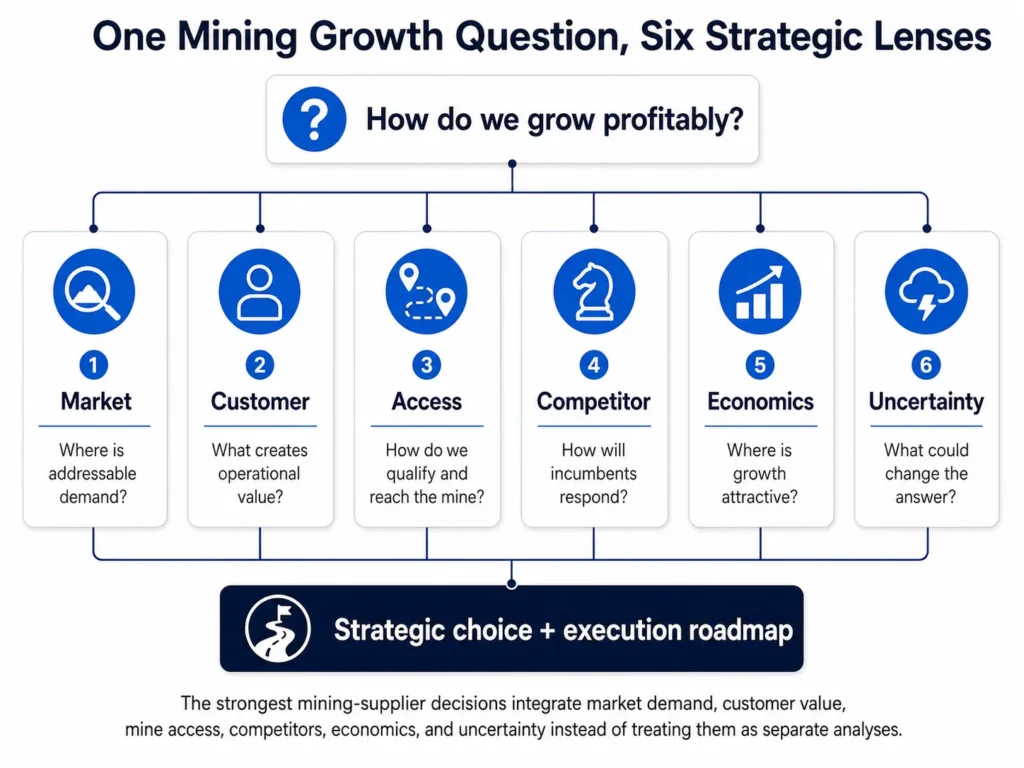
Figure 4: The strongest mining-supplier decisions integrate market demand, customer value, mine access, competitors, economics, and uncertainty instead of treating them as separate analyses.
Selected Evidence of Mining-Sector Consulting Experience
Our mining-related work has supported companies selling products, equipment, technology, consumables, and services into complex mining markets across different minerals, mine types, countries, and strategic decisions.
Examples of relevant supplier categories include pumps and valves, drilling equipment and bits, ventilation, filtration, consumables, wear parts, pipes and flow-control systems, safety equipment, electrical products, monitoring technologies, mining software, maintenance solutions, and other mine-site products and services.
Client assignments differ in scope and should not be treated as evidence that the same methodology, result, or recommendation applies to every mining supplier.
What Mining Products Consulting Clients Have Said
“Midas delivered practical, high-impact ideas that helped us expand market share in a competitive environment.”
Marketing Manager, Mining-Industry Supplier — identity withheld due to confidentiality
“Midas was highly effective, giving us the insights and tools we needed to co-create a robust strategy for complex markets.”
Finance executive, Mining-Industry Supplier — identity withheld due to confidentiality
“Midas helped us reassess priorities and focus our efforts where they truly mattered.”
Global Market Segment Leader, Mining-Industry Supplier — identity withheld due to confidentiality
“Midas combined deep market experience with thorough analysis, collaborating effectively across our teams to deliver actionable results.”
Global Product Manager, Mining-Industry Supplier — identity withheld due to confidentiality
Midas reports an 82.2% Net Promoter Score for client feedback collected during 2020–2025. This metric should be interpreted in the context of the respondent base and period measured.
Build the Evidence Around the Mining Decision
Public mining information is useful, but suppliers often need a different level of evidence.
Depending on the assignment, we may combine:
- Mine and project databases
- Production and investment information
- Installed equipment
- Fleet age and utilization
- Replacement cycles
- Consumption rates
- Maintenance intervals
- Import and trade data
- Procurement information
- Mine and contractor interviews
- Engineering input
- Distributor and dealer interviews
- EPCM interviews
- Former industry executives
- Technical specialists
- Competitor intelligence
- Company sales and margin data
- Management hypotheses
Important conclusions are triangulated whenever feasible.
We distinguish facts, estimates, assumptions, hypotheses, and unknowns. When the available evidence does not support one exact number, we prefer a defensible range or scenario to false precision.
Use Credible External Sources to Strengthen the Context
Client-specific strategy should not be built from generic public reports alone. However, authoritative sources can strengthen the context surrounding minerals, mine development, commodity demand, investment, safety, sustainability, and country risk.
Depending on the engagement, useful sources may include the U.S. Geological Survey National Minerals Information Center, the International Energy Agency’s critical-minerals resources, the World Bank’s extractive-industries resources, and relevant national mining ministries, geological surveys, regulators, and company filings.
These sources help establish context. They do not replace direct research with mines, technical users, procurement teams, contractors, distributors, competitors, and other market participants when the decision requires primary evidence.
Why Companies Work With Midas in Mining Products Consulting
More Than 25 Years of Experience
We have supported companies in mining products, industrial equipment, consumables, technology, and other complex B2B markets since 2000.
That experience matters because mining-sector growth requires both market judgment and an understanding of how technical credibility, service, logistics, qualification, customer risk, and economics interact.
Senior Involvement
Senior professionals remain involved in problem definition, research design, strategic interpretation, and management discussions.
Primary Market Intelligence
When public information is not sufficient, we develop evidence through mining companies, contractors, EPCMs, dealers, distributors, service companies, former executives, engineers, and technical specialists, subject to access and participant willingness.
Technical and Commercial Integration
We connect product performance with mine-site outcomes, qualification, supply, service, pricing, account strategy, customer value, and cost to serve.
Strategy Before Methodology
We do not begin by forcing your challenge into a standard framework. We begin with the decision you need to make and determine which evidence and analytical methods can best support it.
Transparent Limitations
Mine data, supplier information, installed bases, and commercial conditions can be incomplete or confidential.
We make assumptions, evidence gaps, estimates, and uncertainty visible rather than presenting artificial precision.
Confidentiality
Mining projects can involve sensitive information about accounts, pricing, distributors, trials, products, service capabilities, competitors, partnerships, and future strategy.
We can work under confidentiality agreements and anonymize public examples when disclosure has not been authorized.
Recommendations Designed for Execution
Your strategy must work technically, commercially, financially, operationally, and organizationally.
We focus on strategic choices, trade-offs, actions, ownership, and practical next steps, not only on analysis.
When Mining Products Consulting Creates the Most Value
An external strategic perspective can be especially useful when:
- You are entering or expanding in a Latin American mining market.
- You need to prioritize countries, minerals, mine sites, accounts, or applications.
- Your product has strong technical performance but adoption remains slow.
- You are losing tenders and internal explanations are inconsistent.
- Price pressure is weakening margins.
- You need to defend a premium through total-cost or productivity value.
- An incumbent is difficult to displace.
- Your distributor or partner model is not creating enough account access.
- You are considering local inventory, service, assembly, or manufacturing investment.
- You need to benchmark commercial, service, or aftermarket capabilities.
- You are preparing a major product launch or strategic account attack.
- You need to understand competitor economics or likely responses.
- Different internal teams hold conflicting views of the opportunity.
- You need to challenge a plan before committing significant resources.
- Commodity cycles, regulation, project timing, technology, or local-content requirements could materially change your assumptions.
When the cost of a wrong decision is high, improving the fact base before execution can be far less expensive than learning only after capital, inventory, management attention, or customer credibility have already been committed.
Frequently Asked Questions About Mining Products Consulting
What types of mining suppliers do you support?
We support companies selling products, equipment, technology, consumables, and services to mining companies, contractors, and related organizations. Relevant categories can include pumps and valves, drilling equipment, drill bits, ventilation, filtration, wear parts, safety equipment, pipes, electrical products, monitoring technologies, mining software, maintenance solutions, and other mine-site products and services.
Do you cover both open-pit and underground mining in your mining products consulting?
Yes. The analysis is adapted to the different operating conditions, equipment, processes, technical requirements, safety expectations, maintenance needs, service requirements, and buying criteria of open-pit and underground operations.
Which minerals can you analyze?
Depending on the assignment, the work may include copper, gold, lithium, silver, iron ore, coal, aggregates, industrial minerals, and other mineral segments. The most useful segmentation depends on your product and application.
Can you estimate the market for our mining product?
Yes, when sufficient evidence is available.
Depending on the product, we may combine installed equipment, operating hours, production, meters drilled, maintenance intervals, replacement rates, consumption rates, expansions, new projects, imports, competitor intelligence, and primary interviews.
When the evidence does not justify one exact figure, we normally use ranges and make the assumptions explicit.
Can you analyze installed mining fleets?
Yes. Depending on the product and data availability, we may analyze equipment population, brand and model mix, age, utilization, replacement cycles, maintenance practices, relevant consumables, compatible components, and aftermarket demand.
Can you identify relevant mines and mining projects?
Yes. We can identify and prioritize operating mines, new projects, expansions, underground developments, processing upgrades, maintenance opportunities, and life-extension projects.
Prioritization can consider project stage, probability, product relevance, access, qualification, incumbent suppliers, timing, economics, and strategic value.
Can you help us understand supplier qualification?
Yes. We can research supplier registration, technical requirements, safety documentation, quality standards, certifications, field-trial processes, references, approved-brand lists, local-service expectations, and procurement procedures.
Formal legal, engineering, safety, regulatory, or certification conclusions should be verified with appropriately qualified specialists.
Can you interview mining companies and technical users?
Yes. Depending on the assignment and access, primary research may include mine managers, operations teams, maintenance and reliability professionals, engineers, processing specialists, drilling professionals, safety teams, procurement, EPCMs, contractors, dealers, distributors, former mining executives, and technical specialists.
Can you evaluate our distributors or local partners?
Yes. We can assess account access, geographic coverage, technical capabilities, service, inventory, logistics, financial strength, conflicts, management commitment, commercial capability, and strategic fit.
We can also support decisions involving distributor replacement, supplementation, renegotiation, or a hybrid direct-and-indirect model.
Can you analyze competitors without relying only on public information?
Yes, subject to legal and ethical research practices.
We can combine public sources, market interviews, customer and channel evidence, benchmarking, commercial observations, and other legitimate sources of competitive intelligence.
We do not seek confidential competitor information through deception or improper means.
Can the engagement combine several consulting services?
Yes. Mining decisions frequently cut across market analysis, market entry, competitors, customer value, benchmarking, channels, strategy, and uncertainty. We can structure the work as one integrated program or as phases with decision gates between them.
How long does a mining consulting project take?
A focused market, competitor, account, distributor, or opportunity assessment may require several weeks. A multicountry or integrated strategy program can require longer.
We define the scope, milestones, deliverables, and expected timing before the engagement begins.
What information do you need from us?
Useful inputs may include strategic objectives, products, applications, sales, margins, installed-base estimates, priority accounts, distributors, technical specifications, service model, existing research, competitor hypotheses, and decision timetable.
We begin with what is already available and identify which additional evidence is worth obtaining.
How do you protect confidential information?
We treat client information as confidential and can work under a nondisclosure agreement. Sensitive client, account, product, pricing, partner, competitor, and strategic information can be anonymized in public examples when disclosure has not been authorized.
Do you guarantee a specific commercial result?
No responsible strategy advisor should guarantee a specific sales, margin, market-share, tender, account-entry, or market-entry result.
Performance depends on product quality, mine economics, qualification, customer acceptance, pricing, supply, service, partner execution, competitors, project timing, regulation, and other factors. Our role is to strengthen the evidence, choices, preparation, and execution behind your decisions.
Ready to Make the Next Mining Growth Decision With Greater Confidence?
You may be deciding where to invest, which mines to prioritize, how to displace an incumbent, which partner to select, how to defend margin, or how to prepare for an uncertain competitive move.
You do not need to have the entire problem defined before contacting us.
Tell us the decision you are facing, what you already know, and what remains uncertain. We will help you determine which evidence is worth gathering, which assumptions need to be challenged, and which strategic choices deserve management attention.