

Business Strategic Advisory for Boosting your Market Share and Profits!
When you are deciding where to grow, how to defend market share, how to respond to a competitor, or which strategic investment deserves priority, you do not need another generic presentation. You need a reliable fact base, a clear set of choices, and a practical path from decision to action.
That is the role of our business strategic advisory. At Midas Consulting, we work with C-level executives and leadership teams to clarify the decision, understand the market and competitive system around it, challenge assumptions, compare strategic options, and help your organization move forward with greater confidence.
You may be trying to accelerate growth, enter a new market, strengthen profitability, improve your value proposition, understand why competitors are winning, align your leadership team, or stress-test a strategy before committing major resources. We adapt the work to the decision you need to make rather than forcing your situation into a standard consulting template.
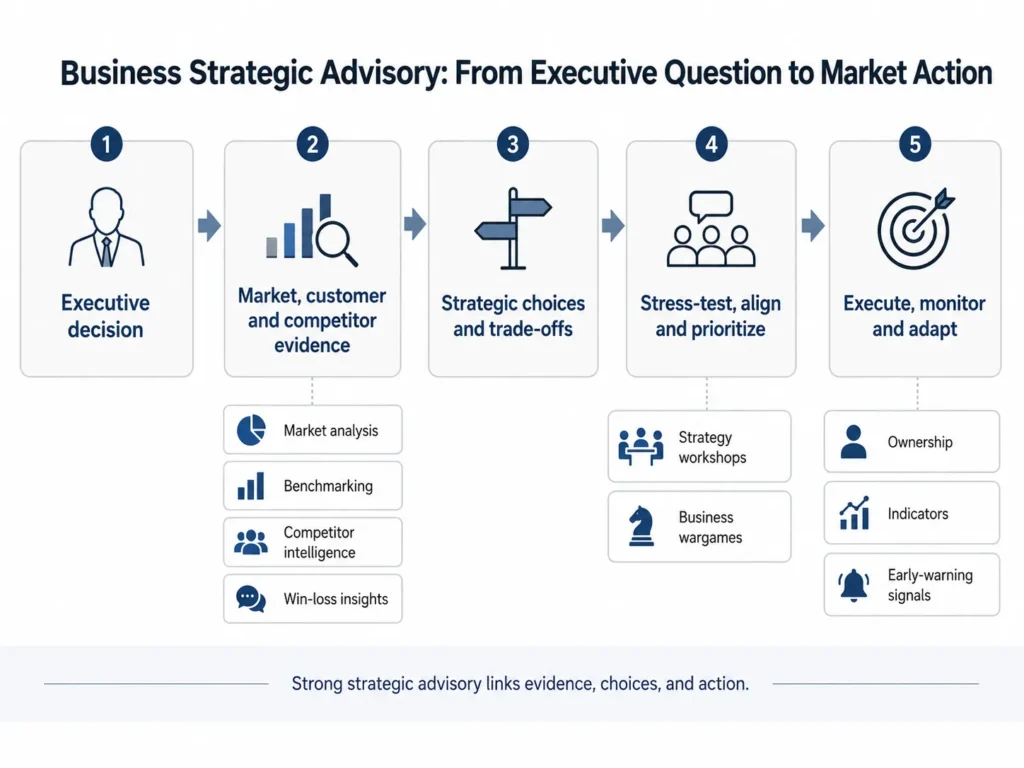
Figure 1: Strong strategic advisory connects evidence with explicit choices, tests those choices before resources are committed, and creates a practical path to execution.
The First Question Is Not “Which Consulting Service Do We Need?”
The first question is: What decision are you trying to make?
A market can be attractive and still be the wrong place for your company to invest. A competitor can appear cheaper and still be winning because of service, channel reach, trust, availability, or a stronger value proposition. A strategy can look compelling in the boardroom and still fail once competitors react or the organization tries to implement it.
That is why we begin with the management decision and the uncertainties that could materially change it. We then determine what evidence is needed, which analytical lenses matter, which assumptions must be challenged, and where primary research can add insight that public information cannot provide.
Your decision may involve where to compete, how to win, how to protect margin, which customers or segments to prioritize, whether to enter or exit a market, how to respond to a rival, which capabilities to strengthen, how to sharpen your brand or value proposition, or how to create leadership alignment around a difficult strategic choice.
Business Strategic Advisory Should Change the Decision, Not Just Add Information
Executives rarely suffer from a complete lack of information. More often, the challenge is that the available information is fragmented, internally biased, inconsistent across countries or functions, or disconnected from the decision that leadership actually needs to make.
Our role is to help you separate signal from noise. We connect market attractiveness, customer priorities, competitor behavior, performance gaps, commercial economics, organizational capabilities, and future uncertainty so you can compare options on a common strategic basis.
The output should not be a long report that describes the market. It should help you answer practical questions such as: Which opportunity deserves investment? Which competitor weakness is real and exploitable? Which customer problem is worth owning? Which capability gap matters most? Which assumption could invalidate the strategy? Which response should we prepare before competitors move?
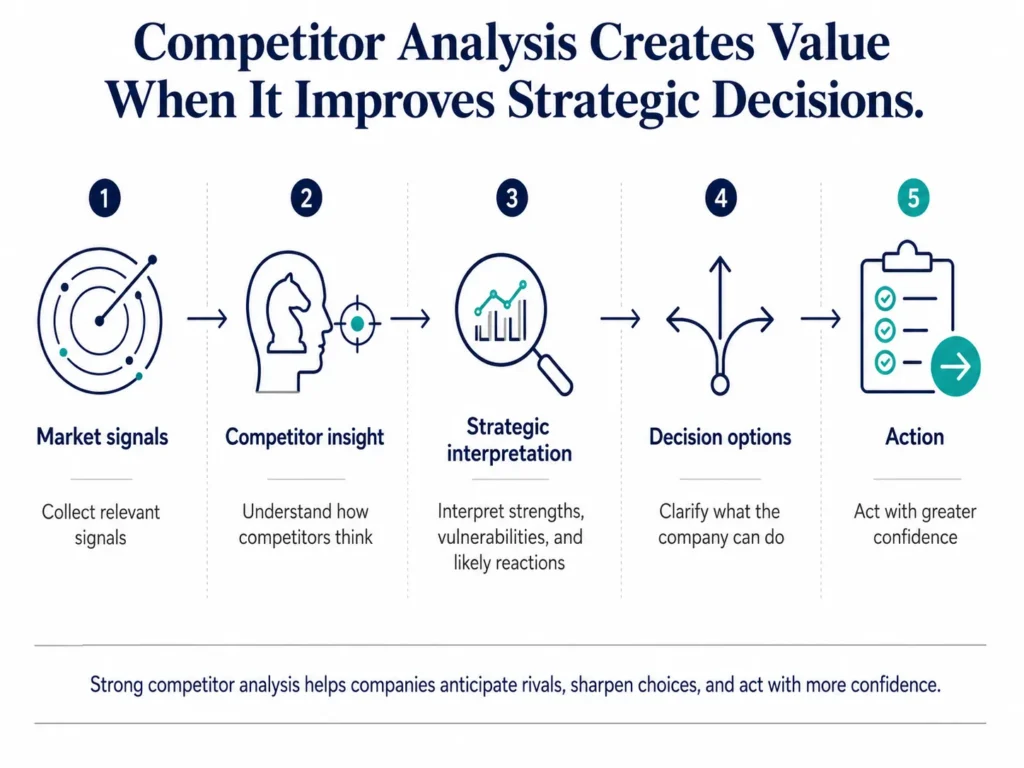
Figure 2: Strategic intelligence creates value when market and competitive signals are interpreted in the context of the decision and translated into actionable strategic options.
Choose the Business Strategic Advisory Lens That Fits Your Decision
Some strategic questions require one focused discipline. Others require several. We combine the services below when that produces a stronger answer, while keeping one executive decision at the center of the engagement.
Benchmarking Consulting
Use benchmarking when you need to understand why a competitor, peer, internal unit, or best-in-class company performs differently. We go beyond rankings and averages to explain the drivers behind cost, productivity, service, commercial effectiveness, operating models, capabilities, and performance gaps, and which lessons are actually transferable to your business.
Brand Consulting
Use brand consulting when awareness is not translating into preference, pricing power, loyalty, or growth. We connect customer perceptions and competitive positioning with the business system behind the brand, including portfolio, pricing, channels, sales, service, customer experience, and communication.
Competitor Analysis Consulting
Use competitor analysis when the outcome of your decision depends on what rivals want, what they can do, where they are vulnerable, and how they may respond. We examine objectives, assumptions, strategies, capabilities, constraints, likely moves, and response patterns so you can make a stronger competitive choice.
Market Analysis Consulting
Use market analysis when you need to determine whether demand is attractive and accessible, where the value pools are, what customers need, how the economics work, what barriers matter, and where your organization has a credible ability to win. The goal is not a market-size number; it is a better growth or investment decision.
Market Entry Consulting
Use market entry consulting when you are deciding whether, where, and how to expand. We help you assess market attractiveness, customers, competitors, regulation, profitability, channels, distributors or partners, and execution feasibility so you can prioritize the markets where the probability of success justifies the investment.
Strategy Consulting
Use strategy consulting when the central challenge is to define where to compete, how to win, what to prioritize, what to stop doing, and how to align the organization around those choices. Our workshop-based approach brings the right people, evidence, questions, trade-offs, and ownership into the same decision process.
Value Proposition Consulting
Use value proposition consulting when customers do not see a compelling reason to choose you, your teams describe your value differently, or price is dominating the conversation. We connect customer priorities, competitive alternatives, proof, economic value, and execution so your proposition becomes a strategic choice system rather than a slogan.
Win-Loss Analysis Consulting
Use win-loss analysis when your CRM tells you what happened but not why. Independent buyer interviews help reveal the real reasons customers choose you, choose a competitor, delay, or do nothing. We translate those patterns into action across sales, positioning, pricing, product, service, channels, customer experience, and go-to-market strategy.
Wargame Consulting
Use business wargaming when your strategy could trigger reactions from competitors, customers, regulators, distributors, or other market actors. A structured simulation helps your leadership team expose blind spots, test assumptions, anticipate countermoves, improve preparedness, and refine the strategy before the market tests it for you.
How Our Business Strategic Advisory Engagement Works
1. Define the executive decision
We start by clarifying what your leadership team must decide, what success would look like, which options are already under consideration, what the organization believes today, where internal views differ, and which uncertainties could materially change the answer.
2. Translate the decision into critical questions
We identify the few questions that can change the decision. Depending on the situation, these may involve market demand, customer priorities, competitor economics, channel access, brand preference, pricing, product fit, regulatory conditions, organizational capabilities, or likely competitive response.
3. Build and triangulate the fact base
We combine the evidence that is appropriate for the decision. That can include public sources, internal data, financial and commercial information, customer interviews, distributor or channel perspectives, supplier insight, expert interviews, former industry participants, field research, competitor intelligence, win-loss interviews, and structured comparison across countries or segments.
We do not treat one anecdote, one database, or one executive opinion as the truth. We compare sources, test contradictions, distinguish verified findings from estimates and hypotheses, and make the strength of the evidence visible.
4. Convert evidence into strategic options
The analysis is only useful if it changes what you might do. We translate the evidence into a limited set of strategic options and compare the trade-offs: impact, risk, investment, timing, competitive response, organizational fit, capability requirements, and execution difficulty.
5. Challenge the strategy before you commit
For high-stakes decisions, we can use executive workshops, scenarios, strategic foresight, or business wargaming to pressure-test assumptions and explore reactions before resources are committed. The purpose is not to predict one future with false certainty. It is to expose vulnerabilities early and prepare for several plausible developments.
6. Align ownership, action, and monitoring
We work with your team to clarify priorities, ownership, sequencing, decision triggers, and the indicators that should be monitored after the recommendation. Preliminary findings are shared during the engagement, allowing your team to challenge conclusions, add internal knowledge, and redirect deeper research toward the questions that still matter.
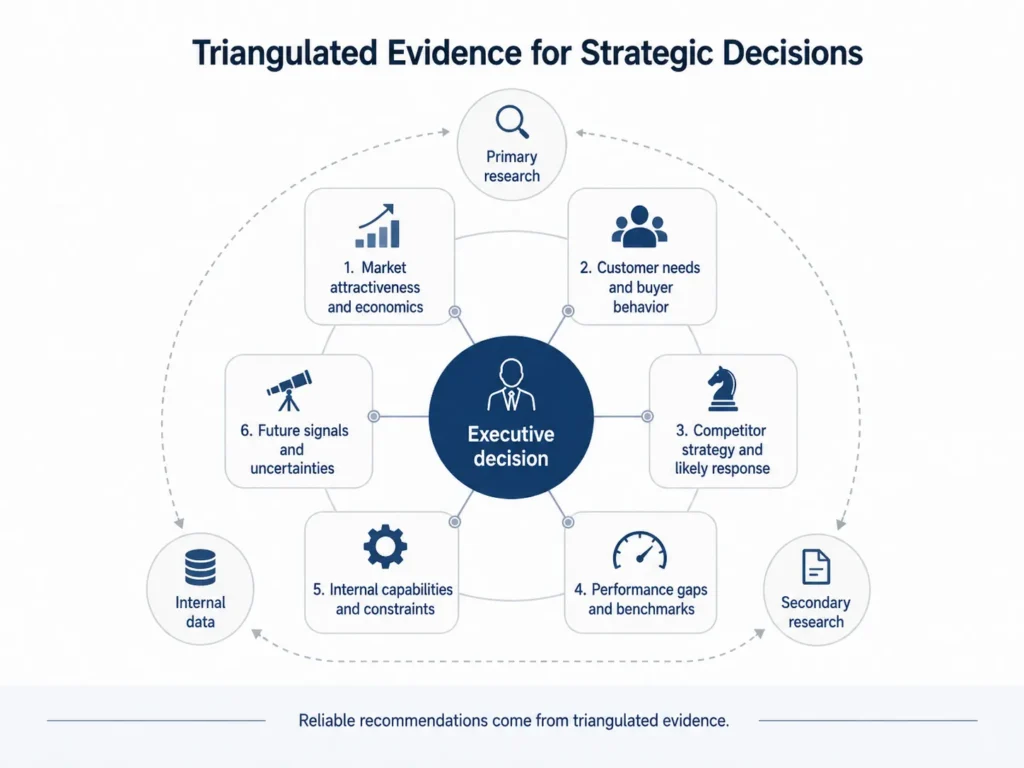
Figure 3: Reliable recommendations come from triangulating market, customer, competitor, performance, capability, and future-facing evidence around one executive decision.
Why This Matters in Latin America
Regional strategies often fail when companies assume that one market behaves like another. Across Latin America, country differences in regulation, inflation, taxes, channel concentration, distributor power, imports, customer relationships, financing, informality, service expectations, and data availability can materially change both the economics and the way competitors behave.
That means your regional strategy needs a common strategic logic without erasing local reality. We use comparable frameworks across countries while normalizing the differences that can distort conclusions. This helps you decide what should be standardized regionally and what requires local adaptation.
Evidence, Ethics, and Confidentiality Matter
Strategic advice is only as credible as the evidence behind it. For competitive and market intelligence work, we use lawful and professional research methods. We do not seek trade secrets, misrepresent who we are, request confidential documents, or encourage anyone to violate legal or contractual obligations.
Our competitive-intelligence work follows the principles of the SCIP Code of Ethics. We also make uncertainty visible: verified facts, estimates, hypotheses, competitor claims, internal assumptions, and unknowns should not all be presented with the same level of confidence.
Your internal information, strategic priorities, and research objectives are treated as confidential. When appropriate, projects can operate under a mutual nondisclosure agreement and with research protocols designed around the sensitivity of the decision.
Experience Should Be Visible in the Way the Work Is Designed
Midas Consulting has worked with leadership teams for more than 25 years across Latin America and selected global markets. Our team brings senior operating and consulting experience across marketing, sales, finance, strategy, market intelligence, research, and business development.
Our current service pages document more than 300 competitor-analysis projects, more than 300 benchmarking projects, more than 200 market-analysis projects, and more than 200 market-entry engagements. We have also facilitated business wargaming and strategy work for more than two decades.
Client feedback collected between 2020 and 2025 produced a Net Promoter Score of 82.2%. We share that number because trust should be supported by evidence, but the more important test is whether the engagement helps your leadership team see the decision more clearly and act on it.
Our partners and directors bring more than 160 years of combined experience and have held leadership responsibilities in areas such as marketing, sales, finance, market research, competitive intelligence, pharmaceuticals, industrial products, consumer goods, and services. You can learn more about the people behind the work on our Midas Consulting team page.
Selected Examples of Strategic Advisory in Action
Turning benchmarking into commercial redesign
In one regional benchmarking engagement, we compared sales structures, roles, compensation, coverage, and commercial practices across several Latin American markets for a multinational healthcare company. The client adapted its model by country while preserving a clearer regional logic; the program contributed to a 30% increase in sales within one year.
Using competitor intelligence to support an acquisition decision
For another client, we compared private Brazilian competitors across market position, customers, capacity, growth, profitability, risk, owner willingness, and strategic fit. The analysis helped the leadership team prioritize the strongest acquisition target and use the transaction to improve its competitive position.
Replacing a simple price explanation with a stronger competitive response
In a competitor-analysis engagement, the initial assumption was that a rival was gaining share mainly because of lower prices. Customer and channel evidence showed a broader explanation involving distributor relationships, technical support, buying simplicity, and a clearer proposition. Instead of responding with a broad price cut, the client refined segment priorities, strengthened distributor support, and targeted the competitor where it was more vulnerable.
These examples are illustrative of prior Midas engagements. Results depend on each company’s starting position, market conditions, execution, and other factors; no specific outcome is guaranteed.
What Clients Value in the Relationship
“Thanks to Midas, we walked away with a clear, well-organized strategy. The collaboration between different business units and the fresh market insights were outstanding.”
Go-to-Market Manager
“They are responsive, professional, detail-oriented, and client-focused. I love that Midas prioritizes co-success with the client and works hard to meet our needs and solve our problems.”
Executive Chair
“We left with great ideas to grow our market share. I realized there’s not just one way to win, but many.”
Marketing Manager
Go Deeper Into the Thinking Behind Our Approach
If you want to understand the methods before discussing an engagement, explore how strategic benchmarking explains performance gaps, how competitor analysis moves from intelligence to strategic action, and how market analysis supports better investment and growth decisions.
For customer and commercial choices, see our guides to building a stronger value proposition and using win-loss analysis beyond the sales function.
For strategy design and preparedness, explore strategy workshops as an executive decision process, how to design and implement a business wargame, and how to decide which markets deserve investment.
You can also review our Strategic Foresight and Competitive Response executive insights, which bring together Midas thinking on competitive response, early-warning systems, wargaming, and strategic execution under uncertainty.
How We Protect the Link Between Insight and Execution
A consulting recommendation creates no value if your organization cannot use it. That is why we involve the right executives and specialists during the engagement, share preliminary findings before the final recommendation, make trade-offs explicit, and build the final output around the decisions, owners, and next steps that matter to you.
When alignment is part of the problem, we can facilitate structured leadership workshops. When competitive reaction is a major risk, we can add a wargame. When the future environment is uncertain, we can define scenarios, signals, and response triggers. When customer choice is poorly understood, we can add independent buyer research. The advisory architecture changes with the decision; the discipline of moving from evidence to action does not.
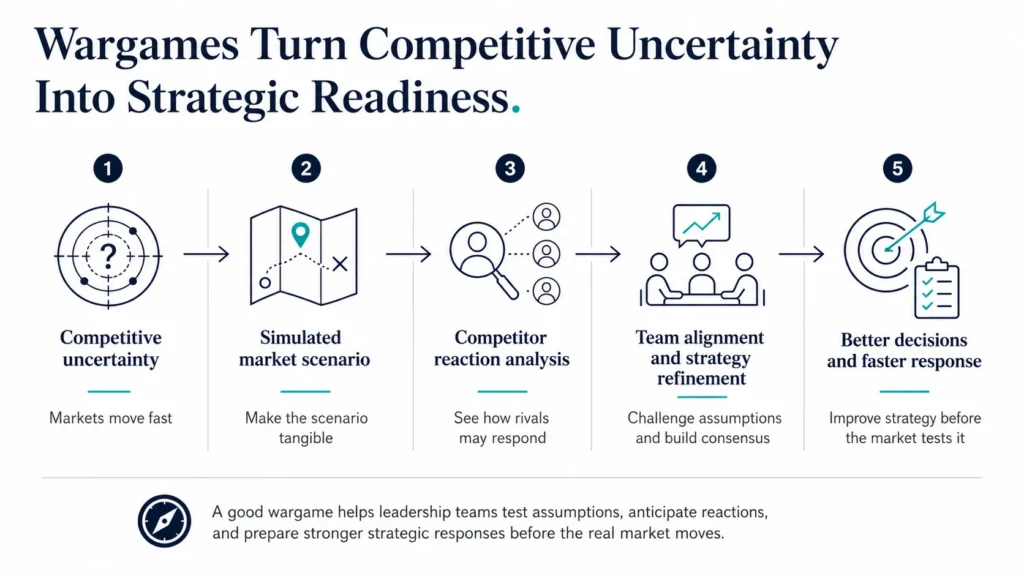
Figure 4: When competitor reactions could materially change the outcome, testing the strategy before execution can expose blind spots and improve strategic readiness.
Frequently Asked Questions About Business Strategic Advisory
What is business strategic advisory?
Business strategic advisory is decision-oriented support for leadership teams facing important growth, market, competitive, positioning, investment, or execution choices. It combines evidence, strategic analysis, executive judgment, and collaboration to help your organization choose what to do and prepare to act.
How is business strategic advisory different from a generic consulting report?
A generic report usually starts with a topic and provides information. Our approach starts with your decision. Research, analysis, workshops, and deliverables are selected according to their ability to change or strengthen that decision.
What if we do not know which business strategic advice service we need?
You do not need to diagnose the methodology before contacting us. Tell us what you are trying to decide, what is making the decision difficult, and what could go wrong. We can then recommend whether the situation calls for market analysis, competitor analysis, benchmarking, win-loss, market entry, value proposition, brand strategy, a strategy workshop, a wargame, or a combination.
Do you conduct primary research for your business strategic advice?
Yes, when primary research can materially improve the decision. Depending on the engagement, that may include interviews with customers, distributors, suppliers, experts, former industry participants, institutions, regulators, or other knowledgeable market participants.
Can you work across several Latin American countries with your business strategic advice?
Yes. We use common definitions and analytical frameworks where regional comparability matters, while adapting the evidence and interpretation to country-specific differences in regulation, economics, channels, customer behavior, competitive dynamics, and execution conditions.
Can you analyze private competitors?
Yes. Depending on the question, we can combine lawful public information, primary research, customer and channel evidence, field observation, economic logic, and strategic inference. We distinguish what is verified from what is estimated or hypothesized rather than presenting uncertain information as fact.
Can you help us move from recommendation to implementation with your business strategic advice?
Yes. We can help your team prioritize actions, define ownership, facilitate alignment, identify decision triggers, and establish the indicators that should be monitored. The exact role depends on the project and on what your organization wants to own internally.
How long does a business strategic advisory project take?
Timing depends on the number of markets, competitors, interviews, workstreams, strategic questions, and decision deadline. A focused diagnostic may take several weeks; a multi-country or highly technical engagement may require longer. We can structure work in phases and share preliminary findings before the final recommendation.
How do you handle confidentiality in your business strategic advice engagements?
We treat your internal information, objectives, and strategic priorities as confidential. When appropriate, we can work under a mutual nondisclosure agreement and design research protocols that protect sensitive information while still allowing us to build a reliable external fact base.
About Midas Consulting — Corporate Author
Midas Consulting is the corporate author and provider of this business strategic advisory service. We help C-level executives and leadership teams make stronger strategic decisions through market analysis, competitor analysis, benchmarking, market entry, strategy consulting, value proposition development, brand consulting, win-loss analysis, business wargaming, strategic foresight, and related advisory work.
Our methodologies are strengthened by senior practice leadership with decades of operating, consulting, research, and teaching experience. Individual leaders contribute expertise, but the service, recommendations, quality standards, and page authorship belong to Midas Consulting as an organization.
Our strategic perspective also recognizes that competition extends beyond direct rivals. Industry structure can be shaped by customers, suppliers, substitutes, new entrants, and existing competitors, consistent with Michael Porter’s work on competitive forces published by Harvard Business Review. We combine established strategic thinking with primary market evidence and the realities of the markets in which you compete.
Last reviewed: August 2026
What Strategic Decision Are You Facing?
You may be defending share, looking for the next growth platform, deciding whether to enter a country, trying to understand a competitor’s advantage, reviewing a weak value proposition, questioning your channel model, considering an acquisition, aligning a regional leadership team, or preparing for a market change that could make today’s strategy obsolete.
You do not need to arrive with the methodology defined. Bring the decision. In an initial conversation, we will discuss what you are trying to achieve, what your team already knows, where the uncertainty sits, the deadline you face, and which questions could materially change the strategy.
From there, we can propose a focused business strategic advisory engagement with a clear scope, research approach, collaboration model, deliverables, timing, and investment.