Brand consulting in Latin America, grow in challenging environment.
Across Latin America, your brand can be recognized everywhere and still mean something different in every market.
A promise that builds preference in Brazil may feel distant in Chile. A brand that wins on trust in Colombia may be trapped in price competition in Argentina. A regional campaign may look consistent while local customers, distributors, employees, and decision-makers interpret it in ways headquarters never intended.
The executive challenge is not simply to standardize or localize. It is to decide:
What must remain strategically consistent across the region, what should adapt by country or segment, and how should your organization respond when customer expectations, competitors, channels, and cultural meanings begin to shift?
At Midas Consulting, we help you answer that question with evidence. We combine brand diagnosis, qualitative and quantitative research, competitive benchmarking, segmentation, value analysis, and strategic foresight to show how your brand is really perceived, and what leadership should change.
The result is not another brand-tracking report. It is a regional decision system that connects brand meaning with preference, loyalty, pricing power, channel strength, customer experience, and profitable growth.
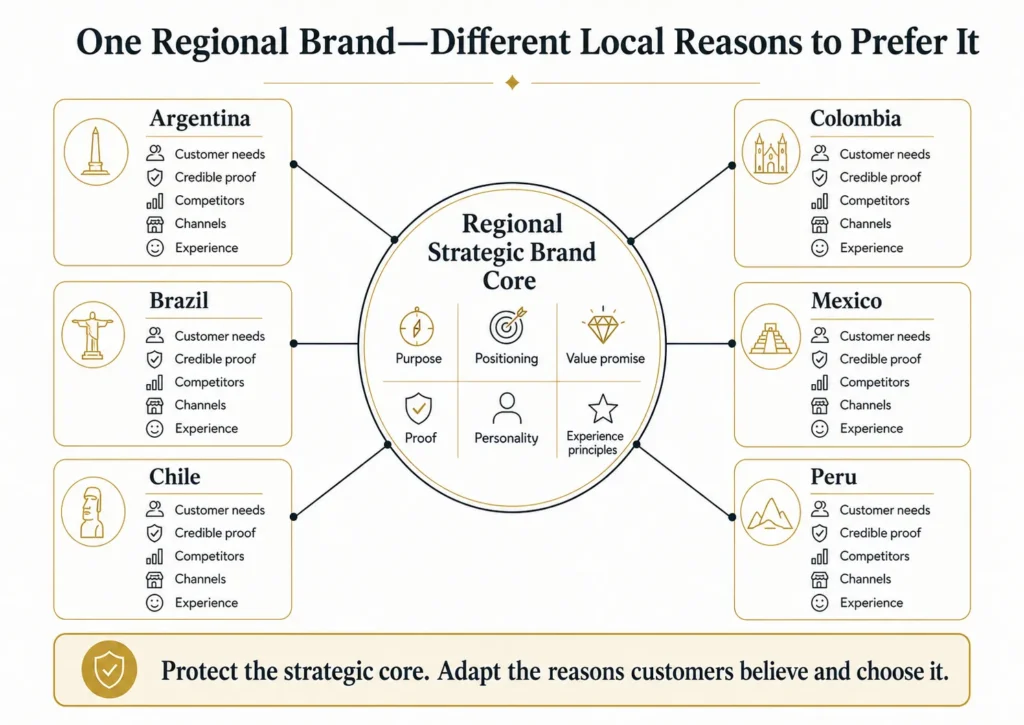
Figure 1. A regional brand should preserve a clear strategic core while adapting the proof, expression, channels, and customer experience that create preference locally.
The Strategic Question Is Not “Should the Brand Be Global or Local?”
That framing is too simplistic.
The stronger executive question is:
Which parts of the brand create scale and strategic coherence, and which parts must change to remain relevant, credible, and competitive in each market?
- Which customer needs are shared across markets.
- Which needs, tensions, and purchase drivers vary locally.
- Which brand associations should be consistent.
- Which proof points need local validation.
- Which competitors define the frame of reference in each country.
- How much flexibility country teams should have.
- Where local adaptation strengthens the brand—and where it fragments it.
- How positioning should influence portfolio, pricing, channels, communication, and experience.
The goal is not uniformity. It is strategic coherence with enough local relevance to create preference.
Awareness Is Not the Same as Preference
A well-known brand may still be seen as interchangeable, associated with an outdated benefit, respected but not preferred, strong with users but weak with decision-makers, or difficult to justify at a premium.
Leadership needs to understand:
- What the brand stands for in the customer’s mind.
- Which functional, emotional, economic, and reputational benefits matter.
- How clearly the brand differs from alternatives.
- Whether customers believe the promise.
- What prevents consideration, preference, loyalty, or recommendation.
- How brand perception affects sales conversion and pricing power.
Brand Strength Is a Business Asset, not a Communication Metric
Your brand can influence how quickly customers understand your offer, whether they include you in the shortlist, how much proof they require, how they interpret your price, whether distributors prioritize you, how easily new products gain acceptance, and how resilient you are when competitors attack.
A strong brand reduces friction across the commercial system. A weak or unclear brand forces every function to work harder.
Latin America Is One Region, but Not One Brand Market
Regional strategies often fail through over-standardization or over-localization. The right balance depends on the category, customer, buying system, channel structure, brand maturity, and competitive context.
Argentina
Volatility, inflation, promotions, regional differences, and fragile loyalty can push brands toward short-term price competition.
Brazil
Scale, cultural diversity, language, strong local competitors, digital behavior, and regional differences require more than translating a regional campaign into Portuguese.
Chile
High recognition may not convert into preference when customers see limited differentiation, insufficient local relevance, or stronger evidence from competitors.
Colombia
Trust, reputation, emotional connection, local credibility, regional diversity, and channel influence can determine whether recognition becomes active preference.
Mexico
Regional cultures, North American influence, local identity, concentrated business groups, retail structures, and industrial clusters can change how the same promise is interpreted.
Peru
Recognition can remain superficial when a brand lacks local proof, emotional relevance, regional reach, or a customer experience strong enough to overcome incumbent relationships.
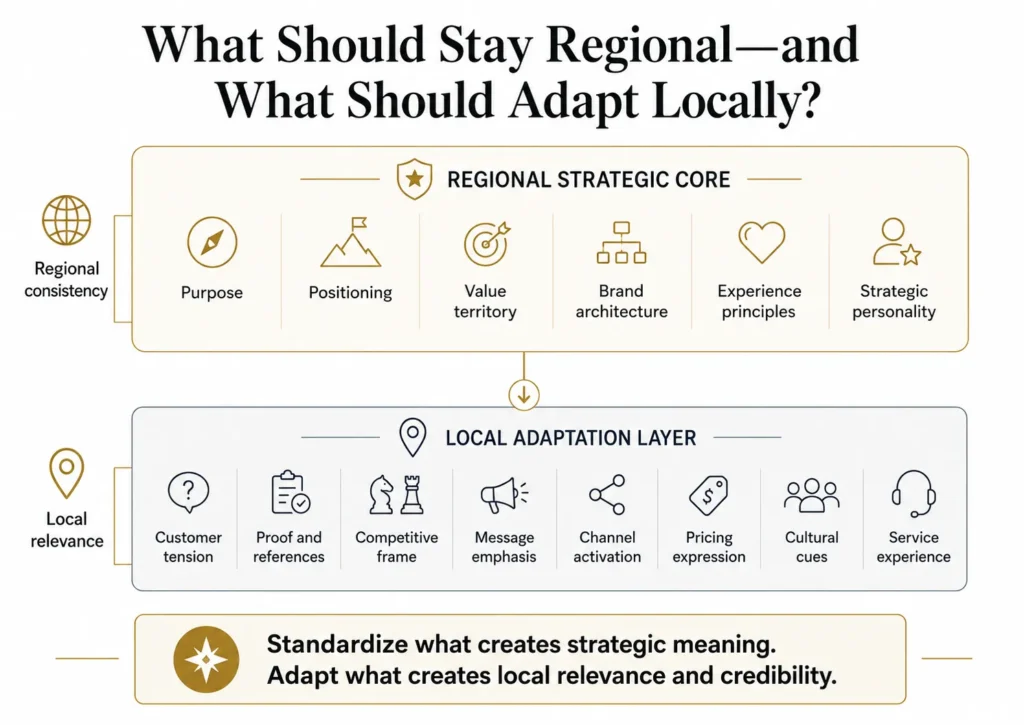
Figure 2. Regional brand governance should standardize the elements that create strategic meaning and adapt the elements that create local relevance, credibility, and commercial response.
Brand Strategy Must Anticipate Change, not Only Measure the Present
Traditional brand research describes current awareness, associations, satisfaction, and preference. Your leadership team also needs to know which expectations are emerging, which associations are becoming less relevant, which competitors are redefining the category, and which weak signals could become material threats.
Midas’s broader strategic work emphasizes converting market signals into executive action, stress-testing assumptions, identifying critical success factors, and anticipating competitor responses rather than treating strategy as a static document.
For branding, that means moving from “What does our brand mean today?” to “What will customers need to believe tomorrow, how will competitors respond, and what must we strengthen before the market forces us to react?”
Brand Research Should Lead to Decisions
Many companies already track awareness, consideration, NPS, satisfaction, image attributes, and campaign performance. The problem is rarely lack of data. It is the absence of a decision framework.
Brand evidence should help leadership decide which positioning territory to own, which segments deserve priority, which associations to strengthen or abandon, whether the brand architecture is clear, and how strategy should affect pricing, innovation, channels, sales, and customer experience.
What Midas Evaluates Through IDB360
- Awareness and top of mind.
- Consideration and preference.
- Brand health and relevance.
- Functional and emotional associations.
- Differentiation and credibility.
- Net Promoter Score and advocacy.
- Perceived value and pricing power.
- Competitive positioning.
- Segment and country differences.
- Customer experience and delivery of the promise.
- Brand architecture and portfolio clarity.
- Internal alignment and execution capability.
The Six Tests of a Strong Regional Brand
1. Relevance
Does the brand address a need, tension, aspiration, or risk that matters to priority customers?
2. Differentiation
Does it occupy a territory that customers can distinguish from alternatives?
3. Credibility
Do proof, experience, capabilities, and behavior support the promise?
4. Coherence
Do portfolio, communication, channels, pricing, sales, and service reinforce the same strategic meaning?
5. Local adaptability
Can the brand remain relevant across countries and segments without fragmenting?
6. Future resilience
Can the positioning withstand changes in customer expectations, channels, regulation, technology, and competitor behavior?
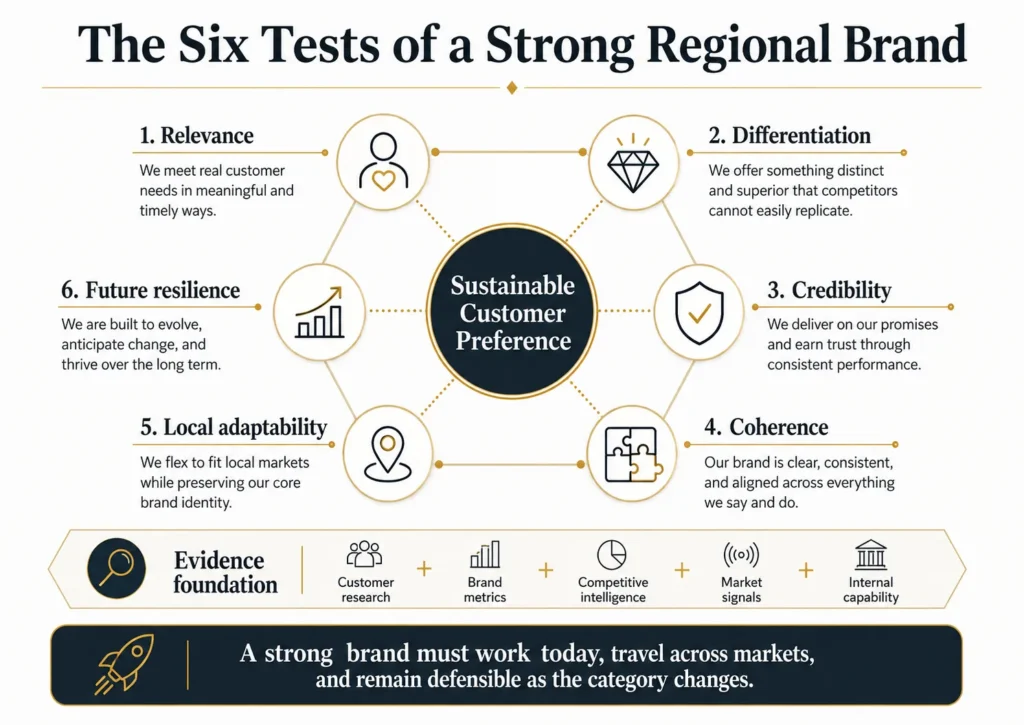
Figure 3. Sustainable regional preference requires relevance, differentiation, credibility, coherence, local adaptability, and resilience to future market change.
How Midas Consulting Builds a Regional Brand Strategy in Latin America
1. Define the executive decision
We clarify whether leadership needs to strengthen preference, reposition the brand, protect margins, align countries, respond to a competitor, simplify the portfolio, support market entry, or prepare for changing expectations.
2. Build the regional fact base
We combine existing research, brand metrics, market data, competitive intelligence, customer evidence, channel input, and internal perspectives.
3. Listen to customers and stakeholders
We use interviews, focus groups, quantitative surveys, win-loss insights, distributor research, expert interviews, or other methods appropriate to the decision.
4. Diagnose the brand by market and segment
We identify shared strengths, local weaknesses, emerging opportunities, competitive threats, and differences in the drivers of preference.
5. Map the competitive brand landscape
We compare the territories, claims, proof, experiences, and emotional spaces competitors appear to own.
6. Identify strategic brand territories
We evaluate territories against customer relevance, competitive whitespace, credibility, profitability, organizational fit, and future resilience.
7. Define the regional core and local adaptation rules
We specify what must remain consistent and where country teams have permission to adapt.
8. Translate strategy into the commercial system
We connect positioning with communication, portfolio, innovation, pricing, channels, sales enablement, customer experience, and service.
9. Mobilize and measure
We define priorities, ownership, indicators, governance, and a learning cycle.
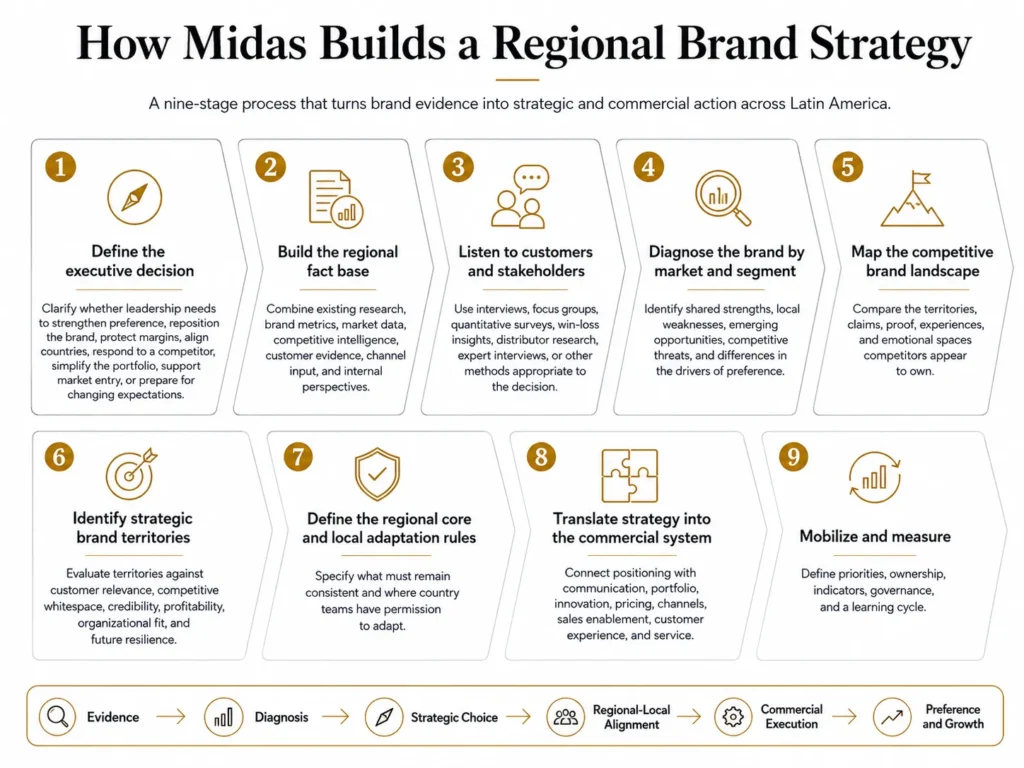
Figure 4. Midas’s nine-stage regional brand strategy process turns customer, market, and competitive evidence into a clear strategic choice, coordinated regional-local execution, and measurable preference and growth.
What Leadership Should Receive in a Brand Consulting Project in Latin America
- An executive diagnosis of the brand’s current position.
- Country and segment comparisons.
- Awareness, relevance, differentiation, credibility, preference, and loyalty findings.
- Competitive brand and territory maps.
- Customer needs and decision-driver analysis.
- Perceived-value and pricing implications.
- Brand architecture and portfolio recommendations.
- Regional core and local adaptation guidelines.
- Customer-experience and channel implications.
- Future signals and competitive-response scenarios.
- A prioritized roadmap with owners and indicators.
- An executive workshop to align regional and country leadership.
Explore Brand Strategy Consulting by Country in Latin America
- Brand Consulting in Argentina
- Brand Consulting in Brazil
- Brand Consulting in Chile
- Brand Consulting in Colombia
- Brand Consulting in Mexico
- Brand Consulting in Peru
For our full consulting offer, visit Brand Consulting for a Stronger Market Position.
For Midas’s broader thinking on strategic foresight and execution, visit Strategic Foresight and Execution: Insights for the Global Executive.
Why Midas for Brand Strategy Consulting in Latin America?
- Business strategy connection: We link positioning and brand equity with market share, pricing power, channel strength, innovation, and growth.
- Research plus judgment: We combine qualitative and quantitative evidence, benchmarking, market intelligence, and executive interpretation.
- Regional-local balance: We identify what should be standardized and what must adapt.
- Foresight and competitive response: We examine emerging expectations, competitor moves, and the future defensibility of the positioning.
- Execution focus: We translate strategy into portfolio, communication, pricing, channels, sales, service, and customer experience.
- Experience: Midas has more than 200 brand studies across Latin America.
Frequently Asked Questions About Brand Consulting in Latin America
Is branding consulting in Latin America mainly about communication?
No. Communication expresses the strategy, but brand strength also depends on positioning, proof, portfolio, pricing, channels, service, customer experience, and organizational behavior.
Should one regional positioning be used in every country?
The strategic core may be regional, but the customer tension, proof, message emphasis, channel activation, and experience often require local adaptation.
How do you know what should be standardized with your brand consulting in Latin America?
We evaluate whether the element creates strategic meaning and scale across markets. Elements that create local relevance or credibility may need controlled adaptation.
Can a well-known brand still be weak?
Yes. Awareness does not guarantee relevance, differentiation, credibility, preference, loyalty, or pricing power.
Can brand consulting help B2B companies in Latin America?
Yes. In B2B markets, brand perception can influence shortlisting, risk, trust, proof requirements, distributor support, and willingness to pay.
Can you compare our brand with competitors with your brand consulting in Latin America?
Yes. We compare positioning territories, associations, value, proof, experience, consideration, preference, and perceived strengths and weaknesses.
Can you help us respond to a new competitor with your brand consulting in Latin America?
Yes. We can assess how an entrant may reshape category expectations and define strategic and tactical responses.
Can you evaluate brand architecture with your brand consulting in Latin America?
Yes. We can assess the roles and relationships among corporate, master, product, service, and sub-brands.
Can brand research in Latin America support pricing decisions?
Yes. Research can show whether the brand creates enough relevance, differentiation, trust, and perceived value to support a premium.
Can you work across several Latin American countries with your brand consulting?
Yes. We use a common framework for comparison while adapting research and interpretation to each market.
How do you convert brand consulting research into action in Latin America?
We connect findings with specific choices, priorities, owners, indicators, governance, and an implementation roadmap.
About the Author
Víctor Sales Navas, COO, leads Midas Consulting’s Branding Practice and brings more than 34 years of experience across Latin America.
A graduate in Accounting from the Universidad de Buenos Aires, Víctor built his career at leading advertising agencies including Young & Rubicam, ADD, and Gowland. He developed deep expertise in brand strategy, market research, benchmarking, competitive intelligence, and mergers and acquisitions.
He also heads Midas’s Services Practice, advising clients in logistics, ports, consumer goods, and industrial products. Víctor has directed projects throughout the region and successfully led multiple start-ups in Latin America.
He speaks English, Portuguese, and Spanish and is recognized for translating market insight into actionable brand and business strategy.
Build a Brand That Travels Across Markets Without Losing Meaning
You may be trying to understand why your brand performs differently by country, why awareness is not becoming preference, how to protect margins, how to respond to a competitor, or how much freedom local teams should have.
You do not need more disconnected metrics. You need a clear view of how customers interpret the brand, which differences matter, which strategic territory you can own, and how regional and country teams should act.
In an initial conversation, we will discuss your markets, portfolio, customer segments, current research, competitors, brand challenges, and the executive decisions the engagement must support.