
Market analysis in Latin America to unlock growth!
Latin America may look like one regional growth opportunity from headquarters. It rarely behaves like one in the market.
A country with attractive demand may be difficult to access. A smaller market may offer better margins, stronger distributor fit, faster regulatory access, or less entrenched competition. Customers may value technical performance in one country, financing in another, local references in a third, and service coverage somewhere else.
That is why regional market analysis should not simply rank countries by GDP, population, imports, or estimated market size. Those indicators help describe a market. They do not tell you whether the opportunity is accessible, profitable, strategically relevant, or realistic for your company.
At Midas Consulting, we help your leadership team answer the harder questions: Which markets deserve priority? Where is demand genuinely attractive? What will customers require from you? Which channels can provide access? What will it cost to compete? Where are the risks manageable? And in which countries do your capabilities give you a credible right to win?
The result is not a collection of country reports. It is a regional strategic choice: where to focus, how to enter or expand, what to adapt, which assumptions to test, and how to sequence investment.
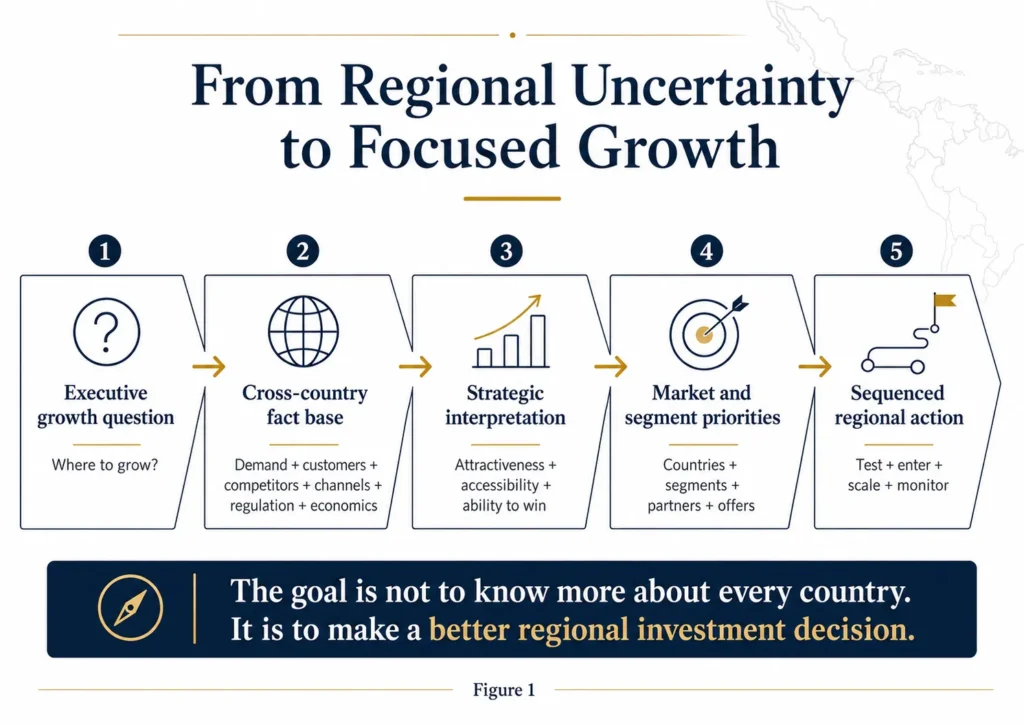
Figure 1. Regional market analysis creates value when country evidence is converted into priorities, strategic choices, and sequenced action.
The Strategic Market Analysis Question Is Not “How Large Is Latin America?”
Regional headline data can establish scale, but they can also create false confidence. Large populations and expanding categories do not automatically create attractive opportunities for your company.
A strategically useful market analysis asks a different set of questions:
- How much demand is economically and commercially accessible to you?
- Which customers, applications, and use cases generate the most attractive value?
- How concentrated or fragmented is demand?
- What criteria determine supplier choice?
- How strong are existing competitors and substitutes?
- Which channels, distributors, institutions, or partners control access?
- What regulatory, technical, financial, or operational barriers must you overcome?
- Can your business model deliver the required price, service, financing, and responsiveness?
- What level of investment is required before the opportunity becomes scalable?
- Which markets should you enter now, prepare for later, or decline?
The objective is to move from theoretical market potential to the opportunity your company can realistically capture and serve profitably.
Market Size Is Not the Same as Market Opportunity
Executives often begin with total market size. That is useful, but insufficient.
A large market can be unattractive because demand is concentrated among inaccessible accounts, purchasing is dominated by a few incumbents, regulation slows entry, margins are weak, service costs are high, or the required channel capabilities do not exist.
A smaller market may be strategically superior because customers have an unmet need, competitors are weak, approval is faster, pricing is healthier, a capable distributor is available, or your existing capabilities transfer more effectively.
A stronger regional assessment separates several layers:
Total market
The broad category, including all products, customers, applications, and channels that might appear relevant.
Relevant market
The portion that fits your product, technology, regulatory position, and strategic scope.
Accessible market
The demand you can realistically reach through available channels, approvals, partners, commercial capabilities, and service coverage.
Economically attractive market
The portion that can generate acceptable margins and returns after pricing, cost-to-serve, channel economics, investment, working capital, and risk are considered.
Winnable market
The opportunity where your value proposition and capabilities can outperform existing alternatives strongly enough to create customer movement.
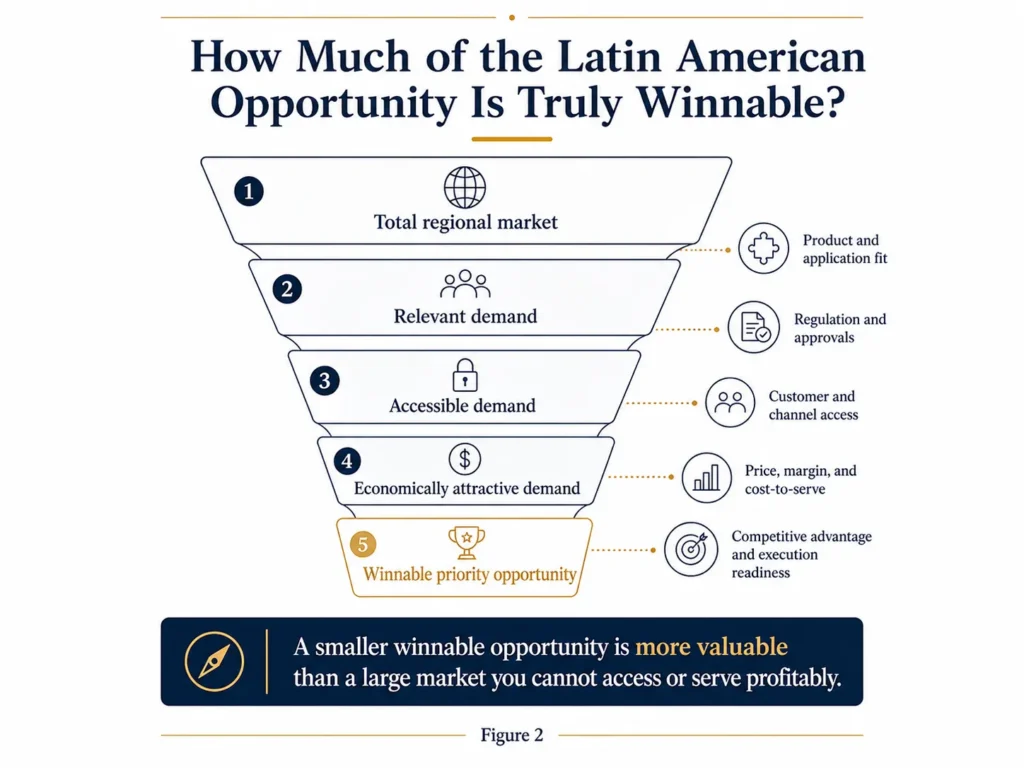
Figure 2. Market analysis should narrow theoretical regional demand into the priority opportunity your company can access, serve profitably, and win.
Why the Same Offer Performs Differently Across Latin America
A regional strategy often starts with the assumption that a proven offer can be transferred with limited adaptation. Market analysis tests that assumption before your company commits significant resources.
Performance can change from country to country because of differences in:
- Customer needs and purchasing criteria.
- Willingness to pay and price sensitivity.
- Financing, credit, and payment practices.
- Distributor reach, quality, and economic incentives.
- Service expectations and geographic coverage.
- Competitive intensity and incumbent relationships.
- Regulation, certifications, registrations, and procurement rules.
- Local production, imports, logistics, and availability.
- Market concentration and account structure.
- Management autonomy and execution speed.
The strategic implication is not that every country needs a completely different model. It is that you need to distinguish what can be standardized regionally from what must be adapted locally.
What Should Be Standardized, and What Must Remain Local in Market Analysis in Latin America?
Standardize the strategic questions
A consistent regional framework allows you to compare countries and prevent local enthusiasm or internal politics from distorting priorities.
Across markets, you can assess:
- Demand size, growth, and concentration.
- Customer needs, decision criteria, and willingness to pay.
- Competitive intensity and available substitutes.
- Channel structure and partner quality.
- Pricing, margin, and cost-to-serve.
- Regulatory and market-access requirements.
- Execution capabilities and investment needs.
- Strategic fit and ability to win.
Adapt the evidence and interpretation
The data sources and market mechanisms behind those questions may differ considerably. Public tenders may be important in one country. Import statistics may be more useful in another. A third may require extensive interviews because formal data fail to capture channel activity or customer behavior.
The relevant market definition may also change. A category defined by product in one country may need to be analyzed by application, institution, region, or customer segment elsewhere.
Compare the reason behind the score
Regional scoring systems can be helpful, but only when the explanation behind each score remains visible.
Two countries may receive the same channel-attractiveness rating for entirely different reasons. One may have several capable distributors and manageable conflict. Another may offer one excellent partner but create significant dependence. The same score should not imply the same strategy.
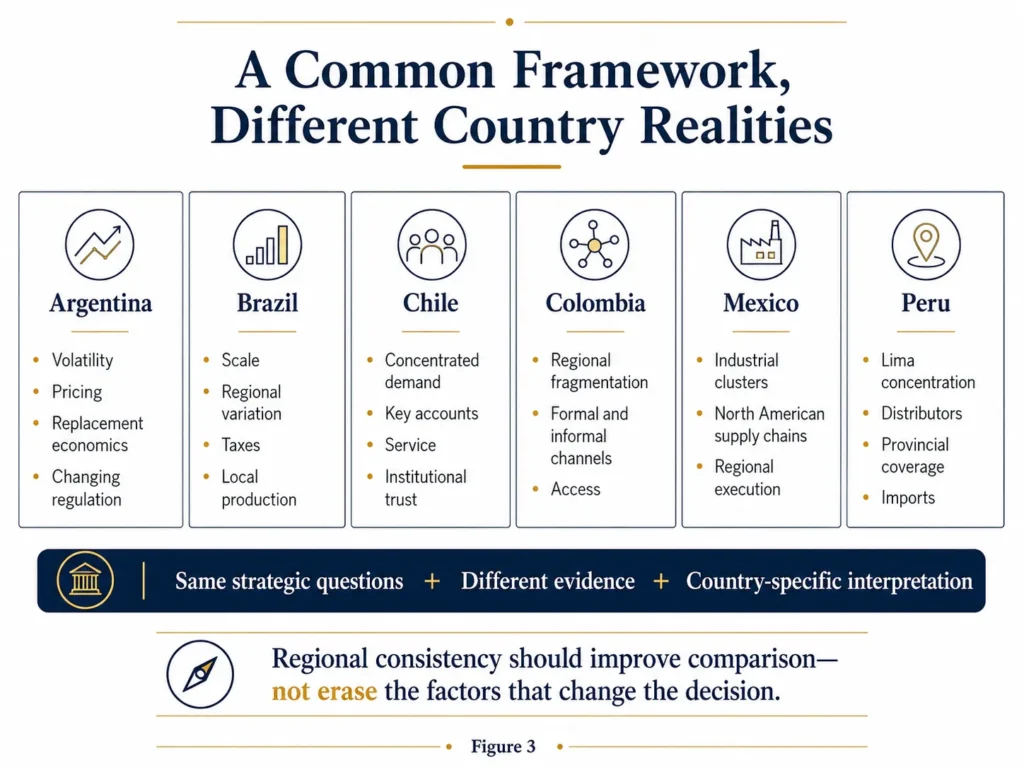
Figure 3. A regional market analysis in Latin America should use consistent strategic questions while adapting evidence and interpretation to each country.
How Market Reality Changes Across Priority Countries
The themes below are starting hypotheses, not universal descriptions of every sector. Their purpose is to show why a regional decision requires country-level validation.
Argentina: Can the opportunity survive economic and regulatory change?
In Argentina, nominal market growth, prices, and customer spending can be difficult to interpret without considering inflation, exchange rates, imports, inventory, payment terms, replacement economics, and changing regulations.
Your analysis should distinguish real volume and value growth from nominal effects and test whether the opportunity remains attractive under more than one plausible economic scenario.
Explore market analysis in Argentina.
Brazil: Where within the national market is the opportunity attractive?
Brazil’s scale can conceal major differences by state, region, industrial cluster, channel, tax structure, logistics model, and customer segment.
Your analysis should determine where demand is concentrated, how delivered economics change geographically, and whether your channels, production, supply, and service model can support the opportunity.
Explore market analysis in Brazil.
Chile: Is the market large enough, and can you access the accounts that matter?
Chile can offer attractive institutional quality and customer sophistication, but some categories are narrow or concentrated among a limited number of accounts, retailers, institutions, or industries.
Your analysis should connect market size with account access, switching barriers, service requirements, channel power, and the cost of building credibility.
Explore market analysis in Chile.
Colombia: How much demand is hidden by regional and channel fragmentation?
Colombia’s cities and regions can differ in income, customer behavior, industry concentration, institutional access, and route to market. Formal statistics may not fully capture informal channels, independent distributors, or regional competitors.
Your analysis should validate where demand actually occurs and distinguish customer preference from the availability and access created by channels.
Explore market analysis in Colombia.
Mexico: Which industrial ecosystems and regions offer the strongest fit?
Mexico combines a large domestic market with industrial clusters and North American supply-chain integration. Demand, customer requirements, competitor strength, channels, and local capabilities can vary substantially by region and industry.
Your analysis should determine which clusters are relevant, whether you can serve multinational and local customers, and which capabilities must be localized.
Explore market analysis in Mexico.
Peru: Is the opportunity driven by demand, or controlled by access?
In Peru, Lima concentration, distributor economics, imports, inventory, credit, provincial reach, and access to strategic accounts can shape visible market performance.
Your analysis should determine whether market growth can be captured through the available route to market and where regional or account-level gaps create an opening.
Explore market analysis in Peru.
How to Prioritize Markets Without Oversimplifying Them in Market Analysis in Latin America
Country rankings are valuable when they force explicit trade-offs. They become dangerous when a single score hides the logic of the decision.
A strong prioritization should combine at least three perspectives:
Market attractiveness
- Accessible demand and growth.
- Customer need and willingness to pay.
- Margin and value-pool potential.
- Competitive intensity.
- Regulatory and structural risk.
Ability to win
- Value-proposition fit.
- Brand, references, and relationships.
- Channel and partner capabilities.
- Product, service, and supply readiness.
- Relative capabilities versus competitors.
Execution feasibility
- Required investment and working capital.
- Time to approval and commercial access.
- Availability of talent and partners.
- Operational complexity.
- Management attention and implementation risk.
The best market is not necessarily the one with the highest theoretical attractiveness. It is the one that gives your company the most attractive combination of opportunity, strategic fit, access, economics, and executable advantage.
Why We Conduct Regional Market Analysis in Latin America in Waves
At the beginning of a multi-country project, your team rarely knows exactly which markets, segments, and issues deserve the deepest research. Attempting to study everything at the same level can waste time and budget.
A wave-based approach improves focus.
First wave: Establish the comparative fact base
We assess the broad opportunity across countries, test the initial market definitions, identify major differences, and challenge your most important assumptions.
Management refinement: Redirect the effort
Your leadership team reviews preliminary findings. Markets that initially appeared attractive may become less compelling. Smaller opportunities may emerge as strategically superior. New questions may become more important than the original scope.
Second wave: Deepen the priority decisions
We focus additional research on the countries, segments, channels, partners, customers, and economic questions that can change the decision.
This prevents your team from overanalyzing low-priority markets and gives decision makers an opportunity to shape the analysis before it is finalized.
For the complete market-analysis process and the rationale for wave-based research, visit Market Analysis: The Key to Informed Strategic Decisions.
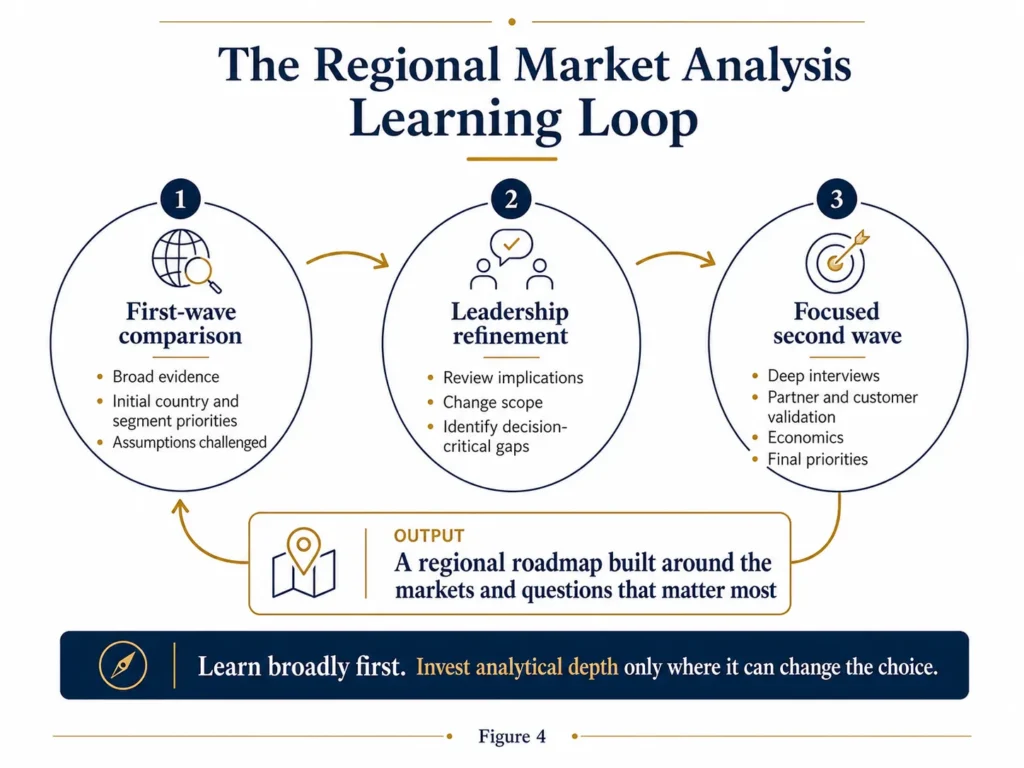
Figure 4. Wave-based analysis allows regional leadership to redirect research toward the opportunities and uncertainties that matter most.
How Midas Structures a Regional Market Analysis in Latin America
The scope is designed around your decision, but a regional engagement typically includes five broad elements:
1. Define the growth decision
We clarify what your team must decide, the countries and products under consideration, the assumptions behind the opportunity, the investment horizon, and the criteria for success.
2. Establish a consistent comparison framework
We define common questions and metrics so that countries can be compared meaningfully without forcing artificial uniformity.
3. Build and validate country-level evidence
We combine secondary information with primary interviews involving customers, distributors, suppliers, experts, institutions, regulators, and other knowledgeable sources where appropriate.
4. Interpret attractiveness, accessibility, and fit
We distinguish market size from accessible demand, connect customer value with channel and competitive realities, assess economics, and determine what your company would need in order to win.
5. Convert the findings into a regional roadmap
We recommend which countries and segments to prioritize, how to sequence entry or expansion, which partners or customers to evaluate, what to adapt, and which assumptions should be tested before scaling.
We share preliminary findings during the project so that your team can challenge conclusions and redirect the analysis before the final recommendation.
Case Example: From Regional Presence to Double the Sales
The executive challenge
A multinational manufacturer of medicinal-gas equipment already operated in Brazil, Mexico, Argentina, and Colombia. The company believed the region offered considerable growth potential, but it lacked a clear explanation of where the best opportunities were and how its strategy should differ by country.
The key question was not whether demand existed. It was how to convert regional presence into a focused growth strategy.
How we approached the decision
We combined secondary research with interviews involving equipment manufacturers, medical-gas producers, hospitals, distributors, and other market participants.
The analysis assessed:
- Market size, growth, and segment structure.
- Customer needs and purchasing criteria.
- Competitor positions and sources of advantage.
- Critical success factors and barriers.
- Distribution and partner capabilities.
- Market risks and plausible future developments.
- The strategic differences among Brazil, Mexico, Argentina, and Colombia.
Rather than recommend one regional commercial model, we identified the country-specific actions required to support one coherent growth objective.
How the market analysis findings in Latin America changed the strategy
The final roadmap clarified where to focus, which customer groups and opportunities deserved priority, how the commercial approach should change by country, and which capabilities were required to execute.
With the country-specific strategy in place, the company doubled its regional sales within four years.
The case demonstrates the value of regional synthesis: growth came not from treating Latin America as one market, but from coordinating different country choices around one strategic objective.
“Thanks to Midas, we walked away with a clear, well-organized strategy. The collaboration between different business units and the fresh market insights were outstanding. Kudos!”
— Go-to-Market Manager
“Their report and analysis were thorough. They collaborated well with our team, including our tech department. One of the reasons we chose them was their depth of experience, which was evident throughout the project.”
— Global Product Manager
When You Need a Regional Market Analysis in Latin America
A regional approach is particularly valuable when you are:
- Deciding which Latin American countries to enter first.
- Reviewing why growth differs despite a common regional strategy.
- Prioritizing countries, segments, applications, or customer groups.
- Evaluating whether a product or business model can transfer across markets.
- Planning a regional product launch or portfolio investment.
- Comparing distributors, partners, or market-entry models.
- Assessing regional pricing, margins, and cost-to-serve.
- Building a fact base for an acquisition, partnership, or capacity decision.
- Trying to identify where a smaller but more accessible opportunity may outperform a larger market.
- Aligning regional and country leadership around investment priorities.
Why Midas for Market Analysis in Latin America?
We begin with the strategic decision
We do not start with a generic market-report template. We define what your leadership team must decide and focus the research on information that can change that decision.
We connect market attractiveness with your ability to win
A market can be attractive and still be wrong for your company. We examine opportunity, access, economics, strategic fit, capabilities, and execution readiness together.
We combine regional consistency with local depth
We use a common framework for comparison while adapting market definitions, evidence, interviews, and interpretation to each country.
We use primary research where published data is insufficient
In many Latin American industries, databases are incomplete, too aggregated, or unable to explain customer and channel behavior. We validate the fact base through carefully designed interviews and market checks.
We work in waves
Preliminary findings allow your team to redirect the research toward the countries and strategic issues that matter most before the project is completed.
We translate insight into a sequenced roadmap
The engagement ends with priorities, strategic choices, assumptions to test, partner or customer actions, and a practical sequence for entry or expansion.
We bring direct experience in market analysis in Latin America
We have analyzed B2B, B2C, industrial, technology, consumer, pharmaceutical, and healthcare markets across Latin America, supporting market entry, growth, pricing, channel, portfolio, investment, and acquisition decisions.
Ethical and Reliable Market Intelligence Analysis in Latin America
We comply with SCIP’s Code of Ethics, the profession’s gold standard. We comply with applicable laws, accurately disclose relevant identity and organizational information before interviews, avoid conflicts of interest, provide honest recommendations, and promote ethical conduct throughout the engagement.
We do not seek trade secrets, request confidential documents, misrepresent who we are, induce contractual breaches, or facilitate improper exchanges of competitively sensitive information.
We also make the limitations of the evidence visible. We distinguish verified facts from estimates and hypotheses, triangulate interview findings, explain market definitions, and use ranges when the available evidence does not support false precision.
You can review SCIP’s ethical intelligence guidance and Code of Ethics.
Frequently Asked Questions about Market Analysis in Latin America
Can you compare several Latin American countries using the same framework?
Yes. We define common strategic dimensions such as accessible demand, customer needs, competition, channels, regulation, economics, fit, and execution requirements. We then adapt the sources and interpretation to each market.
How do you avoid comparing countries using inconsistent data in your market analysis in Latin America?
We define the market, time period, product scope, geography, channels, units, and assumptions before comparing estimates. We triangulate data and explain where perfect comparability is not possible.
Can you rank the markets we should enter with your market analysis?
Yes. We can build a transparent prioritization that combines market attractiveness, ability to win, and execution feasibility. The ranking includes the rationale and trade-offs behind each position rather than relying on one opaque score.
How do you estimate market size when public data is limited in your market analysis in Latin America?
We combine relevant official and commercial data with imports, company activity, customer demand, channel interviews, pricing, installed base, usage, or other industry-specific evidence. We use ranges when exact estimates are not defensible.
Can you analyze both B2B and B2C markets with your market analysis in Latin America?
Yes. The research design changes according to how customers buy, how demand is concentrated, what channels matter, and which decisions the analysis must support.
Do you conduct interviews in each country for your market analysis in Latin America?
When primary research is required, we interview relevant customers, distributors, suppliers, experts, institutions, regulators, and other knowledgeable sources. The number and type of interviews depend on the decision and market.
Can you evaluate distributors or market-entry partners with your market analysis in Latin America?
Yes. We can assess coverage, customer access, inventory, credit, technical capability, service, regulatory knowledge, commitment, competing brands, and strategic fit.
Can you analyze pricing and profitability across countries in your market analysis in Latin America?
Yes. We can examine effective pricing, discounts, terms, channel margins, taxes, freight, service, working capital, and cost-to-serve where relevant and ethically obtainable.
How does the wave-based market analysis process work?
The first wave establishes broad comparisons and tests assumptions. Your team then reviews the implications and refines the questions. The second wave deepens research only where additional precision can change the decision.
How long does a market analysis in Latin America take?
The timing depends on the number of countries, products, segments, interviews, and questions involved. We define the scope around your deadline and can share preliminary findings in phases.
Will the recommendations of your market analysis be regional or country-specific?
Usually both. We identify which priorities and capabilities should be coordinated regionally and which elements of pricing, channels, positioning, service, or execution need local adaptation.
About the Author
Adrian Alvarez, PhD is Managing Partner at Midas Consulting, Wharton Alumnus, MBA Professor at Universidad Argentina de la Empresa (UADE), and Competitive Intelligence Fellow. He specializes in competitive strategy, market analysis, strategic intelligence, market entry, and executive decision-making under uncertainty in Latin America.
He has analyzed B2B, B2C, technology, industrial, consumer, pharmaceutical, and healthcare markets across the region. His work has been published in the United States, Spain, and Germany. You can access his library of strategic insights and published research here
View professional profile on LinkedIn
Selected Sources for Regional Market Analysis in Latin America
The sources required depend on the industry and decision. Regional analysis may draw from:
- World Bank Data for comparable macroeconomic and development indicators.
- Economic Commission for Latin America and the Caribbean for regional economic and social analysis.
- International Monetary Fund Data for economic and financial indicators.
- Inter-American Development Bank for regional sector, infrastructure, productivity, and development research.
- National statistical agencies, central banks, regulators, customs and trade sources, procurement platforms, company disclosures, industry associations, and primary market interviews.
Official data provide essential context, but strategic decisions usually require more granular evidence about customers, channels, competitors, economics, and execution.
Turn Regional Potential into a Focused Growth Decision
You may be deciding which countries to enter, where to invest, why regional performance differs, which segments deserve priority, or whether your existing commercial model can scale across Latin America.
You do not need seven disconnected country reports or a ranking based only on market size. You need a clear view of where demand is attractive, where access is realistic, where your capabilities create an advantage, and how to sequence action without overcommitting resources.
In an initial conversation, we will discuss your growth decision, the countries and products involved, what your team already knows, the assumptions you need to test, and which uncertainties could materially change the strategy.
We can then propose a focused regional market-analysis engagement with a clear scope, wave-based research plan, collaboration model, timing, and deliverables.