
Market analysis in Brazil to grow and compete better!
Brazil’s national scale can make almost any opportunity look attractive from a distance.
But the market you can actually capture may be concentrated in a limited number of states, industrial clusters, channels, applications, or customer groups. Demand may be strong in one region and difficult to serve profitably in another. A national distributor may have excellent relationships in selected territories but little operational reach elsewhere. Local production may improve availability and customer confidence while creating fixed-cost, tax, capacity, or complexity risks.
That is why market analysis in Brazil should not stop at national market size, population, imports, or category growth. It should help your leadership team understand where the opportunity exists, how customers buy, what the delivered economics look like, which capabilities are required, and where your company has a credible right to win.
At Midas Consulting, we combine secondary research, primary market interviews, regional validation, economic analysis, and strategic interpretation so you can make stronger decisions about market entry, regional prioritization, local production, channels, pricing, service, portfolio, partnerships, acquisitions, and investment in Brazil.
The result is not one national answer. It is a focused growth strategy that shows where to compete, what must be localized, how the commercial and operating model should change, and how to sequence investment.
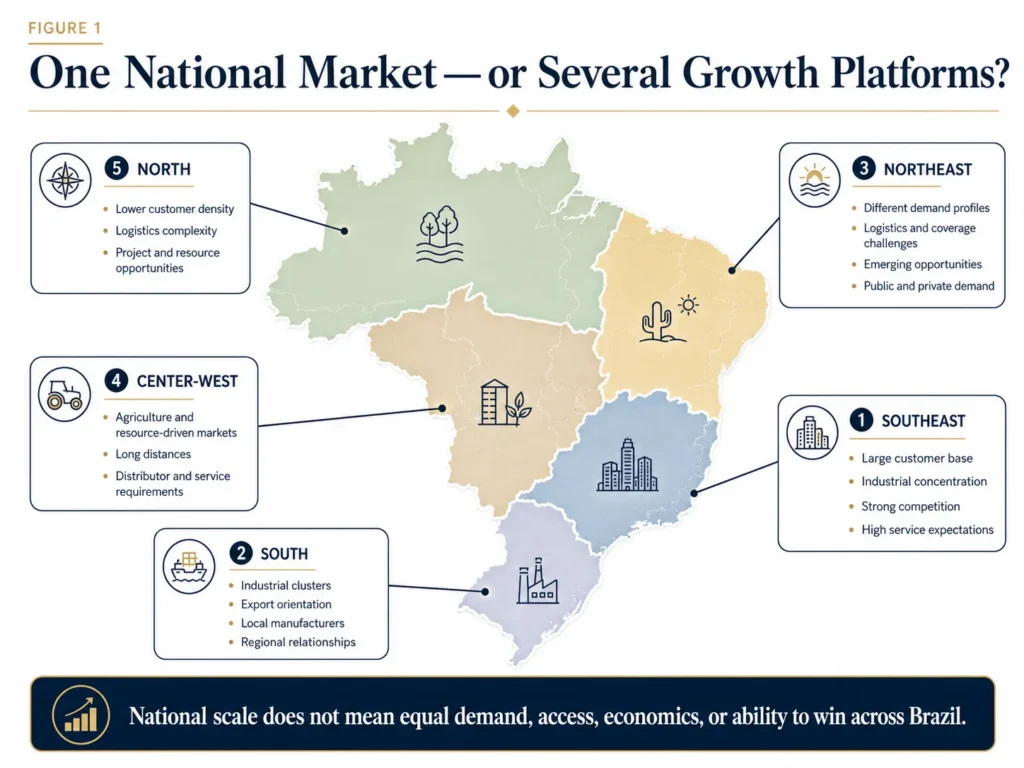
Figure 1. Brazil’s national scale conceals different opportunity structures, customer concentrations, service requirements, and competitive conditions across regions.
The Strategic Market Analysis Question Is Not “How Large Is Brazil?”
Brazil may be large enough to justify strategic attention in many industries. That does not mean every segment, region, or route to market offers attractive economics for your company.
Your leadership team needs to understand:
- Where demand is concentrated by state, region, city, industry, application, and customer group.
- Which parts of the market are growing—and which are only large.
- How purchasing criteria differ among regions and customer segments.
- Where competitors are deeply embedded and where customers remain underserved.
- How taxes, freight, inventory, service, and channel margins change delivered economics.
- Whether your existing product, pricing, and service model fits local expectations.
- Which distributors, dealers, integrators, or direct-sales capabilities can provide real access.
- Whether local production creates a genuine advantage or unnecessary complexity.
- What level of investment and management attention is required before growth becomes scalable.
- Which opportunities should be entered now, developed in stages, accessed through partners, or rejected.
The objective is to move from Brazil’s theoretical national potential to the specific opportunity your company can access, serve profitably, and defend.
National Market Size Can Hide the Opportunity That Matters
Demand may be geographically concentrated
A national estimate can be dominated by the Southeast, one industrial corridor, a limited number of metropolitan areas, or a few large customers. Your market may not be “Brazil.” It may be a defined set of states, industrial clusters, institutions, applications, or accounts.
Category size may hide different economic pools
Two segments can generate similar revenue while requiring very different investment, service, working capital, channel support, and cost-to-serve. The most attractive value pool may not be the largest volume segment.
Reported coverage may not equal executable access
A company or distributor may claim national reach while operating strongly in only selected states. True access depends on sales activity, customer relationships, inventory, credit, technical competence, logistics, service, and management focus.
Growth can be attractive but difficult to capture
A high-growth segment may already be controlled by entrenched competitors, require certifications or local references, depend on a few accounts, or demand a service network your organization does not yet have.
A smaller regional opportunity may offer a better strategic fit
A focused cluster can be more attractive than a broad national launch when customer needs are clear, channels are available, cost-to-serve is manageable, and your capabilities create a meaningful advantage.
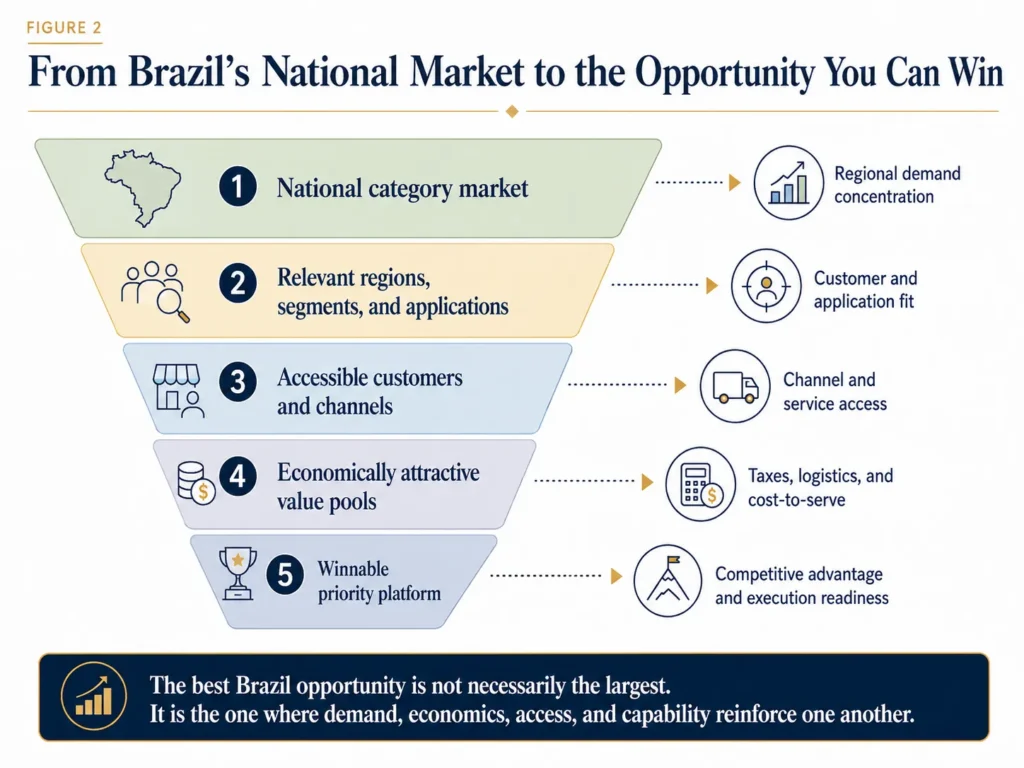
Figure 2. Strategic market analysis narrows Brazil’s national potential into the regional, segment, and customer opportunities your company can access and win profitably.
Regional and State-Level Differences Can Change the Strategy
Brazil’s states and regions can differ materially in customer density, income, industry structure, infrastructure, taxes, logistics, regulation, competition, and service expectations.
Southeast
The Southeast often concentrates major corporate headquarters, industrial demand, institutions, sophisticated customers, and intense competition. Attractive opportunities may require strong differentiation, references, technical expertise, fast service, and account-level focus.
South
The South can offer dense industrial clusters, export-oriented companies, strong local manufacturers, and regionally embedded relationships. Local credibility and operational performance may matter as much as national brand strength.
Northeast
The Northeast contains diverse markets with different customer needs, infrastructure conditions, income levels, public and private demand, and logistics requirements. A national model may need significant regional adaptation.
Center-West
Agriculture, food processing, logistics, infrastructure, mining, and resource-related demand can create attractive opportunities. Distance, service, inventory, and specialized distribution may be decisive.
North
Lower customer density and complex logistics can increase cost-to-serve, while resource, infrastructure, healthcare, and project-driven demand may create focused opportunities. Market access often needs to be designed around specific accounts or projects rather than broad coverage.
These are starting hypotheses. The relevant segmentation depends on your industry. In some markets, state boundaries matter. In others, the better unit of analysis is an industrial corridor, customer ecosystem, application, service territory, or channel.
Delivered Economics Matter More Than the Factory Price
A national price comparison rarely explains the attractiveness of an opportunity in Brazil.
The effective economics may depend on:
- Production or import location.
- Freight and warehousing.
- State-level tax structure and commercial flow.
- Inventory requirements and lead times.
- Distributor, dealer, integrator, or representative margins.
- Installation, training, maintenance, and service.
- Financing, payment terms, and working capital.
- Customer-specific technical or compliance requirements.
- Volume density within the service territory.
A region with high demand can still be unattractive if cost-to-serve, channel economics, and operational complexity consume the margin. Conversely, a smaller cluster can be highly attractive when customers are concentrated, service is efficient, and your offer solves a high-value problem.
When Does Local Production Create Strategic Value?
Local production is often viewed as an automatic advantage in Brazil. It can be, but only under the right conditions.
Potential advantages
- Shorter lead times and better availability.
- Product adaptation and local engineering.
- Greater confidence among customers and partners.
- Reduced exposure to some import and logistics constraints.
- Access to local-content requirements or specific procurement opportunities.
- Stronger service, technical support, and operational responsiveness.
Potential disadvantages
- Fixed cost and minimum efficient scale.
- Capacity-utilization risk.
- Labor, tax, environmental, and compliance complexity.
- Dependence on imported components or raw materials.
- Portfolio rigidity and changeover costs.
- Additional management and capital requirements.
The decision should compare local production, assembly, importing, contract manufacturing, partnership, acquisition, and hybrid options according to demand density, economics, flexibility, risk, and strategic fit.
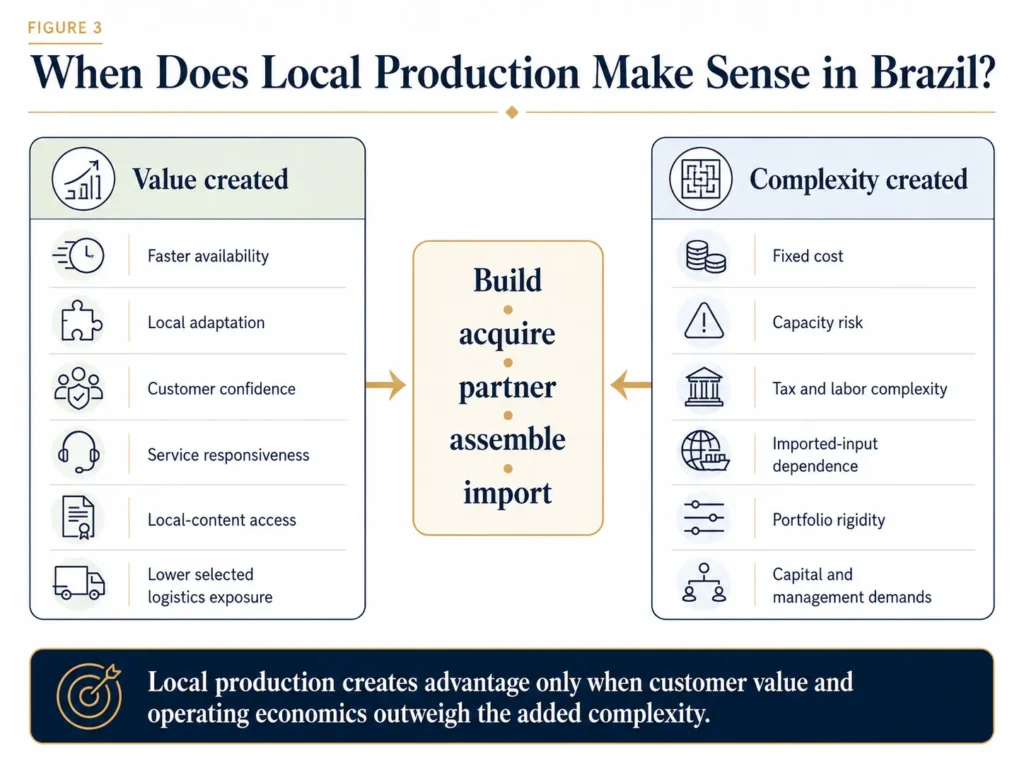
Figure 3. The value of local production depends on whether improved customer access, availability, and responsiveness justify the cost, risk, and organizational complexity.
Channels and Service Can Determine Whether the Market Is Accessible
Brazil’s size often makes indirect channels essential, but partner quality varies significantly.
We assess:
- Actual geographic and industry coverage.
- Customer ownership and account influence.
- Inventory and working-capital capability.
- Technical sales, installation, and service competence.
- Credit, collection, and commercial discipline.
- Demand-generation capability.
- Competing brands and portfolio conflicts.
- Management commitment and willingness to invest.
- Ability to support the required customer experience.
A distributor may provide rapid access while creating dependence. Direct sales may improve customer knowledge but require significant fixed investment. A hybrid model may be stronger when strategic accounts require direct management and broader coverage can be served through partners.
Customer Needs and Buying Criteria Differ Across Brazil
The same product can create different value across industries, regions, and customer types.
Depending on your market, customers may prioritize:
- Price and financing.
- Product performance and reliability.
- Availability and delivery speed.
- Technical service and uptime.
- Local references and reputation.
- Regulatory or quality compliance.
- Integration with existing systems or processes.
- Total cost of ownership.
- Supplier scale and continuity.
- Customization and response speed.
Primary interviews help determine which criteria truly drive the decision, how competitors perform against them, and whether your current value proposition is transferable or needs local adaptation.
How to Prioritize Brazilian Regions, Segments, and Value Pools for Market Analysis
A strong prioritization should combine three perspectives.
Market attractiveness
- Accessible demand and growth.
- Customer urgency and willingness to pay.
- Margin and value-pool potential.
- Competitive intensity.
- Structural and regulatory risk.
Ability to win
- Value-proposition fit.
- Customer references and relationships.
- Channel, service, and supply capability.
- Production or localization advantages.
- Relative differentiation versus competitors.
Execution feasibility
- Required investment and working capital.
- Time to commercial access.
- Tax, logistics, and operational complexity.
- Availability of partners and talent.
- Management attention and scalability.
The best opportunity is where these three dimensions reinforce one another. A large market with low ability to win can destroy value. A smaller opportunity with strong fit and efficient execution can become a scalable platform.
How Midas Builds a Reliable Fact Base for Market Analysis in Brazil
Brazil offers extensive public information, but the data may be aggregated, delayed, inconsistent across sources, or too broad for a specific industry decision.
We triangulate evidence from:
- Official economic, demographic, industry, trade, regulatory, and procurement information.
- Company, product, facility, capacity, pricing, channel, investment, and hiring signals.
- Interviews with customers, distributors, dealers, integrators, suppliers, specialists, former industry participants, institutions, and other knowledgeable sources.
- State, regional, industrial-cluster, and customer-level validation.
- Production, imports, installed base, usage, replacement, and service indicators where relevant.
- Your team’s commercial, operational, technical, and financial knowledge.
We define the market carefully, reconcile conflicting estimates, distinguish verified facts from informed hypotheses, and use ranges when the evidence does not support false precision.
For the complete research process and wave-based methodology, visit Market Analysis: The Key to Informed Strategic Decisions.
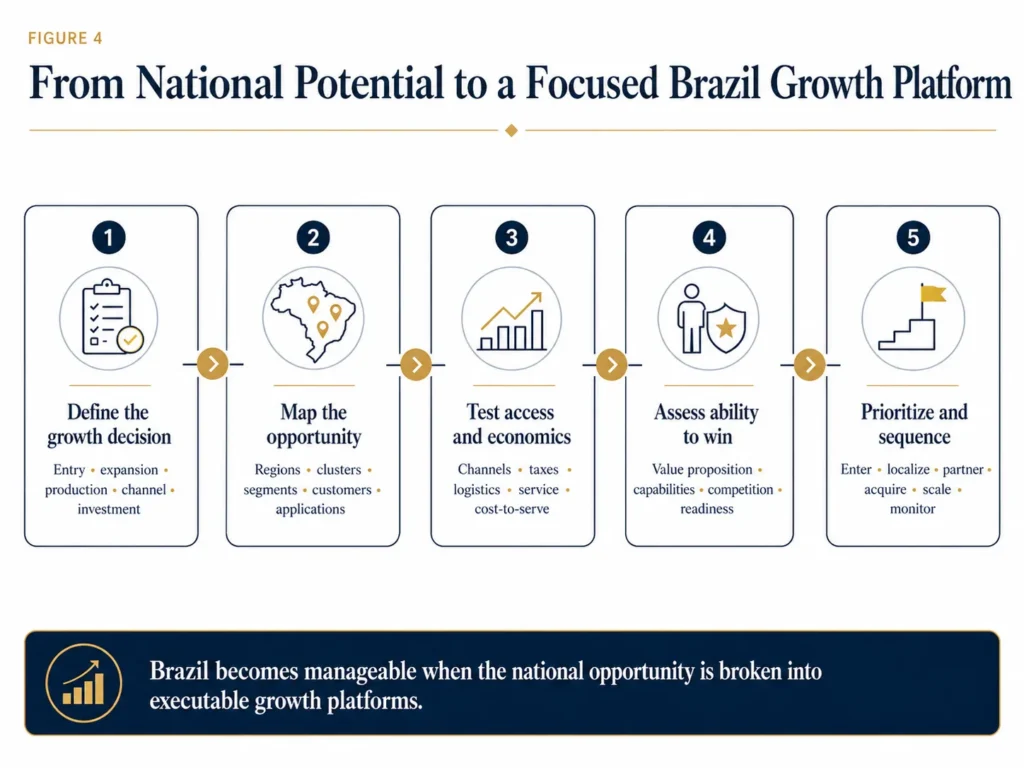
Figure 4. Brazil market analysis becomes actionable when national potential is translated into regional priorities, executable business models, and a sequenced investment plan.
How Market Analysis Changes Your Decision in Brazil
Regional and segment prioritization
You can determine which states, clusters, industries, applications, customer groups, and value pools deserve investment.
Market-entry decisions
You can compare direct entry, distributor-led entry, partnership, acquisition, selected-region entry, and staged expansion.
Production and localization decisions
You can assess whether to import, assemble, manufacture, contract, partner, or acquire based on scale, economics, flexibility, and customer value.
Channel and service decisions
You can identify where existing partners provide real access, where coverage is weak, which accounts require direct management, and what service model is necessary.
Pricing and value-proposition decisions
You can connect customer value with delivered cost, taxes, logistics, channel margins, service, financing, and willingness to pay.
Investment and sequencing decisions
You can decide what to build now, what to test first, which capabilities can be shared nationally, and which must be established regionally.
Case Example: Doubling Sales in Brazil Through a Focused Market Strategy
The executive challenge
A multinational manufacturer of medicinal-gas equipment already operated in Brazil but had not fully converted the country’s potential into growth.
The company needed more than a national market estimate. It needed to understand where demand was most attractive, how customers and channels differed, which competitors shaped the market, what barriers constrained growth, and how the commercial and operating model should be adapted.
How we approached the decision
We combined secondary research with interviews involving:
- Equipment manufacturers.
- Medical-gas producers.
- Hospitals and healthcare providers.
- Distributors and logistics partners.
The analysis assessed market size, regional and segment opportunities, customer needs, competitors, critical success factors, barriers, risks, channels, and growth options.
We translated the evidence into a Brazil-specific strategy rather than relying on one regional commercial model.
How the market analysis findings in Brazil supported growth
The company refined its operations, prioritized higher-growth segments, improved its understanding of local complexity, and focused its resources on the opportunities with the strongest fit.
The company doubled its sales in Brazil within four years.
The Brazil strategy also formed part of a broader Latin American growth program. For the regional case and cross-country roadmap, visit Market Analysis in Latin America.
“Thanks to Midas, we walked away with a clear, well-organized strategy. The collaboration between different business units and the fresh market insights were outstanding. Kudos!”
— Go-to-Market Manager
“Their report and analysis were thorough. They collaborated well with our team, including our tech department. One of the reasons we chose them was their depth of experience, which was evident throughout the project.”
— Global Product Manager
When You Need Market Analysis in Brazil
- Entering Brazil or reassessing your entry model.
- Deciding which states, regions, clusters, or segments to prioritize.
- Trying to reconcile national market size with uneven local performance.
- Assessing local production, importing, assembly, partnership, or acquisition.
- Evaluating distributors, dealers, integrators, or direct-sales models.
- Reviewing pricing, taxes, logistics, service, or cost-to-serve.
- Preparing a product launch or portfolio investment.
- Identifying underserved customer groups or regional value pools.
- Testing whether a high-growth opportunity is realistically accessible.
- Building a sequenced national expansion plan.
When your decision covers several countries, the Brazil analysis should fit into a consistent regional framework. See our Latin America market-analysis hub.
For the complete consulting offer, engagement model, and deliverables, visit our market-analysis consulting service page.
Why Midas for Market Analysis in Brazil?
We look below the national average
We analyze demand and economics by region, state, cluster, segment, channel, application, and customer group.
We connect opportunity with delivered economics
We examine taxes, logistics, production, imports, inventory, channel margins, service, working capital, and cost-to-serve.
We assess ability to win, not only market attractiveness
We compare customer needs and competitive conditions with your value proposition, capabilities, references, channels, and execution readiness.
We evaluate organic and inorganic growth options
The analysis can compare entry, partnership, distributor investment, local production, acquisition, and staged expansion.
We combine primary research with structured analysis
We complement official and commercial information with carefully designed interviews and local validation.
We translate evidence into a sequenced roadmap
The engagement ends with regional and segment priorities, business-model choices, investment requirements, assumptions to test, and next steps.
We bring direct market analysis in Brazil experience
We have analyzed B2B, B2C, technology, industrial, automotive, consumer, pharmaceutical, and healthcare markets in Brazil, supporting growth, entry, pricing, channel, portfolio, production, and investment decisions.
Ethical and Reliable Market Intelligence in Brazil
We comply with SCIP’s Code of Ethics, the profession’s gold standard. We comply with applicable laws, accurately disclose relevant identity and organizational information before interviews, avoid conflicts of interest, provide honest recommendations, and promote ethical conduct throughout the engagement.
We do not seek trade secrets, request confidential documents, misrepresent who we are, induce contractual breaches, or facilitate improper exchanges of competitively sensitive information.
We also make uncertainty visible. We explain definitions, assumptions, evidence quality, and confidence ranges so that your leadership team can distinguish a reliable conclusion from false precision.
Review SCIP’s ethical intelligence guidance and Code of Ethics.
Frequently Asked Questions about Market Analysis in Brazil
Can you estimate market size by state or region with your market analysis in Brazil?
Yes. We can structure the estimate by state, macro-region, industrial cluster, customer type, channel, application, or another unit that matches how the market actually works.
How do you size a market when public information is incomplete?
We triangulate official data with production, imports, installed base, usage, customer demand, company activity, channel interviews, pricing, and other industry-specific evidence. We use ranges when exact estimates are not defensible.
Can you compare tax and logistics effects across regions with your market analysis in Brazil?
Yes, at a strategic and commercial level. We can assess how production location, commercial flows, freight, inventory, service, and observable tax structures affect delivered economics. Specialist tax advice may be required for formal legal conclusions.
Can you evaluate whether local production is justified with your market analysis in Brazil?
Yes. We can compare production, assembly, importing, contract manufacturing, partnership, acquisition, and hybrid options according to demand, capacity, cost, flexibility, risk, customer value, and investment.
Can you assess distributors and dealers with your market analysis in Brazil?
Yes. We can examine real coverage, customer access, inventory, credit, technical capability, service, competing brands, commitment, economics, and scalability.
Can you analyze B2B and B2C markets?
Yes. The methodology is adapted to customer concentration, channel structure, purchasing behavior, available data, and the strategic decision.
Can you compare multinational and local competitors with your market analysis in Brazil?
Yes. We assess the capabilities and sources of advantage that matter to the market rather than assuming one company type is inherently stronger.
Can you help us decide where to enter first?
Yes. We can prioritize regions, segments, accounts, or value pools using market attractiveness, ability to win, and execution feasibility.
How do you validate customer needs across a large country with your market analysis in Brazil?
We segment the research according to the regions, industries, channels, and customer groups relevant to the decision and test whether patterns are broad or localized.
How long does a market analysis in Brazil take?
The timing depends on the number of regions, segments, interviews, channels, and strategic questions involved. We scope the work around your decision and can share preliminary findings in phases.
About the Author
Adrian Alvarez, PhD is Managing Partner at Midas Consulting, Wharton Alumnus, MBA Professor at Universidad Argentina de la Empresa (UADE), and Competitive Intelligence Fellow. He specializes in competitive strategy, market analysis, strategic intelligence, market entry, and executive decision-making under uncertainty in Brazil and Latin America.
He has analyzed B2B, B2C, technology, industrial, automotive, consumer, pharmaceutical, and healthcare markets in Brazil. His work has been published in the United States, Brazil, Spain, and Germany. You can access his library of strategic insights and published research here
View professional profile on LinkedIn
Selected Brazilian Sources You May Need to Monitor
The right source mix depends on your industry and decision. A Brazil fact base may include:
- IBGE for official economic, demographic, industrial, and regional information.
- Banco Central do Brasil for monetary, credit, exchange, and economic information.
- Ministry of Development, Industry, Trade and Services for relevant trade, industry, and investment information.
- CADE for competition, merger, and market-structure information.
- ANVISA when healthcare, pharmaceutical, food, medical-device, or other regulated products are involved.
- State agencies, procurement platforms, customs and trade information, sector regulators, industry associations, company disclosures, distributor evidence, and primary market interviews as appropriate.
Official information is essential, but it rarely explains actual channel quality, customer priorities, regional service capability, competitive intent, or the operational feasibility of your strategy on its own.
Turn Brazil’s Scale into a Focused Growth Platform
You may be deciding which region to enter, whether to localize production, how to structure distribution, where to invest service capacity, or why national market potential is not translating into profitable growth.
You do not need a national market estimate that hides regional concentration, delivered economics, channel gaps, and execution complexity. You need to understand where demand, access, economics, and your capabilities reinforce one another.
In an initial conversation, we will discuss your decision, the regions, products, customers, channels, and investment options involved, what your team already knows, and which uncertainties could materially change the strategy.
We can then propose a focused Brazil market-analysis engagement with a clear scope, research plan, regional segmentation, timing, and deliverables.