
Use Competitor Analysis in Argentina to Grow
In Argentina, a competitor’s visible price, growth, or market share may not tell you what you think it does.
A low price can reflect a structural cost advantage. It can also reflect inventory acquired under a different exchange rate, delayed price adjustments, access to imports, local production, a distributor absorbing margin, or a deliberate attempt to protect a strategic account.
Strong availability may come from superior supply capabilities, or simply from having entered the cycle with more stock. Rapid growth may reflect customer preference, but it can also result from a competitor being one of the few suppliers able to deliver when imports or working capital become constrained.
When conditions change quickly, the executive challenge is not simply to gather more competitor data. You need to understand the economics, timing, incentives, and constraints behind the data so that you can distinguish a durable competitive advantage from a temporary market effect.
At Midas Consulting, we help you build that understanding ethically. We combine structured research, local market insight, and strategic interpretation so you can make better decisions about pricing, channels, customers, supply, positioning, investment, and competitive response in Argentina.
Companies’ responses to trade opening show why understanding a competitor requires looking beyond prices and market share. In the Midas Import Competition Monitor 2026, we analyzed 151 business decisions and found very different responses to similar competitive pressure: investing, reconfiguring operations, importing, regionalizing, reducing capacity, or exiting the market. Forbes Argentina used the Midas Consulting Monitor to examine these different strategic responses.
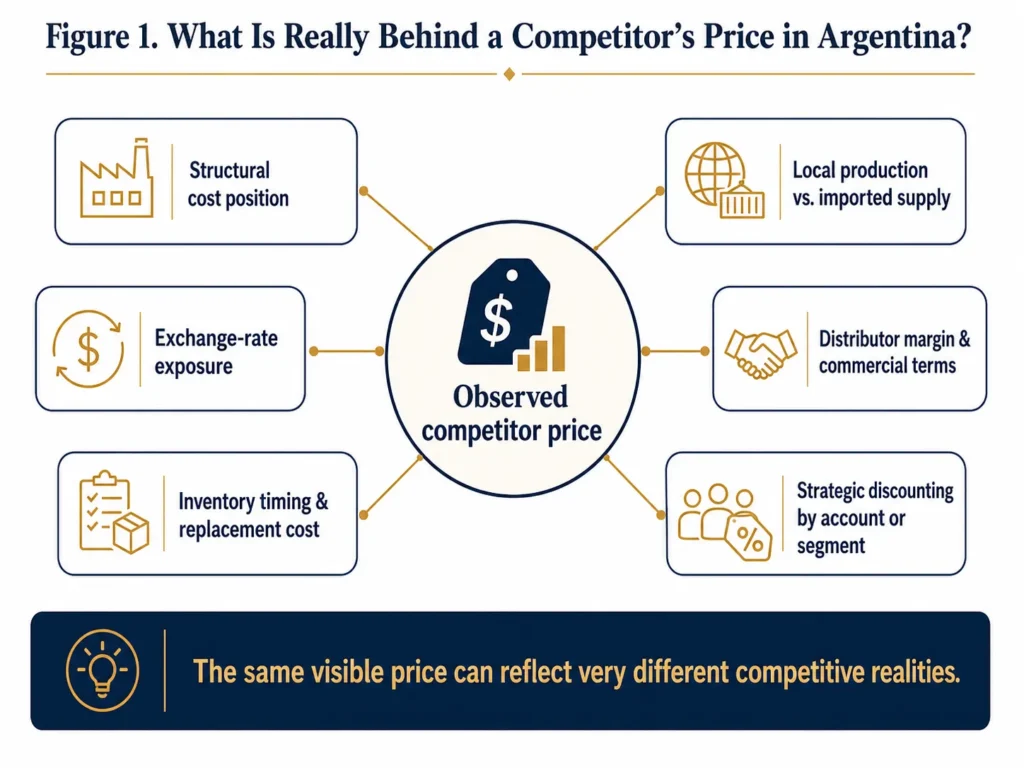
Figure 1. A competitor’s visible price in Argentina can result from several economic and strategic factors that imply very different responses.
Why Competitor Performance Is Easy to Misread in Argentina
Argentina’s competitive environment often changes faster than conventional market reports. Pricing, availability, payment terms, sourcing, and customer priorities can shift before published data catches up.
This creates several common interpretation errors.
You may mistake old inventory for a cost advantage
Two competitors can sell the same type of product at very different prices because their inventories were acquired at different moments. A company selling stock purchased under earlier cost and currency conditions may appear more efficient than it really is.
Your decision should depend on whether the price can be sustained once that inventory is replaced, not only on the price visible today.
You may compare nominal prices that reflect different commercial realities
List prices can hide discounts, payment terms, financing, rebates, bundled services, freight, technical support, taxes, credit risk, and distributor margins. During periods of rapid change, the timing and conditions of payment can be as important as the nominal amount.
A useful price comparison therefore needs to establish what the customer actually pays, when the supplier receives the money, what is included, and which party is absorbing the economic risk.
You may confuse product availability with customer preference
When supply is restricted, customers may buy what is available rather than what they prefer. A competitor can gain share because it has inventory, local manufacturing, faster customs clearance, access to inputs, or a distributor willing to finance stock.
That advantage may remain important, but you need to identify whether customers would continue choosing the competitor if availability normalized.
You may overestimate a national position that depends on a few accounts or channels
A company may appear strong nationally while depending heavily on a limited number of customers, distributors, tenders, regions, or product lines. The reverse can also happen: a competitor with modest reported size may hold powerful positions in specific applications or relationships that matter to your strategy.
You may assume that the next response will resemble the last one
Competitors change behavior as economics, regulation, inventory, and management priorities evolve. A company that defended share aggressively in one period may protect cash or margin in the next. Another may use a temporary disruption to enter strategic accounts or consolidate distributor relationships.
This is why competitor analysis in Argentina should explain not only what happened, but also what conditions made that behavior rational and whether those conditions still apply.
The Executive Questions You Need to Answer with Competitor Analysis in Argentina
Your analysis should begin with the decision you are facing. The questions below are especially important in Argentina because they connect visible market behavior with the underlying economics and capabilities.
- Is a competitor’s price advantage sustainable at current replacement costs?
- How frequently does the competitor adjust prices, discounts, and payment terms?
- Which products or customers is it willing to protect—and which can it afford to lose?
- How much of its supply is locally produced, imported, assembled, or sourced through third parties?
- What inventory position is supporting current availability and pricing?
- Who carries currency, financing, inventory, and credit risk across the channel?
- How dependent is the competitor on one distributor, supplier, customer group, or regulatory pathway?
- Where does it have genuine customer preference, and where is it winning because alternatives are unavailable?
- Which capabilities will remain valuable if economic or regulatory conditions change?
- How is the competitor likely to respond if you change price, increase availability, enter an account, replace a distributor, or launch a new offer?
The objective is not to create a static profile. It is to understand the competitor’s current logic well enough to anticipate where it will defend, adapt, retreat, or invest.
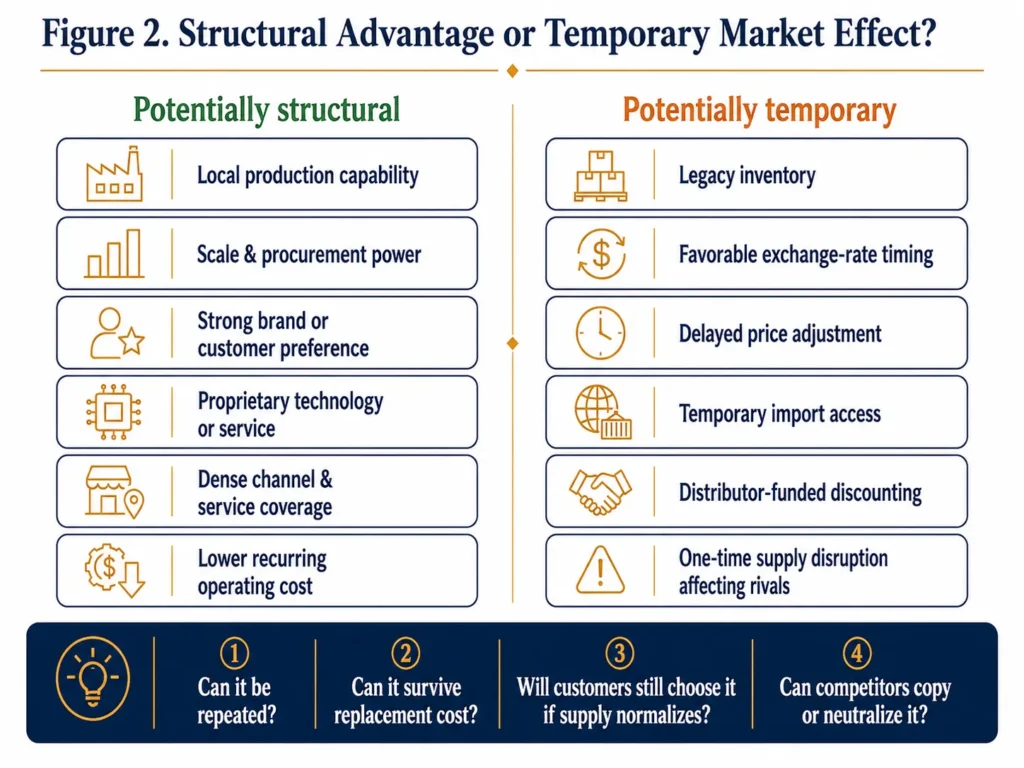
Figure 2. Before reacting, determine whether the competitor’s apparent advantage is repeatable, defensible, and likely to survive changing market conditions.
What You Need to Understand Beyond the Price for Competitor Analysis in Argentina
Cost and replacement economics
Historical cost can explain the past. Replacement cost is often more useful for anticipating the next commercial move.
We examine the factors that may shape a competitor’s future economics, including sourcing model, local content, exposure to imported inputs, inventory cycles, logistics, scale, channel margins, service requirements, and working-capital needs.
The analysis does not require access to confidential cost data. It requires disciplined estimation, triangulation, and testing of the assumptions that would make the competitor’s observed behavior economically plausible.
Pricing behavior and commercial conditions
We look beyond the published price to understand how competitors manage different customers, channels, and product lines.
Depending on your industry, the analysis may consider:
- Frequency and timing of price adjustments.
- Discounts by customer, channel, volume, or product mix.
- Payment terms, financing, and credit exposure.
- Rebates, bonuses, bundles, and service inclusions.
- Freight, installation, technical support, warranties, or inventory commitments.
- Differences between list price, quoted price, invoiced price, and effective economic value.
- The accounts or segments a competitor is willing to subsidize strategically.
This helps you avoid a broad price response when the competitor may be defending only a narrow group of accounts.
Supply, inventory, and import exposure
Availability can become a strategic differentiator in Argentina. We assess how competitors source, stock, replenish, and allocate products when conditions change.
Questions may include:
- Which products are locally manufactured and which depend on imports?
- How exposed is the competitor to imported finished goods, components, or raw materials?
- How much inventory does it appear to hold and where?
- How quickly can it replace stock at current economics?
- Which customers receive priority when supply is constrained?
- Does the distributor finance stock, or does the manufacturer carry the exposure?
- Could a change in supply conditions weaken the competitor’s current position?
Channels and distributor economics
A competitor’s route to market may be a source of advantage, dependency, or hidden risk.
We examine who owns the customer relationship, how distributors are incentivized, which party controls pricing and inventory, how territories or segments are divided, and whether the partner is committed to one brand or balancing several alternatives.
This is especially important when reported market presence is actually the result of one powerful distributor rather than a direct capability controlled by the competitor.
Customer loyalty versus constrained choice
Customers may continue buying from a competitor because they value its brand, product, service, technical support, installed base, or relationship. They may also stay because switching is costly, supply is limited, approvals take time, or the available alternatives create operational risk.
Those situations require different strategies. Genuine preference may require stronger differentiation. Constrained choice may create an opening if you can remove the obstacle that prevents the customer from switching.
How Market Conditions Can Change Competitor Behavior and Analysis in Argentina
A competitor’s strategy is shaped by what management wants to achieve, but also by what the company can fund, supply, import, price, and execute at that moment.
Several changes can alter competitive behavior:
- A shift in exchange-rate exposure or replacement costs.
- Reduced access to imported products or inputs.
- A change in inventory levels or product availability.
- Higher financing and working-capital pressure.
- New regulatory, tax, customs, or compliance requirements.
- A distributor facing liquidity, credit, or portfolio conflicts.
- A local producer expanding capacity or changing product mix.
- A multinational changing the strategic importance of Argentina.
- A new tender, customer investment cycle, or sector-specific recovery.
The strongest analysis identifies which signals deserve attention before a visible strategic move occurs.
For a deeper explanation of competitor signals, plausible moves, management triggers, and response options, see Strategic Foresight and Competitive Response: Executive Insights.
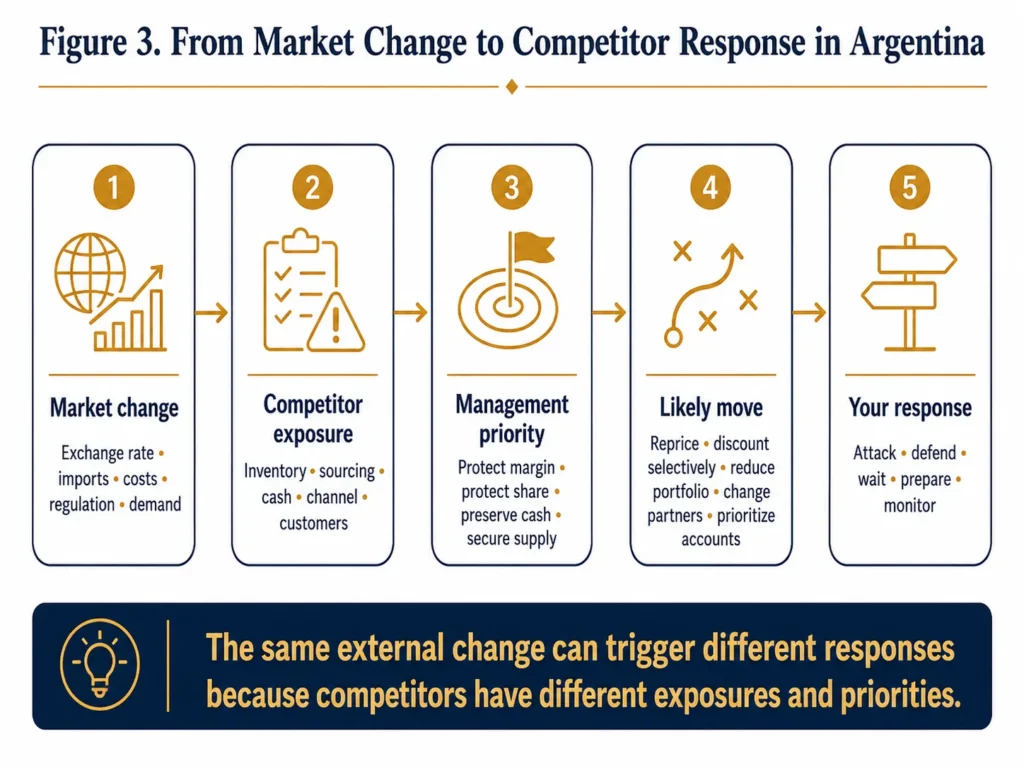
Figure 3. Market changes do not determine competitor behavior by themselves; the response depends on each company’s exposure, priorities, capabilities, and constraints.
How Midas Builds a Reliable Fact Base in Argentina for Competitor Analysis
Public information alone is rarely enough to explain how a competitor really operates. At the same time, individual interviews can reflect partial knowledge, personal incentives, or outdated experience.
We therefore triangulate evidence rather than relying on one source.
Depending on the assignment, the fact base may combine:
- Company, product, financial, regulatory, customs, tender, and industry information where available.
- Price, portfolio, channel, communication, hiring, investment, and partnership signals.
- Interviews with customers, distributors, suppliers, specialists, former industry participants, associations, and other knowledgeable market sources.
- Your team’s commercial, operational, technical, and strategic knowledge.
- Comparisons with regional competitors or neighboring markets where they help test an assumption.
We assess the reliability of each conclusion, distinguish verified evidence from informed hypotheses, and make uncertainty visible. This matters because an executive decision should not depend on a claim merely because it sounds plausible.
We also conduct the work ethically. We do not seek trade secrets, misrepresent our identity, or request confidential competitor information. Our objective is to understand market behavior through legal, professional, and reputation-safe methods.
For the complete competitor analysis process, including how to define intelligence questions, profile competitors, triangulate findings, and translate evidence into action, visit our competitor analysis step-by-step guide.
How Competitor Analysis in Argentina Changes Your Decision
A strong Argentina competitor analysis should help you make a specific choice—not simply describe the market.
Pricing and margin decisions
You can determine whether to respond broadly, protect only priority accounts, change payment conditions, revise bundles, redesign the offer, or wait for the competitor’s temporary advantage to weaken.
Supply and portfolio decisions
You can identify which products require stronger inventory protection, local sourcing, alternative suppliers, portfolio simplification, or different service levels.
Channel and distributor decisions
You can assess whether your route to market gives you sufficient customer access, whether a competitor’s partner can be challenged, and whether incentives, coverage, inventory, or commercial control need to change.
Customer and account decisions
You can distinguish accounts that are genuinely loyal from those that may switch if you improve availability, reduce risk, strengthen service, or present a more credible economic proposition.
Investment and market-position decisions
You can decide which advantages deserve investment, which segments should be defended, where competitors are vulnerable, and whether current conditions create a temporary opening or a long-term opportunity.
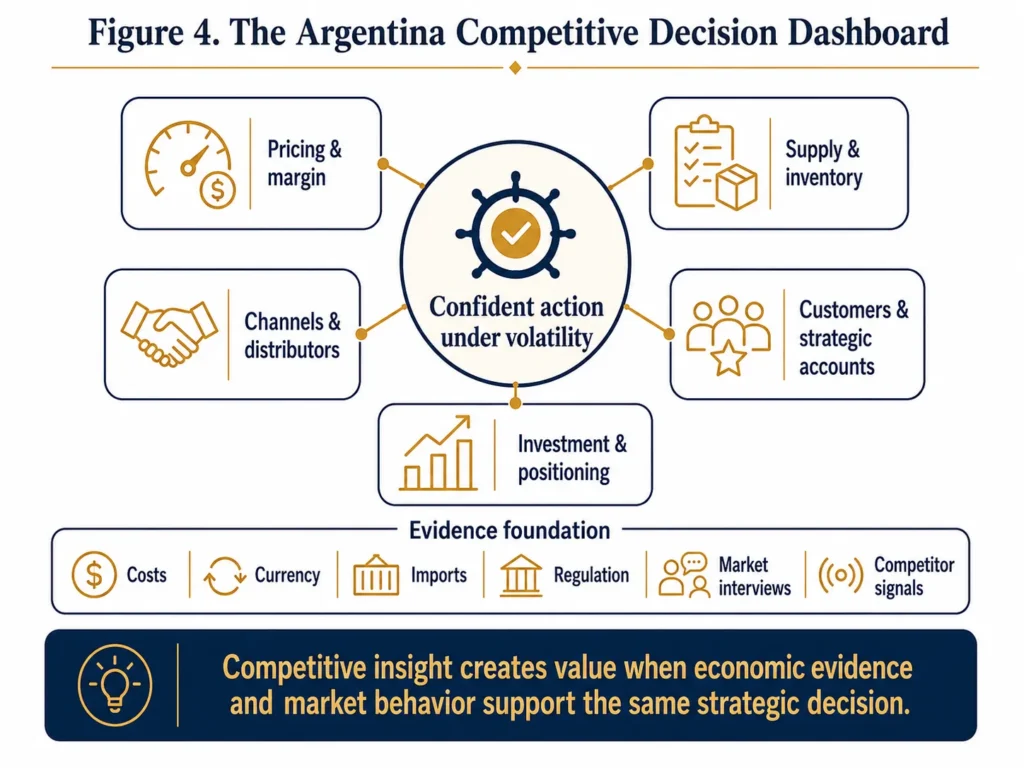
Figure 4. Competitor analysis should connect Argentina’s economic and market evidence with the pricing, supply, channel, customer, and investment decisions you need to make.
Case Spotlight: Preparing for Biosimilar Competition in Argentina
The decision
A multinational pharmaceutical company needed to prepare for the expiration of patents protecting three major biologics. Several biosimilar developers were advancing, but the timing, pricing, commercialization model, and potential impact in Argentina remained uncertain.
The company needed more than a general forecast of biosimilar entry. It needed to understand how Argentina’s regulatory pathway, local biotechnology capabilities, market-access conditions, physician influence, patient programs, pricing, and potential partnerships could shape competitor behavior.
How we approached it
We combined secondary research with interviews involving knowledgeable regulatory, clinical, and market participants. We assessed development progress, likely approval paths, entry timing, potential pricing strategies, local partnerships, commercialization models, and vulnerabilities that could delay or weaken competitor launches.
We also connected the Argentina findings with the wider regional threat so the company could distinguish locally required actions from decisions that should be coordinated across Latin America.
How the competitor analysis insight supported action
The findings helped the company refine defensive pricing, patient access, and stakeholder-engagement actions for Argentina. Management could focus on the scenarios and competitor weaknesses that mattered locally rather than applying one uniform regional response.
For the full multi-country case and the role Argentina played within the regional strategy, visit Competitor Analysis in Latin America.
“We’ve done competitor analysis before, but never have I been so clear on how and why competitors act the way they do.”
— Regional Leader, Pharmaceutical Company
When You Need Competitor Analysis in Argentina
A focused Argentina assignment can be particularly valuable when you are:
- Reviewing prices, discounts, terms, or margin strategy.
- Trying to explain a sudden gain or loss in market share.
- Assessing whether a competitor’s price or availability advantage is sustainable.
- Entering Argentina or increasing your investment in the market.
- Launching, repositioning, or rationalizing a product portfolio.
- Selecting, replacing, or negotiating with a distributor.
- Protecting strategic accounts from aggressive offers.
- Evaluating local production, importing, sourcing, or inventory alternatives.
- Preparing for a regulatory, economic, or sector-specific change.
- Anticipating how competitors may respond to your next move.
When the decision covers several markets, the Argentina analysis should fit into a consistent regional framework. See how we compare country evidence and coordinate responses on our Latin America competitor analysis hub.
If your challenge extends beyond Argentina-specific market conditions, our competitor analysis consulting approach helps you understand how competitors make money, where they are vulnerable, how they are likely to respond, and what those insights mean for your strategic decisions.
Why Midas for Competitor Analysis in Argentina?
We understand the difference between data and economics
We do not treat visible prices, market shares, or availability as self-explanatory. We investigate the cost, currency, inventory, supply, channel, and strategic conditions that may be producing them.
We combine local depth with regional perspective
Argentina-specific evidence is essential, but regional comparison can reveal whether a competitor is following a local tactic or a broader strategic direction. We connect both levels when your decision requires it.
We use primary insight where public information is incomplete
We complement secondary research with interviews and market validation designed around the decision you need to make.
We turn uncertainty into practical options
We identify what is known, what remains uncertain, which scenarios matter, what signals to monitor, and which actions are attractive under different conditions.
We bring direct experience in competitor analysis in Argentina
We have led dozens of competitive intelligence and competitor analysis assignments in Argentina, supporting decisions involving pricing, market entry, channels, customers, product launches, acquisitions, and competitive response.
We conduct the work ethically and discreetly
Our research follows legal and professional competitive-intelligence practices designed to protect your company, our sources, and the integrity of the engagement. We comply with SCIP’s code of ethics, the profession’s gold standard.
“They are responsive, professional, detail-oriented, and client-focused. I love that Midas prioritizes ‘co-success with the client’ and works hard to meet our needs and solve our problems.”
— Executive Chair, FMCG Company
Frequently Asked Questions
How do you compare competitor prices in a high-inflation environment for your competitor analysis in Argentina?
We avoid relying on one nominal price. We consider timing, adjustment frequency, discounts, payment terms, financing, services, freight, inventory age, replacement cost, exchange-rate exposure, and channel economics. The objective is to understand the effective offer and whether the competitor can sustain it.
Can you estimate competitor costs without accessing confidential information?
Yes, at an appropriate level. We develop and test cost hypotheses using observable sourcing models, product specifications, supply chains, local or imported content, scale, logistics, channel structure, service requirements, market interviews, and other legal sources. We clearly communicate assumptions and confidence levels.
Can you determine whether a competitor has inventory or import advantages through your competitor analysis in Argentina?
We can assess signals and build an evidence-based view of relative inventory, availability, replenishment, sourcing, and import exposure. Exact confidential quantities may not be knowable, but your decision often requires a reliable directional assessment rather than false precision.
Can you investigate discounts and customer-specific commercial practices?
When relevant and ethically obtainable, we can examine discount structures, bundles, terms, service inclusions, channel incentives, and how offers differ by customer or segment. We do not seek confidential documents or induce sources to disclose protected information.
How do you validate information in Argentina when public data is incomplete?
We triangulate multiple independent sources, compare statements against observable behavior, test the economic logic, and distinguish verified facts from informed hypotheses. We also use your team’s knowledge as an input while independently challenging assumptions.
Can the competitor analysis in Argentina cover both local and multinational competitors?
Yes. The relevant competitive set may include multinationals, local manufacturers, importers, distributors, private labels, substitutes, new entrants, or alternative business models. We prioritize them according to their impact on your decision.
Can you help us prepare a competitive response?
Yes. We can translate the findings into pricing, account, channel, supply, portfolio, investment, and communication options. When reactions and countermoves are central to the decision, the work can be complemented by strategic foresight or a business wargame.
How long does a competitor analysis in Argentina take?
The timing depends on the number of competitors, interviews, products, customer segments, and questions involved. We scope the project around the decision and can deliver preliminary findings in phases when you have a time-sensitive milestone.
Will our company’s identity remain confidential?
We design the research approach to protect your interests and conduct the assignment discreetly. The disclosure method depends on what is legal, ethical, and appropriate for each research activity. We do not use deception or seek confidential competitor information.
About the Author
Adrian Alvarez, PhD is Managing Partner at Midas Consulting, Wharton Alumnus, MBA Professor at Universidad Argentina de la Empresa (UADE), and Competitive Intelligence Fellow. He specializes in competitive strategy, competitor analysis, strategic intelligence, business wargaming, market entry, and decision-making under uncertainty in Argentina and Latin America.
He has led dozens of competitive intelligence and competitor analysis projects in Argentina and more than 100 across Latin America. His published work has appeared in the United States, Argentina, Spain, and Germany. You can access his library of strategic insights and published research here
View professional profile on LinkedIn
Selected Argentine Sources You May Need to Monitor
The sources that matter depend on your industry and decision. Depending on the assignment, the fact base may include official information and market evidence from institutions such as:
- INDEC for official economic and sector information.
- Banco Central de la República Argentina for monetary, financial, and exchange-related information.
- ANMAT for healthcare, pharmaceutical, medical-device, and regulated-product information.
- Argentina’s productive-development authorities for relevant industrial, trade, and sector policies.
- Sector regulators, public procurement platforms, customs and trade information, industry associations, company disclosures, and primary market interviews as appropriate.
Official sources are essential, but they rarely explain competitor intent or commercial behavior on their own. The value comes from connecting institutional information with customer, channel, supplier, and competitor evidence.
Understand the Advantage Before You Decide How to Respond
You may be facing an aggressive price, unexplained share movement, a supply disadvantage, a distributor conflict, a new entrant, a product launch, or a competitor that appears better positioned to navigate the next market change.
Before you react, you need to know whether the advantage is structural or temporary, how it is being funded, which customers it affects, what could weaken it, and how the competitor is likely to respond to your move.
In an initial conversation, we will discuss your decision, the competitors involved, what your team already knows, and which uncertainties could materially change the action. We can then propose a focused Argentina research and analysis plan designed around your decision—not a generic country report.