

Strategic consulting for pharmaceutical and healthcare products to accelerate access and growth.
A clinically strong product can still underperform if the market-access and commercial system around it is weak.
You may be preparing a launch, entering a new country, defending a specialty therapy, repositioning a medical device, evaluating a local partner, or deciding which patient, institution, payer, or channel opportunity deserves investment. In every case, the challenge is bigger than market size.
You need to understand who controls access, who carries the economic risk, what evidence changes the decision, where the patient or institution can actually obtain the product, how competitors may respond, and what must be true for your strategy to create sustainable value.
That is where Pharmaceutical and Healthcare Products Consulting should help.
Midas Consulting helps you connect market evidence, stakeholder economics, competitive intelligence, access pathways, channel realities, and strategic uncertainty so you can make better growth decisions before capital and management attention are committed.
For more than 25 years, we have supported pharmaceutical, biologic, medical-device, diagnostics, healthcare-consumable, and related companies in Latin America and selected international markets. Our role is not to replace regulatory, medical, legal, pharmacovigilance, reimbursement, or health-economic specialists. It is to help your team make sharper strategic and commercial choices around the market those specialists help you navigate.
The objective is a clearer answer to four questions: Where should you play? What creates value for the stakeholders who control adoption and access? How should you reach the market? And how should you respond when competitors, payers, institutions, regulation, or economics change the game?
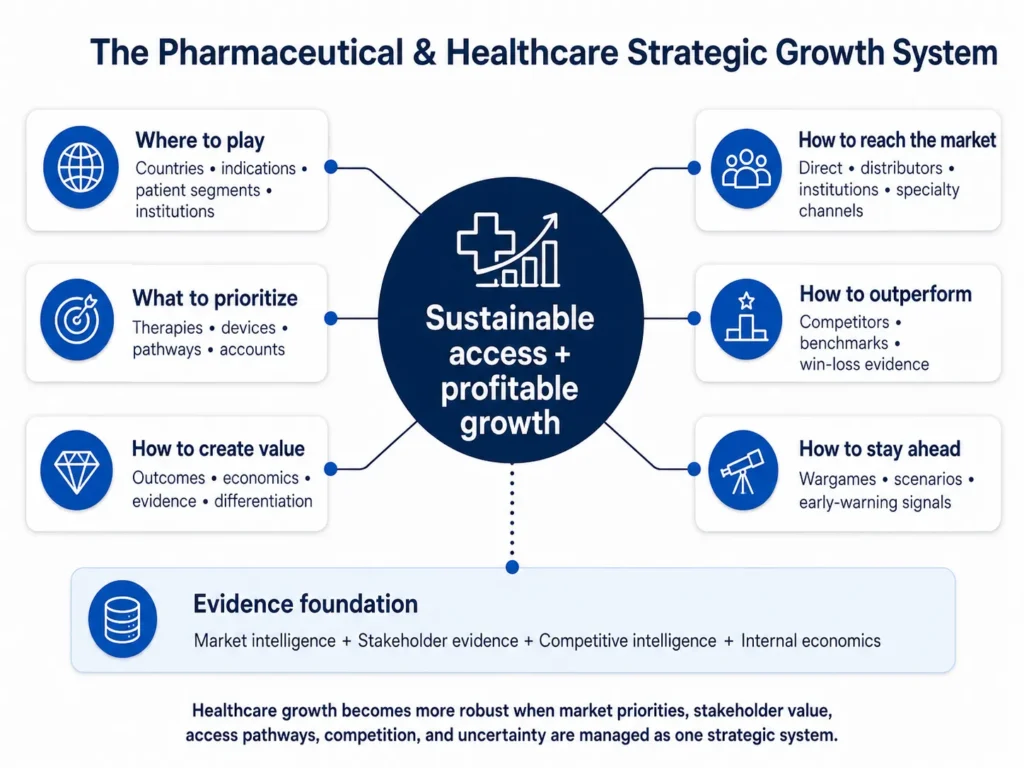
Figure 1: Healthcare growth becomes more robust when market priorities, stakeholder value, access pathways, competition, and uncertainty are managed as one strategic system.
Start With the Strategic Decision
Healthcare markets generate enormous amounts of information: epidemiology, clinical evidence, regulatory milestones, reimbursement rules, payer policies, procurement data, hospital protocols, prescription behavior, channel data, patient pathways, competitor activity, and internal forecasts.
But more information does not automatically produce a better decision.
We start Pharmaceutical and Healthcare Products Consulting engagements by clarifying what your team actually needs to decide.
You may need to determine:
- Which countries, indications, patient segments, institutions, or channels deserve incremental investment.
- Whether a market is attractive enough, and accessible enough, to justify entry.
- Which access barriers are commercial, which are institutional, and which require specialized regulatory, medical, reimbursement, or health-economic expertise.
- Which stakeholders influence diagnosis, prescription, approval, funding, procurement, dispensing, administration, and persistence.
- How to demonstrate value when clinical efficacy alone is not enough to secure access or preference.
- Whether a direct, distributor, specialty-pharmacy, institutional, tender, or hybrid commercial model is appropriate.
- How to prioritize hospitals, payers, physician groups, laboratories, distributors, or other accounts.
- How to compete when an incumbent has stronger relationships, broader evidence, a lower price, or established protocol status.
- How competitors are likely to respond to a launch, indication expansion, pricing move, channel change, or new evidence.
- Which assumptions could fail if reimbursement, regulation, budgets, treatment guidelines, competitive evidence, or patient pathways change.
Once the decision is explicit, we build the fact base around it. That keeps the work focused on what your organization can actually do differently.
Where Should You Place the Next Healthcare Growth Bet?
The largest healthcare market is not automatically the most attractive one for your company.
A country may have a large eligible population but restrictive access. An indication may have significant unmet need but fragmented diagnosis. A hospital segment may be clinically attractive but difficult to reach. A device may solve a real clinical problem but require workflow changes that slow adoption. A specialty therapy may show strong value but face funding or affordability constraints.
We help you compare opportunities using criteria that reflect both market potential and your ability to create access.
Depending on the decision, those criteria may include:
- Eligible patient population
- Diagnosed and treated population
- Clinical or operational unmet need
- Current standard of care
- Treatment or care pathway
- Reimbursement and funding structure
- Institutional access
- Procurement model
- Prescriber or user concentration
- Patient journey friction
- Competitive intensity
- Evidence requirements
- Switching barriers
- Channel access
- Partner availability
- Price and margin potential
- Cost to serve
- Working-capital requirements
- Strategic fit
- Execution feasibility
- Risk and uncertainty
The objective is not to chase the largest epidemiological number. It is to identify the opportunities where need, access, economics, differentiation, and execution align.
Our market analysis consulting helps you build the market, stakeholder, demand, channel, and competitive fact base behind those choices.
When geographic expansion is the decision, our market entry consulting helps you compare countries, barriers, entry models, partners, economics, and implementation priorities.
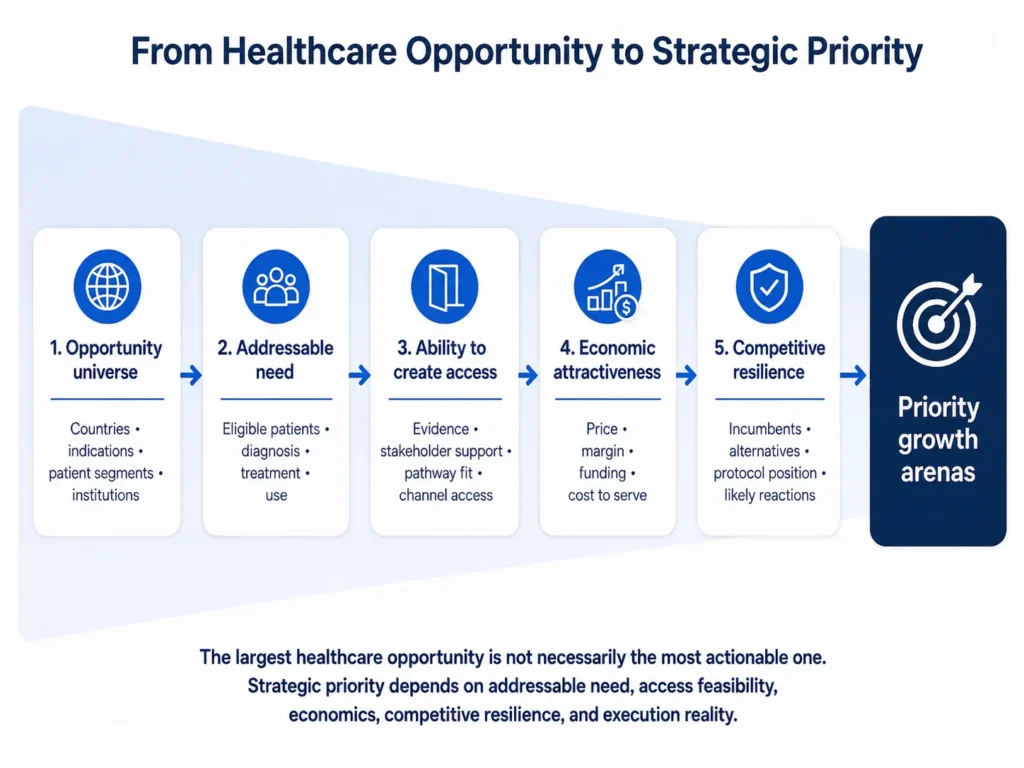
Figure 2: The largest healthcare opportunity is not necessarily the most actionable one. Strategic priority depends on addressable need, access feasibility, economics, competitive resilience, and execution reality.
Map the Full Access Pathway with Our Pharmaceutical and Healthcare Products Consulting
In healthcare, demand does not automatically translate into access.
A patient may need to be identified, diagnosed, referred, tested, approved, funded, prescribed, procured, dispensed, administered, and monitored before your product ever creates value.
A medical device may require a different sequence involving capital approval, clinical sponsorship, procurement, technical evaluation, training, installation, workflow integration, maintenance, and utilization.
The strategic question is therefore not only who the customer is. It is where the pathway can break.
We help you map:
- Patient identification
- Diagnosis and testing
- Referral
- Clinical decision
- Guideline or protocol influence
- Funding and reimbursement
- Authorization
- Procurement
- Distribution
- Dispensing or administration
- Training
- Follow-up
- Persistence or repeat use
This makes bottlenecks visible and helps you distinguish a market-demand problem from an access, evidence, funding, channel, or execution problem.
Understand the Stakeholders Who Shape Access
Healthcare purchasing decisions are rarely controlled by one person.
A physician may value clinical outcomes. A hospital may focus on budget impact and workflow. Procurement may focus on price, supply reliability, and contractual terms. A payer may focus on eligibility, evidence, utilization, and financial exposure. Patients and caregivers may face affordability, travel, education, adherence, or access barriers.
A strategy that speaks only to one stakeholder can fail even when the product is strong.
Depending on the category, we can help you understand the priorities and influence of:
- Patients
- Caregivers
- Physicians
- Pharmacists
- Nurses
- Hospital administrators
- Procurement teams
- Payers
- Health plans
- Public-health authorities
- Laboratories
- Diagnostic centers
- Distributors
- Specialty channels
- Clinical societies
- Key opinion leaders
- Technical users
- Biomedical or engineering teams
The output is a clearer stakeholder strategy: who matters, what each group values, what can block access, what evidence changes the discussion, and where your organization should invest its effort.
Translate Clinical or Technical Performance Into Stakeholder Value with Midas’ Pharmaceutical and Healthcare Products Consulting
Clinical efficacy, diagnostic accuracy, device performance, or product quality may be necessary for success. They are not always sufficient.
Stakeholders may also care about budget impact, avoided procedures, reduced hospitalization, faster diagnosis, shorter length of stay, lower complication risk, improved workflow, reduced staff time, lower maintenance, simpler administration, or greater predictability.
A stronger value proposition connects the product’s performance to the outcome the stakeholder is trying to improve.
Depending on the category, that may include:
- Clinical outcomes
- Patient quality of life
- Time to diagnosis
- Time to treatment
- Hospital-resource use
- Length of stay
- Procedure avoidance
- Treatment persistence
- Workflow efficiency
- Staff productivity
- Operational reliability
- Lower total cost of care
- Lower total cost of ownership
- Predictable supply
- Reduced implementation risk
Our value proposition consulting helps you translate evidence into a sharper reason for stakeholders to support, select, fund, or use your offer.
Our brand consulting can help strengthen the broader credibility, trust, relevance, and differentiation surrounding that promise.
Claims involving clinical, medical, safety, reimbursement, or economic outcomes should always be validated through the appropriate medical, regulatory, legal, and health-economic review processes before external use.
Choose the Right Route to Market
Healthcare route-to-market decisions have strategic consequences.
A direct model may provide greater control over clinical education and key accounts but require substantial local capability. A distributor may provide coverage and logistics but need strong technical competence and commitment. A specialty channel may be critical for patient access. Institutional tenders may concentrate volume but create different pricing and service requirements.
Depending on your category and market, we can help you evaluate routes such as:
- Direct sales
- Key-account models
- Hospital and institutional sales
- Distributors
- Specialty distributors
- Wholesalers
- Specialty pharmacies
- Retail pharmacies
- Diagnostic networks
- Private hospital groups
- Public tenders
- Local commercial partners
- Service partners
- Hybrid models
The right structure should connect stakeholder access, product requirements, service, logistics, economics, control, incentives, compliance, and scalability.
A partner should not be selected simply because it has market presence. It should be capable of supporting the access strategy and value proposition your product requires.
Understand Competitors Before They Redefine Access through Our Pharmaceutical and Healthcare Products Consulting
Healthcare competitors can change the market without changing the underlying clinical need.
They may generate new evidence, broaden an indication, alter pricing, improve contracting, gain protocol inclusion, strengthen payer relationships, improve supply, expand patient support, change distributor economics, introduce a biosimilar or generic alternative, launch a new device, or reposition around a different outcome.
That means competitor analysis should go beyond product tables.
Our competitor analysis consulting helps you examine competitor objectives, access position, evidence strategy, pricing, channels, stakeholder relationships, strengths, vulnerabilities, and likely responses.
The strategic question is not only how competitors compare today. It is how they are likely to behave when your strategy threatens an important patient segment, account, institution, indication, or revenue pool.
Benchmark the Capabilities Behind Stronger Access and Growth
A competitor may have stronger adoption, better account penetration, faster institutional access, more productive distributors, stronger patient support, or better commercial execution.
The visible result tells you what happened. Benchmarking helps you understand what produced it.
Depending on your decision, we can compare:
- Market-access organization
- Key-account coverage
- Field-force deployment
- Medical-commercial interfaces
- Distributor models
- Account segmentation
- Institutional engagement
- Patient-support models
- Launch processes
- Evidence-generation practices
- Commercial analytics
- Pricing governance
- Contracting practices
- Service models
- Training approaches
- Decision rights and organization
Our benchmarking consulting focuses on the capabilities and practices behind performance so you can identify what is transferable to your own organization and what depends on a competitor’s unique context.
Learn Why You Win, and Why You Lose thanks to Midas’ Pharmaceutical and Healthcare Products Consulting
Internal explanations for a hospital, payer, distributor, or account decision may not reveal the real cause.
A loss may be recorded as price when the real issue was evidence, protocol status, implementation risk, supply confidence, contracting, service, stakeholder alignment, or distributor credibility.
A win may be attributed to product superiority when a relationship, patient-support program, service model, or operational advantage actually tipped the decision.
Our win-loss analysis consulting brings the external decision-maker’s perspective into the strategy.
It can help you understand:
- Which decision criteria carried the most weight
- Where your evidence was compelling or insufficient
- Why stakeholders trusted or distrusted the offer
- Which competitor strengths influenced the decision
- Whether price was truly decisive
- Where the access or commercial process helped or hurt
- Which objections emerged late
- Which changes could improve future outcomes
Those insights can inform account strategy, evidence priorities, positioning, channel design, pricing, service, partner management, and launch execution.
Turn Healthcare Market Intelligence Into Strategic Choices
Good Pharmaceutical and Healthcare Products Consulting should change what you do.
The answer may be to prioritize fewer institutions, delay a market entry, change a distributor, invest in pathway development, sharpen the evidence story, focus on one patient segment, redesign account coverage, strengthen service, or prepare a response to a competitor’s likely move.
Our strategy consulting helps you bring market, stakeholder, competitor, access, and internal evidence together so your team can compare alternatives, make trade-offs explicit, and translate the decision into an execution roadmap.
Depending on your situation, we can help you define:
- Where to play
- How to win
- Which patient, institution, account, or segment deserves priority
- Which access barriers deserve management attention
- Which partners fit the strategy
- Which capabilities must be built
- Which opportunities should be delayed or rejected
- Which initiatives should receive resources
- Who owns implementation
- Which milestones and KPIs matter
- Which assumptions require monitoring
Stress-Test the Strategy Before the Market Does with Our Pharmaceutical and Healthcare Products Consulting
Healthcare strategies often look convincing when assumptions are considered one at a time.
The risk becomes more visible when several assumptions move together.
What happens if a competitor generates stronger evidence while payer budgets tighten? What if a reimbursement rule changes while a distributor reduces focus? What if a guideline update shifts treatment earlier or later in the pathway? What if a new diagnostic changes the addressable population? What if a lower-cost alternative gains institutional acceptance faster than expected?
Midas Consulting’s work on strategic foresight, competitive response, and early-warning systems provides an additional foundation for testing those interactions.
The objective is not to predict one exact future. It is to identify which uncertainties could materially change the strategy, what signals would indicate the market is moving, and which response options should be prepared.
Use Wargames to Anticipate Stakeholder and Competitive Reactions
A business wargame allows your team to simulate how competitors, payers, institutions, distributors, policymakers, or other market participants may respond to a strategic move.
You can use it to pressure-test:
- A country entry
- A major launch
- An indication expansion
- A pricing or contracting move
- A distributor change
- A patient-access initiative
- An institutional strategy
- A new value proposition
- A defensive response
- A major portfolio decision
Our wargame consulting helps expose fragile assumptions, plausible countermoves, second-order effects, and actions you may want to prepare before execution.
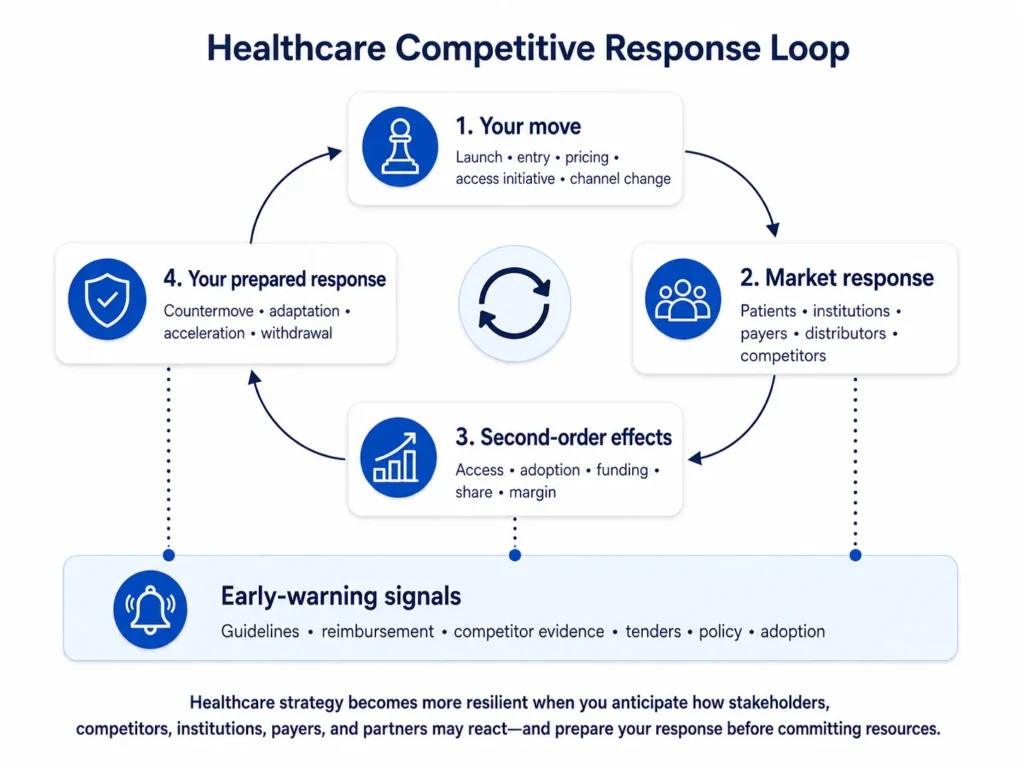
Figure 3: Healthcare strategy becomes more resilient when you anticipate how stakeholders, competitors, institutions, payers, and partners may react, and prepare your response before committing resources.
Pharmaceutical and Healthcare Products Consulting Can Combine Several Strategic Workstreams
Your decision may require one focused engagement or several capabilities working together.
Market entry consulting. Compare countries, patient opportunities, institutions, barriers, entry models, partners, economics, and implementation priorities. Explore market entry consulting.
Strategy consulting. Turn market, stakeholder, competitor, access, and internal evidence into strategic choices, priorities, ownership, and an execution roadmap. Explore strategy consulting.
Wargame consulting. Anticipate competitor, payer, institution, distributor, and policy reactions before a major move. Explore wargame consulting.
Benchmarking consulting. Understand the capabilities and practices behind stronger access, account penetration, partner performance, or commercial execution. Explore benchmarking consulting.
Competitor analysis consulting. Build a deeper view of rival evidence, access position, pricing, partnerships, strengths, vulnerabilities, and likely actions. Explore competitor analysis consulting.
Market analysis consulting. Size addressable need, understand pathways, segment stakeholders, analyze channels, and build the market fact base. Explore market analysis consulting.
Value proposition consulting. Translate clinical, technical, operational, and economic evidence into a clearer reason for stakeholders to support your offer. Explore value proposition consulting.
Win-loss analysis consulting. Understand why institutions, customers, partners, or other decision-makers chose you, or chose an alternative. Explore win-loss analysis consulting.
Brand consulting. Strengthen credibility, trust, relevance, and differentiation around your product or organization. Explore brand consulting.
The advantage of combining these capabilities is that your healthcare strategy is built as one coherent decision system rather than as disconnected analyses.
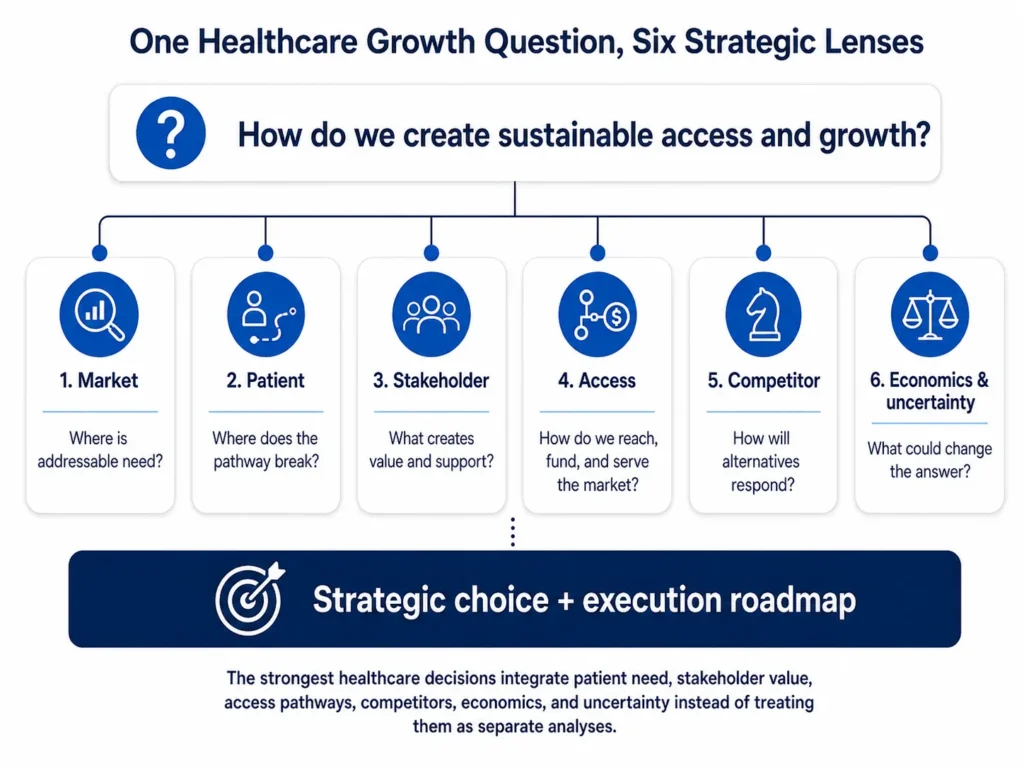
Figure 4: The strongest healthcare decisions integrate patient need, stakeholder value, access pathways, competitors, economics, and uncertainty instead of treating them as separate analyses.
A Healthcare Market-Entry Example: Strategic Clarity Before a Transaction
In a healthcare-sector assignment in Brazil, an international group was evaluating the acquisition of a mid-sized diagnostics company but needed a clearer view of local market dynamics and competitive risks before moving forward.
The strategic work focused on understanding the market, competitive environment, target fit, and the issues that could affect the investment thesis before the transaction advanced into deeper specialist diligence.
The broader lesson applies beyond M&A: in healthcare, an attractive asset, product, or market can look compelling at a distance while access dynamics, competitor strength, institutional structure, regulation, or execution requirements change the real risk-return profile.
For strategic transactions, Midas Consulting can help frame the market and competitive questions. Financial, legal, tax, accounting, clinical, regulatory, and other specialist diligence should be performed by the appropriately qualified advisors.
Client identity and selected transaction details are withheld. This example reflects the circumstances of one engagement and should not be interpreted as a guarantee of equivalent outcomes.
Build the Evidence Around the Decision
Healthcare decisions require disciplined evidence because no single dataset captures the whole market.
Depending on the assignment, we may combine:
- Epidemiological and population data
- Diagnosis and treatment data
- Procedure or utilization data
- Hospital and institution information
- Public procurement and tender data
- Channel and distributor information
- Customer and stakeholder interviews
- Physician or technical-user interviews
- Payer and institutional interviews where feasible
- Former industry executives
- Competitive intelligence
- Pricing and access information
- Patient-pathway research
- Company sales and account data
- Regulatory and policy sources
- Management hypotheses
Important conclusions are triangulated whenever feasible.
We distinguish facts, estimates, hypotheses, assumptions, and unknowns. When the evidence does not support one precise number, we prefer a defensible range or scenario to false precision.
Primary research is conducted subject to applicable legal, ethical, privacy, compliance, and confidentiality requirements. We do not seek protected health information, confidential competitor information, or information that participants are not authorized to disclose.
Use Credible External Sources to Strengthen the Context
Client-specific healthcare strategy should not be built from generic public reports alone. However, authoritative institutional sources can strengthen the broader context surrounding health systems, disease burden, access, regulation, procurement, and policy.
Depending on the engagement, useful sources may include the World Health Organization (WHO), the Pan American Health Organization (PAHO), the World Bank’s health resources, and relevant national health ministries and regulatory authorities such as ANVISA in Brazil, ANMAT in Argentina, COFEPRIS in Mexico, INVIMA in Colombia, ISP in Chile, and DIGEMID in Peru.
These sources can strengthen the contextual fact base. They do not replace specialized regulatory, medical, legal, pharmacovigilance, reimbursement, or health-economic advice when those disciplines are required.
Why Companies Choose Midas for Pharmaceutical and Healthcare Products Consulting
More Than 25 Years of Experience
Midas Consulting has supported pharmaceutical and healthcare companies for more than two decades across Latin America and selected international markets.
That experience matters because healthcare-market success depends on more than demand. It requires understanding access, stakeholder incentives, institutional structure, channels, evidence, competition, local execution, and uncertainty.
Senior Involvement
Senior professionals remain involved in problem definition, research design, strategic interpretation, and management discussions.
Regional Market Knowledge
Healthcare systems, regulation, reimbursement, procurement, institutional concentration, channel structure, and access pathways differ materially across Latin American countries.
We avoid treating Latin America as one homogeneous healthcare market.
Primary Market Intelligence
When public information is not enough, we can develop evidence through customers, distributors, institutions, former executives, technical users, and other informed market participants, subject to access, compliance requirements, and participant willingness.
Strategy Before Methodology
We do not begin by forcing your challenge into a standard framework. We begin with the decision you need to make and determine which evidence and analytical methods can best support it.
Transparent Limitations
Healthcare data can be incomplete, delayed, fragmented, or defined differently across sources.
We make assumptions, evidence gaps, estimates, and uncertainty visible rather than presenting artificial precision.
Clear Boundaries Around Specialized Advice
Midas Consulting provides strategic, market, competitive, and commercial consulting. We do not present our work as medical advice, regulatory approval advice, legal advice, pharmacovigilance advice, or formal health-economic or reimbursement certification.
When those disciplines are required, our strategic work should be coordinated with appropriately qualified specialists.
Confidentiality
Healthcare projects can involve sensitive information about products, pricing, institutions, partners, evidence plans, access strategies, competitors, launches, and future strategy.
We can work under confidentiality agreements and anonymize public examples when disclosure has not been authorized.
Recommendations Designed for Execution
Your strategy must work commercially, financially, operationally, institutionally, and organizationally.
We focus on decisions, trade-offs, actions, ownership, and practical next steps, not simply on analysis.
What Pharmaceutical and Healthcare Products Consulting Clients Have Said About Working With Midas
Midas has an NPS of 82.2% and more than 25 years of sector experience.
When Pharmaceutical and Healthcare Products Consulting Creates the Most Value
An external strategic perspective can be especially useful when:
- You are entering or expanding in a Latin American healthcare market.
- You need to prioritize countries, indications, institutions, patient segments, or accounts.
- A strong clinical or technical product is not translating into access or adoption.
- You need to understand where the patient or institution pathway is breaking.
- You need to improve your stakeholder value proposition.
- You are evaluating a distributor, specialty channel, or local partner.
- You are preparing a launch, indication expansion, or major commercial move.
- You are facing strong incumbent relationships or protocol positions.
- You need a clearer view of competitor access strategy or likely responses.
- You need to benchmark access, account, partner, or launch capabilities.
- You are losing institutional or commercial opportunities and internal explanations are inconsistent.
- You need to allocate resources across several attractive healthcare opportunities.
- Different internal teams hold conflicting views of the market.
- You need to challenge a strategy before committing significant capital or management attention.
- Regulation, reimbursement, guidelines, budgets, competitive evidence, or patient pathways could materially change your assumptions.
When the cost of a wrong decision is high, improving the fact base before execution can be far less expensive than learning only after capital, launch time, partner credibility, or market-access momentum have already been committed.
Frequently Asked Questions About Pharmaceutical and Healthcare Products Consulting
What is Pharmaceutical and Healthcare Products Consulting?
Pharmaceutical and Healthcare Products Consulting is decision-oriented strategic consulting for companies competing in healthcare markets. It can combine market analysis, stakeholder research, access-pathway analysis, competitor intelligence, market entry, partner strategy, benchmarking, value proposition design, win-loss analysis, strategic foresight, and strategy development around a specific growth or competitive decision.
What types of healthcare companies do you support?
We support companies involved in pharmaceuticals, specialty therapies, biologics, medical devices, diagnostics, healthcare consumables, and related healthcare products and services. The approach depends on the product, indication, market, stakeholder system, and decision.
Which healthcare markets can you cover with your pharmaceutical and healthcare products consulting?
Our core experience is in Latin America, including Argentina, Brazil, Chile, Colombia, Mexico, Peru, Central America, and other regional markets. The appropriate geographic scope depends on your strategic question.
Can you size a pharmaceutical or healthcare market?
Yes, when sufficient evidence is available.
Depending on the category, we may combine epidemiology, diagnosis rates, treatment rates, procedure data, hospital activity, utilization, installed base, public procurement, channel information, pricing, stakeholder interviews, company data, and other relevant sources.
When the evidence does not support one precise number, we normally use ranges and make the assumptions explicit.
Can you map a patient or treatment pathway?
Yes. We can research the strategic and commercial pathway around patient identification, diagnosis, referral, treatment decision, authorization, funding, procurement, dispensing or administration, and follow-up.
Clinical pathway conclusions should be reviewed with appropriate medical experts when used for clinical decision-making or external medical communication.
Can you analyze reimbursement and market access?
We can analyze the strategic and market context around reimbursement, funding, institutional access, payer structure, procurement, and stakeholder incentives.
Formal reimbursement submissions, pharmacoeconomic models, regulatory filings, legal interpretation, and official payer negotiations may require specialized experts and should be handled by appropriately qualified advisors.
Can you interview physicians, institutions, distributors, or other stakeholders?
Yes, subject to access, applicable law, ethics, privacy, compliance policies, and participant willingness.
Research designs can include relevant healthcare professionals, institutional stakeholders, distributors, technical users, former executives, and other informed participants. We do not request protected patient information or confidential information participants are not authorized to share.
Can you evaluate healthcare distributors or commercial partners?
Yes. We can assess customer and institution access, geographic coverage, technical or clinical support capabilities, regulatory and quality infrastructure at a strategic level, service, logistics, financial strength, conflicts, management commitment, commercial capability, and strategic fit.
Any formal regulatory, quality-system, pharmacovigilance, or compliance audit should be conducted by qualified specialists.
Can you analyze competitors beyond public information?
Yes, subject to legal and ethical research practices.
We can combine public information, market interviews, customer and channel evidence, former-executive input, benchmarking, commercial observations, and other legitimate sources of competitive intelligence.
We do not seek confidential competitor information through deception or improper means.
Can you help us define a healthcare value proposition with your pharmaceutical and healthcare products consulting?
Yes. We can help identify which clinical, operational, service, access, and economic benefits matter to different stakeholders and how those benefits can support strategic positioning.
Any claims intended for external medical, promotional, regulatory, reimbursement, or health-economic use must go through the appropriate company review and specialist validation processes.
Can Pharmaceutical and Healthcare Products Consulting include medical devices?
Yes. Device-market decisions may require analysis of clinical users, institutions, capital budgets, procurement, technical evaluation, installed base, workflow, service, training, distributors, consumables, maintenance, and competitive alternatives.
The exact scope should reflect whether the product is capital equipment, consumable, diagnostic, implantable, digital, service-intensive, or another device category.
Can an engagement combine several Midas services?
Yes. Healthcare decisions frequently cut across market analysis, market entry, competitors, stakeholders, channels, value propositions, benchmarking, win-loss evidence, foresight, and strategy. We can structure the work as one integrated program or as phases with decision gates between them.
How long does a healthcare consulting project take?
A focused market, competitor, partner, stakeholder, or opportunity assessment may require several weeks. A multicountry, multi-indication, or integrated strategy program can require longer.
We define the scope, milestones, deliverables, and expected timing before the engagement begins.
What information do you need from us?
Useful inputs may include your strategic objectives, products, indications, target patients or institutions, sales, pricing, access assumptions, partner structure, existing research, competitor hypotheses, regulatory status, evidence available for strategic analysis, and decision timetable.
We start with what is already available and identify which additional evidence is worth obtaining.
How do you protect confidential information?
We treat client information as confidential and can work under a nondisclosure agreement. Sensitive information about products, institutions, customers, partners, pricing, evidence strategy, competitors, and future plans can be anonymized in public examples when disclosure has not been authorized.
Do you guarantee a specific commercial or access result?
No responsible strategy advisor should guarantee a specific sales, market-share, reimbursement, formulary, tender, access, launch, or market-entry result.
Performance depends on clinical and technical evidence, regulatory status, funding, pricing, patient and stakeholder behavior, channel execution, institutions, competitors, supply, policy, and other market conditions. Our role is to strengthen the evidence, choices, preparation, and execution behind your strategic decisions.
Ready to Make the Next Healthcare Decision With Greater Confidence?
You may be deciding where to invest, which market to enter, how to strengthen access, which institutions to prioritize, how to improve a partner model, why adoption is slower than expected, or how to prepare for a competitive or policy shift.
You do not need to have the entire problem defined before contacting us.
Tell us the decision you are facing, what you already know, and what remains uncertain. We will help you determine which evidence is worth gathering, which assumptions deserve to be challenged, and which strategic choices require management attention.