

Market Entry Consulting to Ensure Success with Proven Strategies.
Entering a new market is not one decision. It is a sequence of decisions: Is this market attractive enough? Can you realistically win there? How should you enter? Which customers, channels, or partners matter most? What must be adapted? And what could derail the plan after launch?
That is the role of our market entry consulting. At Midas Consulting, we help C-level teams move from expansion ambition to a practical entry decision. We combine market attractiveness, customer needs, competitive dynamics, channel access, regulation, economics, local capabilities, partner options, and execution risk so you can decide where to invest and how to build traction.
The objective is not to enter as many markets as possible. It is to focus capital, management attention, and commercial resources on the opportunities where the combination of market potential, strategic fit, and ability to win justifies the investment.
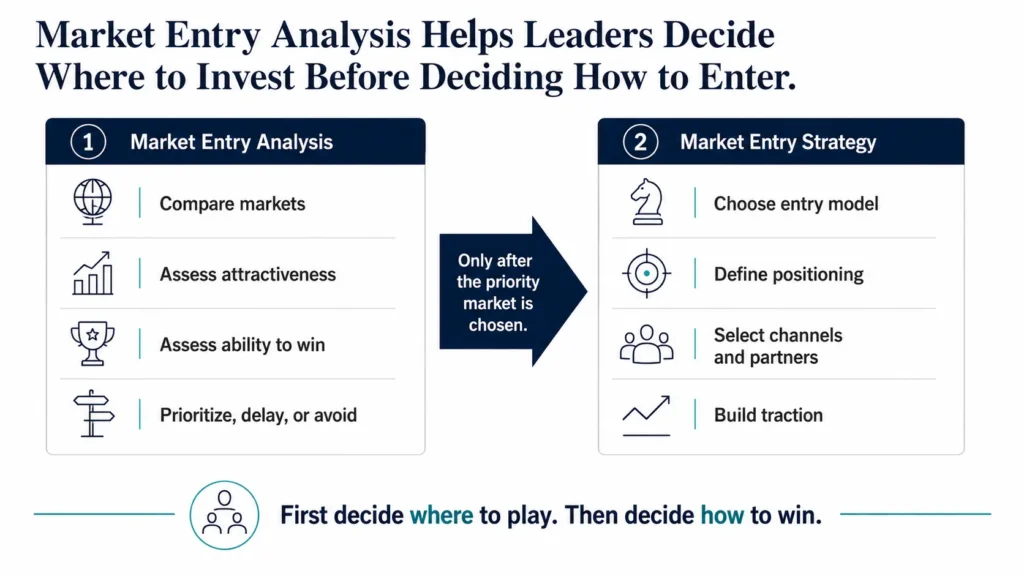
Figure 1: The first expansion decision is not how to enter. It is whether the market deserves investment at all; only then should leadership define the entry model, positioning, channels, partners, and execution plan.
Start With the Most Important Question: Should You Enter at All?
Many expansion projects start too far downstream. Leadership begins discussing distributors, pricing, local hiring, or launch plans before establishing whether the opportunity is attractive enough and whether the company has a credible path to win.
We separate market entry analysis from market entry strategy. Market entry analysis helps you decide which countries, segments, or opportunities deserve investment, which require more validation, and which should be postponed or avoided. Market entry strategy comes next: once the opportunity is selected, it defines how you will enter, compete, reach customers, build credibility, and execute locally.
If your main challenge is comparing several countries or opportunities, our detailed guide to market entry analysis explains how to rank markets systematically, separate attractiveness from ability to win, avoid false precision, and convert analysis into a go, no-go, monitor, partner, or staged-entry recommendation.
When Market Entry Consulting Is Worth Bringing in From Outside
External support becomes especially valuable when the opportunity is important but the evidence is incomplete, local market knowledge is fragmented, several entry paths are possible, or the cost of getting the decision wrong is material.
You may benefit from market entry consulting when you need to:
- Compare several countries, regions, customer segments, or opportunities before investing.
- Determine whether a large or fast-growing market is actually profitable and accessible.
- Understand whether local competitors, regulation, channels, taxes, logistics, or working-capital requirements change the economics.
- Identify which customer segments offer the strongest early traction.
- Decide between direct entry, distributors, partnerships, licensing, acquisition, or a staged approach.
- Assess distributor availability, incentives, capabilities, and potential channel conflicts.
- Understand what customers value and what must be adapted in the offer, pricing, service model, or positioning.
- Estimate how incumbent competitors may respond to your entry.
- Build a realistic roadmap that connects market selection with local execution.
- Decide which markets should not receive capital or management attention yet.
What We Evaluate Before Recommending Market Entry
Market size alone is not enough. A large market can be unattractive, difficult to access, structurally unprofitable, or dominated by competitors with advantages that are expensive to overcome. Conversely, a smaller market may offer faster access, better partner availability, stronger product fit, or a clearer route to profitable growth.
Depending on the decision, we typically examine:
- Market size and growth: How large is the opportunity, and how may it evolve?
- Profitability potential: What margins remain after local pricing, taxes, channel economics, logistics, commercial investment, and cost-to-serve?
- Customer needs and buying behavior: Who decides, what do they value, what slows adoption, and how do they buy?
- Competitive intensity: Who is strong, why do they win, where are they vulnerable, and how could they respond?
- Channel and partner access: Can you reach customers directly, through distributors, partners, digital channels, or another model?
- Regulatory and structural barriers: Which registrations, certifications, import rules, taxes, payment terms, logistics, or compliance issues can affect timing and economics?
- Ability to win: Do your capabilities, value proposition, brand, relationships, resources, and operating model fit the opportunity?
- Execution feasibility: Can the organization actually launch, support, learn, and adapt fast enough?
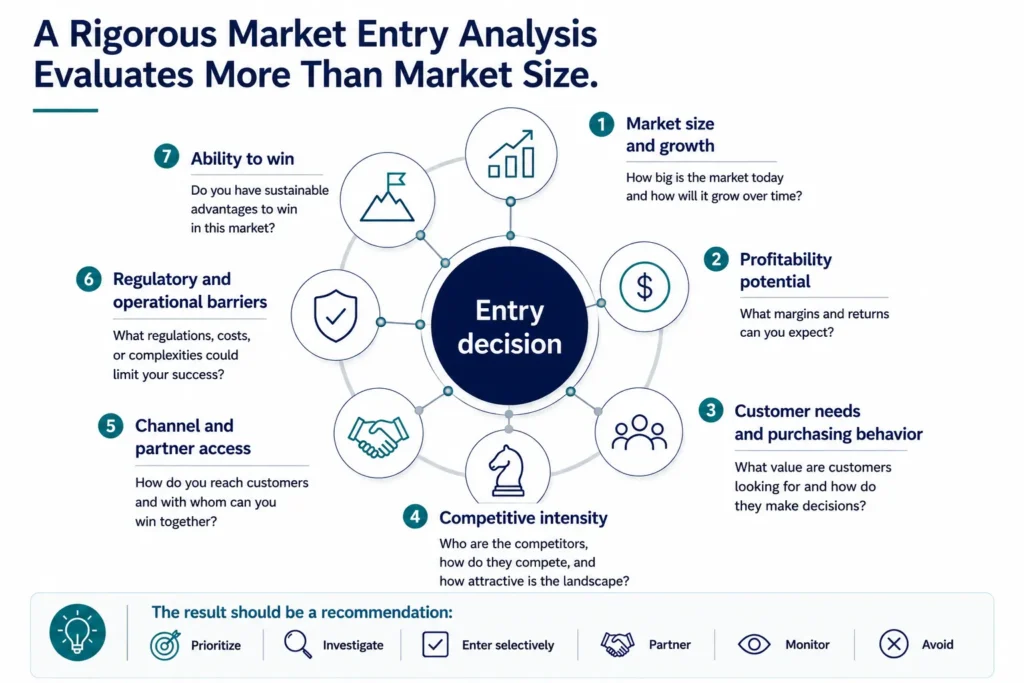
Figure 2: Large markets are not automatically good markets. A credible entry decision balances market potential with profitability, customer behavior, competition, channel access, barriers, and your company’s ability to win.
Our Market Entry Consulting Process
1. Define the expansion objective and decision criteria
We begin by clarifying why you are expanding and what success means. Revenue growth, profitability, customer diversification, regional presence, strategic positioning, portfolio expansion, supply-chain resilience, or competitive defense may imply very different market priorities and entry models.
2. Screen and prioritize the opportunities
When several markets are under consideration, we compare them using consistent criteria. We separate market attractiveness from your ability to win and identify which opportunities deserve a deeper investigation rather than treating a scoring model as an automatic answer.
3. Validate how the priority market really works
We move beyond top-level databases and validate the market through the evidence appropriate to the decision. That can include customer interviews, distributor or partner interviews, expert perspectives, former industry participants, regulator or institutional sources, competitive intelligence, pricing analysis, import data, industry associations, company reports, and local field research.
4. Define the entry path
Once the opportunity is validated, we compare realistic entry models. Depending on your market and objectives, options may include direct investment, distributors, partnerships, licensing, digital-first approaches, acquisitions, or a staged pilot. We make the trade-offs visible across speed, control, investment, margin, risk, channel access, capability requirements, and scalability.
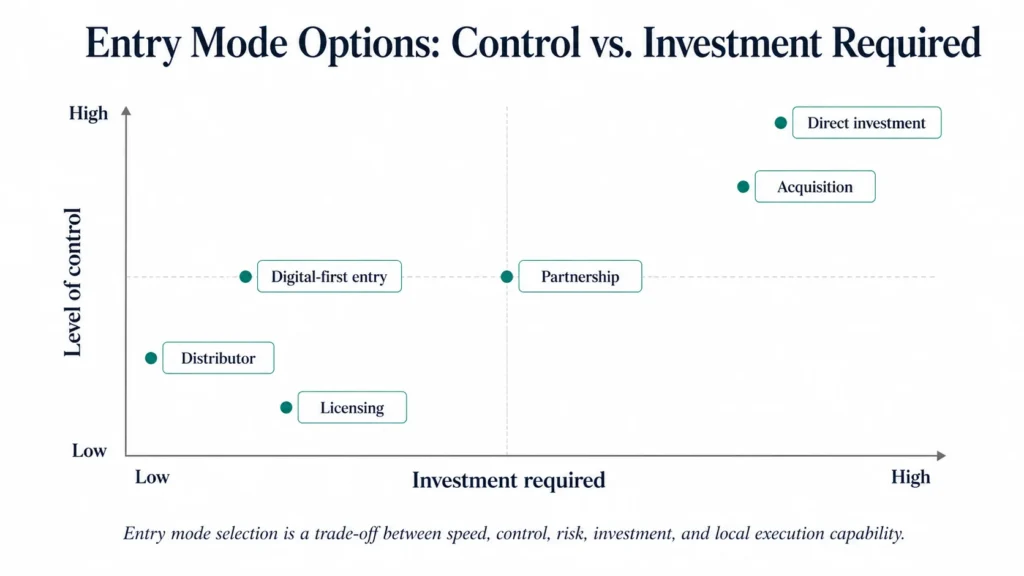
Figure 3: Choosing an entry mode requires balancing control, investment, speed, risk, and local execution capability. The right model depends on both the market and the strategic role you want that market to play.
5. Adapt the offer and commercial model
A market entry strategy often requires more than selecting a route to market. We assess whether the value proposition, portfolio, pricing, service model, channel incentives, customer experience, messaging, or sales approach needs to change for the local market.
6. Pressure-test the strategy
For high-stakes entries, we can test demand assumptions, channel access, regulatory timing, pricing pressure, investment requirements, execution risks, and likely competitor reactions. Depending on the situation, this may include scenarios or a business wargame before major resources are committed.
7. Build the implementation roadmap
The final recommendation should clarify what happens next: target segments, entry model, partner or distributor priorities, value proposition adjustments, commercial actions, ownership, timing, milestones, investment requirements, risks, and the indicators leadership should monitor after launch.
Market Entry in Latin America: One Region, Different Market Realities
Latin America should not be treated as one homogeneous market. Customer behavior, channel structure, distributor economics, taxes, inflation, import dependence, regulatory requirements, payment terms, infrastructure, competitive intensity, and data availability can differ sharply from country to country—and sometimes within the same country.
That means the right regional strategy needs a common logic without forcing identical local execution. We help you distinguish what should remain consistent across markets from what must be adapted country by country.
Our broader guide to market entry in Latin America explores these regional execution issues in greater depth, including information gaps, regulation, channel selection, local partnerships, and the challenges of converting a regional growth mandate into country-level action.
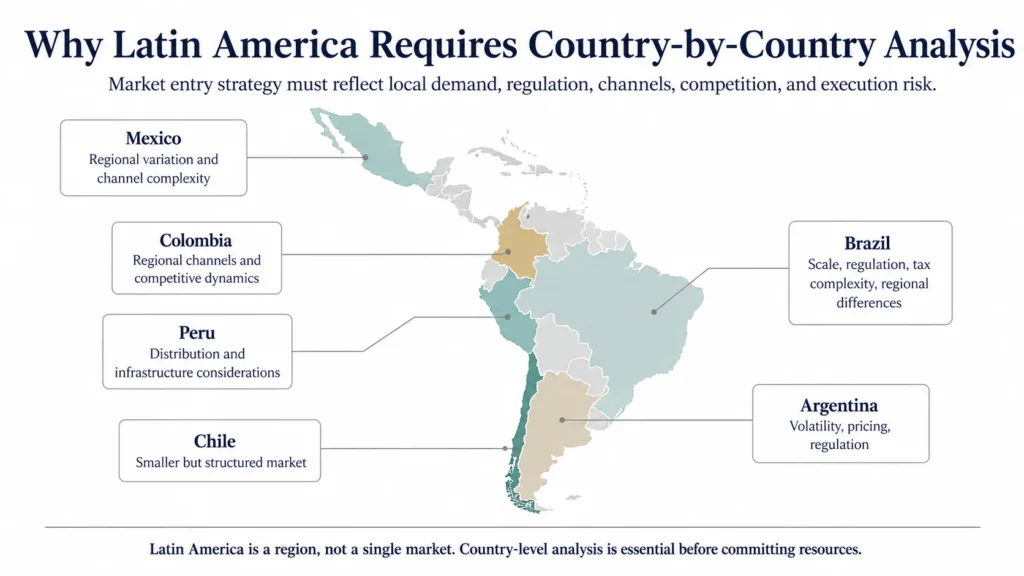
Figure 4: Latin America is a region, not a single market. Country-level analysis helps leadership compare demand, regulation, channels, competition, economics, and execution risk before committing resources.
Do Not Let a Market Ranking Create False Precision
Market rankings are useful because they force leadership to compare opportunities using the same criteria. But a score is a decision aid, not a mechanical answer. A market scoring slightly higher than another may not be the better investment if the data quality differs, the assumptions are fragile, or execution risk has been understated.
We therefore document assumptions, distinguish verified evidence from estimates, test sensitivity where appropriate, triangulate information from multiple sources, and use the scoring model to identify the questions that require deeper validation.
The output should not be “Market A scored 82 and Market B scored 79.” The useful output is: prioritize Market A now; validate these two assumptions before investing; consider a partner in Market B; monitor Market C; and do not pursue Market D under current conditions.
The Best Market Is Not Always the Largest Market
One of the simplest ways to interpret market entry opportunities is to compare two dimensions: market attractiveness and your ability to win.
A highly attractive market where you lack channel access, credibility, competitive advantage, regulatory readiness, or execution capability may require partnerships, capability building, an acquisition, or a staged approach before full entry. A smaller market where your value proposition fits well and execution is easier may produce faster, more attractive returns.
This is why market entry consulting should connect opportunity with fit and feasibility rather than treating top-line market size as the decision.
What You Receive From a Market Entry Consulting Engagement
Deliverables depend on the decision and scope. A typical engagement may include:
- Executive definition of the market entry decision and success criteria.
- Market screening and prioritization framework.
- Market size, growth, profitability, and economics assessment.
- Customer segmentation, buying behavior, unmet needs, and adoption barriers.
- Competitor landscape, strengths, vulnerabilities, positioning, and likely reactions.
- Regulatory, tax, import, logistics, and operational assessment.
- Channel and partner landscape.
- Distributor requirements, incentives, capabilities, and potential fit where relevant.
- Assessment of your ability to win and execution readiness.
- Entry-mode comparison and recommendation.
- Value proposition, pricing, portfolio, or commercial adaptations when needed.
- Go, no-go, monitor, partner, pilot, acquire, or staged-entry recommendation.
- Implementation roadmap with owners, timing, milestones, risks, and next steps.
- Early-warning indicators and decision triggers for high-uncertainty markets.
Market Entry Is Stronger When the Supporting Evidence Is Integrated
Some market entry questions can be solved within one focused engagement. Others benefit from combining several Midas disciplines around the same executive decision.
Market analysis can strengthen the demand, customer, channel, and economic fact base. Competitor analysis can clarify incumbent strengths, likely reactions, positioning, and strategic vulnerabilities. Benchmarking can help compare operating models, channel economics, commercial practices, or country performance.
Value proposition consulting can help adapt the offer to local customer priorities. Strategy consulting can help leadership resolve broader choices and resource trade-offs. Wargame consulting can pressure-test competitor and market reactions before launch.
If your expansion question is part of a broader high-stakes strategic decision, our business strategic advisory approach can combine several disciplines around one executive question. For a broader view of the full service portfolio, visit our Business Consulting Services hub.
Market Entry Under Uncertainty: Know What Would Change the Decision
No market entry analysis eliminates uncertainty. Customer adoption can differ from expectations. Regulations change. Incumbents react. Distributor availability shifts. Pricing pressure appears. An attractive market can become less attractive after entry if one critical assumption proves wrong.
For high-uncertainty markets, we can complement the entry strategy with scenarios, competitor-response analysis, early-warning indicators, and decision triggers. The goal is to identify what leadership should monitor and which developments would justify accelerating, delaying, adapting, or reconsidering the plan.
Our Strategic Foresight and Competitive Response executive insights bring together Midas work on early-warning systems, competitive intelligence, cross-border execution, competitor response, and decision-making under uncertainty.
Why Executives Choose Midas for Market Entry Consulting
More than 200 market entry projects
Midas has completed more than 200 market entry projects. That repeated experience matters because expansion decisions often fail in predictable ways: overstating accessible demand, underestimating channel economics, assuming customer behavior transfers across countries, overlooking regulation, selecting partners too early, or treating local execution as an afterthought.
More than 25 years working across Latin America
Our broader consulting experience spans more than 25 years across Latin America and selected international markets. We have supported multinational and regional companies in Mexico, Brazil, Argentina, Chile, Colombia, Peru, and other markets across sectors including consumer goods, industrial products, chemicals, packaging, technology, food and beverage, pharmaceuticals, and healthcare.
We combine secondary research with primary market evidence
Secondary data is rarely enough for a high-stakes entry decision. Depending on the project, we can interview customers, distributors, suppliers, market experts, former industry participants, institutions, or other knowledgeable sources to validate how the market actually works.
We share preliminary findings before the final recommendation
We normally discuss preliminary findings during the engagement so your team can challenge the evidence, contribute internal knowledge, and redirect deeper research toward the assumptions that still matter. This reduces the risk of discovering at the final presentation that the project answered the wrong question.
Clients recommend the experience
Client feedback collected by Midas between 2020 and 2025 produced a Net Promoter Score of 82.2%. We view that as one trust indicator alongside repeat assignments, referrals, and long-term relationships with clients that have used us repeatedly for opportunity assessment and market entry work.
A Market Entry Example: From a Long List to a Focused Investment Decision
In one engagement, a company asked Midas to evaluate expansion across several Latin American markets. Leadership began with a broad list of possible countries and different internal views about which markets looked most attractive.
We first aligned the decision criteria, including market size, growth, profitability, regulatory complexity, competitive intensity, channel access, product fit, and the company’s ability to execute locally. The initial screening narrowed the field, but it also revealed which assumptions required primary validation.
Interviews with market experts, customers, distributors, and industry participants showed that some apparently attractive markets were less compelling after channel complexity, competitive pressure, and regulatory hurdles were considered. Other smaller markets offered better partner availability, easier access, and a clearer route to early traction.
The result was a focused roadmap: which markets to prioritize, which to monitor, which assumptions to test before further investment, and which opportunities not to pursue in the short term.
The client’s identity and certain commercial details are withheld to protect confidentiality. Case examples illustrate our approach; results depend on market conditions, company capabilities, implementation quality, and other factors.
Industries We Served with Our Market Entry Consulting
Our expertise spans multiple sectors, such as:
What Clients Say About Working With Midas
“I’ve been partnering with Midas for over ten years. Each project, typically focused on opportunities or market entry in Latin America, has been a success. I highly recommend them!”
President
“Midas provided fantastic insights, analysis, and recommendations. We were truly impressed by the depth of their research, especially given the short timeframe.”
Strategy VP
“Midas’ report and analysis were thorough. They collaborated well with our team, including our tech department. One of the reasons we chose them was their depth of experience, which was evident throughout the project.”
Global Product Manager
Market Entry Consulting vs. Market Entry Analysis: How They Fit Together
Market entry analysis answers the upstream investment question: Which markets are attractive, winnable, and worth pursuing—and which should be monitored, delayed, partnered, or avoided?
Market entry consulting is broader. It can include market prioritization, but it continues into the entry path: customers, competitors, channels, partners, local adaptation, economics, risks, and implementation.
Our Market Entry Analysis guide goes deeper into market ranking and go/no-go logic. Our Market Entry in Latin America guide goes deeper into the complexity of regional execution. This service page explains how Midas can support the complete executive decision.
Frequently Asked Questions About Market Entry Consulting
What does a market entry consultant do?
A market entry consultant helps leadership evaluate whether a market deserves investment, understand customers and competitors, assess regulation and economics, compare entry modes, identify channels or partners, adapt the offer, evaluate risks, and build a practical roadmap for entry.
What is the difference between market entry analysis and market entry strategy?
Market entry analysis determines which markets are attractive and winnable enough to justify investment. Market entry strategy determines how to enter the selected market, including entry mode, positioning, pricing, channels, partners, investment priorities, and implementation.
Can you compare several countries before we choose one?
Yes. We can create a common evaluation framework, screen and rank several markets, identify the strongest opportunities, and then conduct deeper validation on the shortlist before recommending where to focus.
Can you help us find or evaluate distributors?
Yes. Distributor availability and fit can be part of the market entry assessment. Depending on the scope, we can identify potential partners, understand what they require, compare capabilities and coverage, assess portfolio fit, and support the decision about whether distribution is the right entry model.
Do you conduct primary research?
Yes, when primary evidence can materially improve the decision. Interviews may include customers, distributors, suppliers, experts, institutions, regulators, former industry participants, or other knowledgeable market actors.
Can you analyze private competitors or markets with limited public data?
Yes. We can combine lawful primary research, public information, customer and channel insight, economic logic, field observation, and strategic inference. We distinguish verified facts from estimates and hypotheses rather than presenting uncertain information as fact.
How do you decide whether to recommend direct entry, a distributor, partnership, or acquisition?
We compare the alternatives against factors such as speed, control, investment, margin, local capabilities, customer access, regulatory complexity, risk, scalability, partner availability, and strategic importance. The right model depends on both market conditions and your organization’s objectives and capabilities.
Can you help us anticipate competitor reactions to entry?
Yes. Competitor analysis can be integrated into the engagement, and for high-stakes entries we can use business wargaming or scenarios to pressure-test the strategy against plausible incumbent responses.
How long does a market entry consulting project take?
Timing depends on the number of markets, research required, regulatory complexity, number of interviews, competitor depth, partner assessment, and decision deadline. A focused single-market project may take several weeks; multi-country projects or engagements involving extensive primary research and partner assessment may take longer. We define the workplan and milestones in the proposal.
How do you handle confidentiality?
We treat your internal information, strategic priorities, market-entry plans, and project findings as confidential. When appropriate, engagements can operate under a mutual nondisclosure agreement. Public case examples are anonymized unless a client has explicitly authorized disclosure.
About Midas Consulting — Corporate Author
Midas Consulting is the corporate author and provider of this market entry consulting service. We have completed more than 200 market entry projects and have more than 25 years of consulting experience across Latin America and selected international markets.
Our team combines experience in strategy, market analysis, competitive intelligence, research, marketing, sales, finance, distribution, business development, and operating leadership. Individual partners and directors contribute specialist expertise, while Midas Consulting remains responsible for the methodology, quality standards, recommendations, and service described on this page. You can learn more about the people behind the work on our team page.
Last reviewed: August 2026
Which Market Should You Enter, and What Will It Take to Win?
You may already have one market in mind, be comparing several countries, or simply know that your next stage of growth needs to come from outside your current footprint. You do not need to arrive with the research methodology or entry model defined.
Bring us the expansion question. We can discuss what you are trying to achieve, which markets or segments are under consideration, what your team already knows, where the uncertainty sits, and which evidence would materially improve the investment decision.