

Strategic consulting for construction products aimed at driving profitable growth.
Construction markets can create growth quickly, and take it away just as fast.
You may be defending a price premium, expanding into a new country, prioritizing infrastructure opportunities, redesigning distribution, launching a sustainable product, or trying to understand why an apparently strong market is not translating into profitable sales.
The strategic challenge is rarely just market size.
You need to understand where demand is truly accessible, who influences product choice, which project and customer segments deserve investment, how channel economics affect your margins, where competitors are structurally stronger, and how the construction cycle may change the answer.
That is where Construction Products Consulting should create value.
Midas Consulting helps you connect market demand, project economics, customer and specifier behavior, channel realities, competitive intelligence, and uncertainty so you can make stronger growth decisions before capital and management attention are committed.
For more than 25 years, we have supported construction-product companies across Latin America with market strategy, competitive intelligence, market entry, benchmarking, value propositions, channel decisions, and commercial strategy. Our role is not to give you another generic construction forecast. It is to help you decide where to play, how to win, and what must be true for your strategy to generate attractive returns.
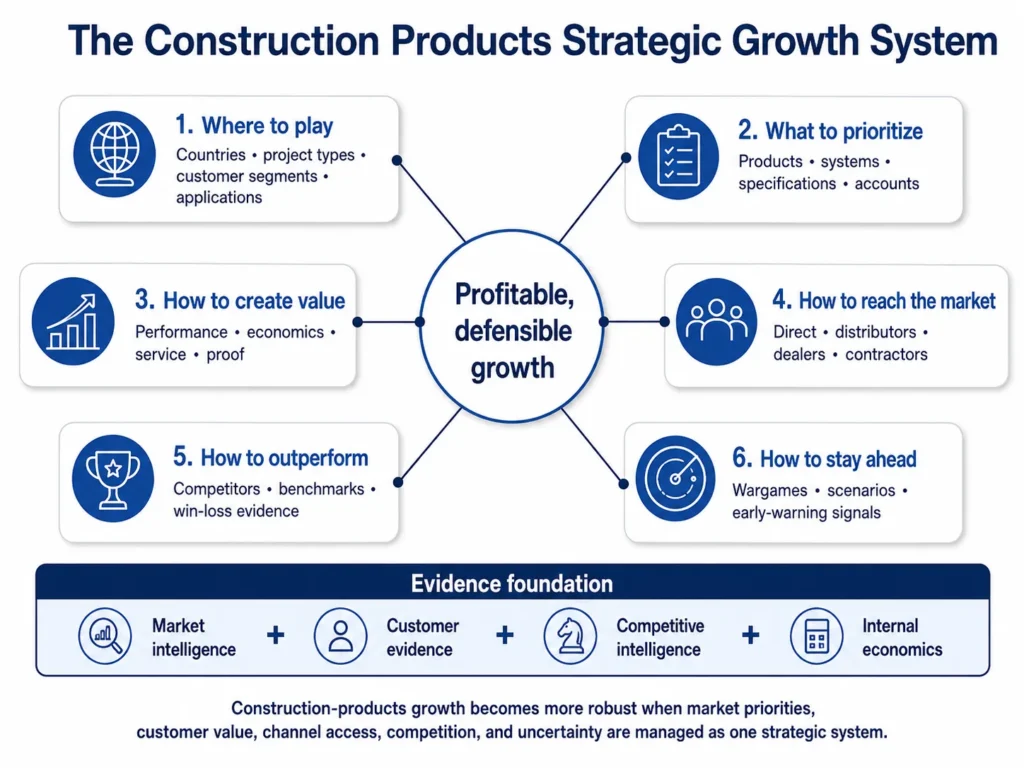
Figure 1: Construction-products growth becomes more robust when market priorities, customer value, channel access, competition, and uncertainty are managed as one strategic system.
Start With the Strategic Decision
Construction companies and suppliers often have plenty of information: project pipelines, permits, building activity, tender data, distributor sales, contractor lists, price files, specification data, customer feedback, competitor offers, and economic forecasts.
The problem is deciding which information should change what you do.
We begin Construction Products Consulting engagements by defining the management decision clearly.
You may need to decide:
- Which countries, regions, cities, project types, or customer segments deserve incremental investment.
- Whether apparent construction growth will translate into addressable demand for your specific product.
- Which products, systems, applications, or accounts should receive commercial priority.
- How to defend a premium when procurement teams view competing products as interchangeable.
- How to influence architects, engineers, contractors, developers, installers, distributors, or other specifiers before the final purchasing decision.
- Whether your route-to-market model provides enough coverage, technical support, availability, credit, and customer influence.
- How to enter a market without overestimating project pipelines or underestimating channel complexity.
- Which sustainability or performance innovations customers are actually willing to specify and pay for.
- How competitors are likely to respond to a launch, price move, distributor change, specification strategy, or geographic expansion.
- Which strategic assumptions could fail if interest rates, public budgets, construction costs, tariffs, regulation, or project timing change.
Once the decision is explicit, we build the evidence around it. That keeps the work focused on choices and action rather than analysis for its own sake.
Where Should You Place the Next Construction Growth Bet?
The largest construction market is not automatically the most attractive one for your company.
A country may have a strong project pipeline but poor payment conditions. A region may show high construction activity while your product is rarely specified. A large infrastructure segment may offer significant volume but aggressive tender economics. A premium building segment may be smaller but create better margins, stronger differentiation, and more predictable demand.
We help you compare opportunities using criteria that reflect your actual strategy and economics.
Depending on the decision, those criteria can include:
- Construction and infrastructure activity
- Project pipeline quality
- Project probability and timing
- Relevant application demand
- Specification influence
- Customer concentration
- Distributor and dealer access
- Contractor and installer influence
- Competitive intensity
- Incumbent strength
- Availability and service expectations
- Price and margin potential
- Credit requirements
- Logistics costs
- Working-capital needs
- Regulatory or technical requirements
- Sustainability requirements
- Strategic fit
- Execution feasibility
- Risk and uncertainty
The objective is not to identify the biggest headline market. It is to identify where demand, differentiation, access, economics, and execution align.
Our market analysis consulting helps you build the demand, customer, project, channel, pricing, and competitive fact base behind those choices.
When geographic expansion is the decision, our market entry consulting helps you compare markets, barriers, entry models, partners, economics, and implementation priorities.
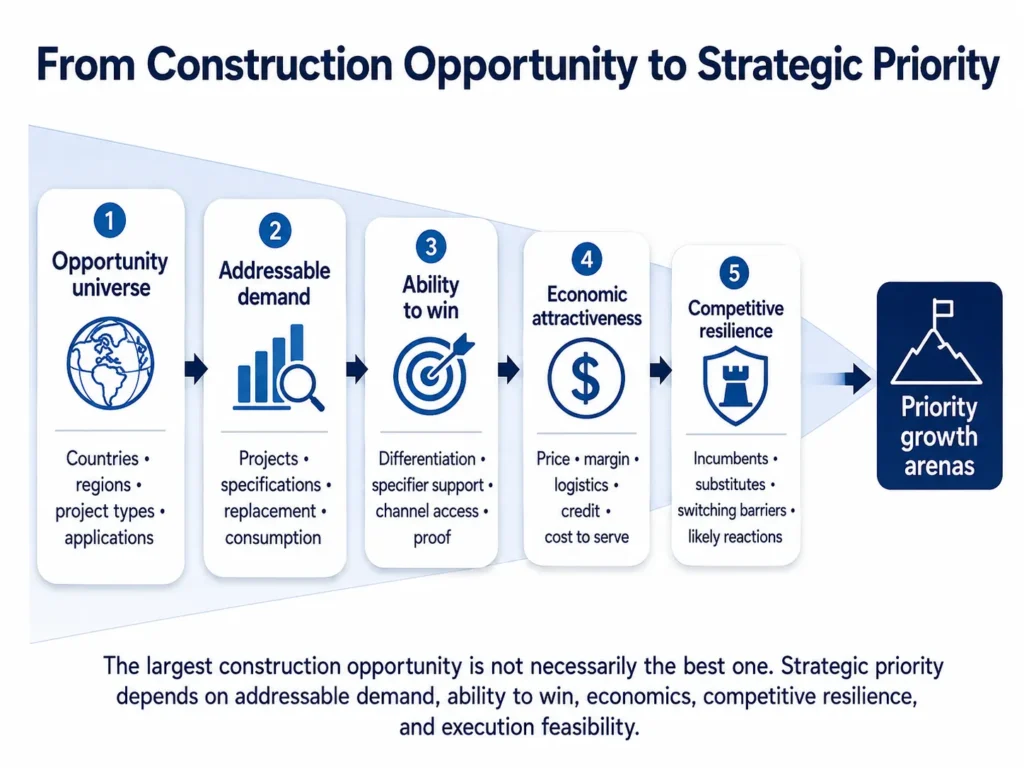
Figure 2: The largest construction opportunity is not necessarily the best one. Strategic priority depends on addressable demand, ability to win, economics, competitive resilience, and execution feasibility.
Understand How the Specification Becomes the Sale with Our Construction Products Consulting
In construction, the company that sends the purchase order may not be the company that really determined the product choice.
Architects, engineers, developers, contractors, installers, project managers, consultants, distributors, and procurement teams can influence the decision at different moments.
A product can therefore lose long before the final quotation is issued.
We help you understand:
- Who defines the technical requirements
- Who influences the approved brands or systems
- Who specifies the product
- Who recommends alternatives
- Who owns installation risk
- Who controls the project budget
- Who purchases
- Who carries inventory
- Who provides credit
- Who approves substitutions
- Who experiences failures or rework
- Who can create repeat demand
This makes it easier to identify where your commercial strategy must act earlier in the project cycle and which stakeholders deserve investment.
Escape the Lowest-Price Trap
Construction products can become commoditized even when their real performance is different.
If the customer sees two materials, components, coatings, systems, cables, fixtures, chemicals, or engineered products as equivalent, the decision naturally moves toward price.
The strategic response is not automatically to discount.
You need to understand which outcomes matter enough to change the comparison.
Depending on the product, value may come from:
- Longer service life
- Lower maintenance
- Faster installation
- Lower labor requirements
- Less waste
- Lower energy consumption
- Lower water consumption
- Reduced rework
- Better durability
- Higher productivity
- Lower failure risk
- More reliable supply
- Improved safety
- Reduced project delays
- Lower total installed cost
- Lower lifecycle cost
A stronger value proposition connects technical performance with the economic outcome that matters to the developer, contractor, installer, distributor, or owner.
Our value proposition consulting helps you translate technical advantages into a clearer reason to choose your product.
Our brand consulting helps strengthen the broader credibility, relevance, trust, and differentiation surrounding that promise.
Make Sustainability Commercially Relevant with Midas’ Construction Products Consulting
Sustainability expectations are reshaping construction materials and building systems, but willingness to pay is not uniform.
A low-carbon, energy-efficient, recycled, longer-life, or lower-waste product can create real value while still struggling commercially if the benefit is poorly quantified, the customer does not control the lifecycle economics, or the channel cannot explain the difference.
We help you assess questions such as:
- Which customer and project segments value the improvement
- Whether sustainability changes specification behavior
- Whether the benefit can support a price premium
- Which proof points matter
- Who captures the economic benefit
- Whether regulation or voluntary standards accelerate adoption
- How competing solutions compare
- What the cost and margin implications are
- Which markets are ready now and which require longer development
The objective is to avoid treating sustainability as either a purely technical agenda or a universal willingness-to-pay assumption. It should be connected to the customer, project, economics, and competitive reality.
Choose the Right Route to Market
Construction distribution is rarely uniform across countries, cities, or product categories.
A direct model may be necessary for large strategic projects. A distributor can create reach but may prioritize competing products. Dealers may influence smaller contractors. Installers can be critical to adoption. A project specification strategy may create demand that the channel then needs to fulfill.
Depending on your category, we can help you evaluate routes such as:
- Direct project sales
- Key-account sales
- Distributors
- Dealers
- Building-material retailers
- Specialized wholesalers
- Contractor channels
- Installer networks
- Engineering or specification channels
- OEM relationships
- Project partners
- Hybrid models
The right structure should connect coverage, specification influence, technical capability, inventory, logistics, credit, economics, incentives, service, and customer ownership.
A distributor should not be selected only because it has warehouses or a customer list. It should be able and motivated to support the strategic role your product requires.
Understand Competitors Before They Reshape the Project Economics with Our Construction Products Consulting
Construction competitors can respond aggressively when a strategic account, distributor, project, or specification is threatened.
They may cut price, extend credit, increase distributor incentives, add local inventory, provide technical support, bundle products, strengthen installer relationships, accelerate certification, or create a lower-cost alternative.
That means competitor analysis should go beyond quoted prices and product catalogs.
Our competitor analysis consulting helps you examine competitor objectives, pricing, channels, specification position, relationships, service capabilities, cost advantages, vulnerabilities, and likely responses.
The strategic question is not only how competitors compare today. It is how they are likely to behave when your strategy threatens something important to them.
Benchmark the Capabilities Behind Stronger Performance
A competitor may have stronger margins, faster growth, better distributor productivity, greater specification influence, better service levels, or more effective project conversion.
The visible result tells you what happened. Benchmarking helps you understand what produced it.
Depending on the decision, we can compare:
- Sales-force deployment
- Specification teams
- Key-account coverage
- Distributor economics
- Dealer programs
- Installer programs
- Pricing architecture
- Discount governance
- Technical support
- Inventory practices
- Service levels
- Project tracking
- Lead conversion
- Product-launch processes
- Sustainability commercialization
- Decision rights and organization
Our benchmarking consulting focuses on the practices and capabilities behind performance so you can identify what is transferable to your business rather than copying another company mechanically.
Learn Why You Win, and Why You Lose thanks to Midas’ Construction Products Consulting
The reason recorded by the sales team is not always the reason a construction opportunity was won or lost.
A loss may be blamed on price when the decisive issue was availability, contractor familiarity, technical support, credit, specification status, installation risk, brand confidence, or distributor commitment.
A win may be attributed to technical performance when the real advantage was delivery reliability or a stronger contractor relationship.
Our win-loss analysis consulting brings the customer and channel perspective into your strategy.
It can help you understand:
- Which criteria carried the most weight
- Whether price was truly decisive
- Where your differentiation was credible
- Which competitor strengths influenced the decision
- Where your commercial process helped or hurt
- Whether the route to market constrained the offer
- Which objections emerged late
- Which changes could improve future conversion
Those insights can improve account strategy, pricing, channel management, product positioning, technical support, and specification strategy.
Turn Construction-Market Intelligence Into Strategic Choices
Good Construction Products Consulting should change what you do.
The answer may be to prioritize fewer markets, focus on higher-value applications, strengthen specification influence, replace or supplement a distributor, redesign channel incentives, defend a premium through quantified lifecycle value, invest in local stock, or stop pursuing low-quality projects.
Our strategy consulting helps you bring market, customer, project, competitor, channel, and internal evidence together so your team can compare alternatives, make trade-offs explicit, and translate the decision into an execution roadmap.
Depending on your situation, we can help you define:
- Where to play
- How to win
- Which project and customer segments deserve priority
- Which products and systems should receive investment
- Which partners fit the strategy
- Which capabilities must be built
- Which opportunities should be delayed or rejected
- Which initiatives should receive resources
- Who owns implementation
- Which milestones and KPIs matter
- Which assumptions require monitoring
Stress-Test the Strategy Before the Cycle Turns with Midas’ Construction Products Consulting
Construction strategies can look attractive when every assumption is considered independently.
The risk becomes more visible when several assumptions move at once.
What happens if interest rates remain high while a competitor cuts price? What if a public infrastructure program is delayed while raw-material costs rise? What if a distributor loses focus while a sustainability requirement changes the specification? What if tariffs alter import economics while local competitors add capacity?
Midas Consulting’s work on strategic foresight, competitive response, and early-warning systems provides an additional foundation for testing those interactions.
The objective is not to predict one exact future. It is to identify which uncertainties could materially change the strategy, what signals would indicate that change is occurring, and which response options should be prepared.
Use Wargames to Anticipate Competitive and Channel Reactions
A business wargame allows your team to simulate how competitors, distributors, contractors, developers, specifiers, regulators, or other market participants may respond to a strategic move.
You can use it to pressure-test:
- A country entry
- A major product launch
- A pricing move
- A distributor change
- A sustainability proposition
- A specification strategy
- A major infrastructure opportunity
- A defensive response
- A local-investment decision
- A portfolio change
Our wargame consulting helps expose fragile assumptions, plausible countermoves, second-order effects, and actions you may want to prepare before execution.
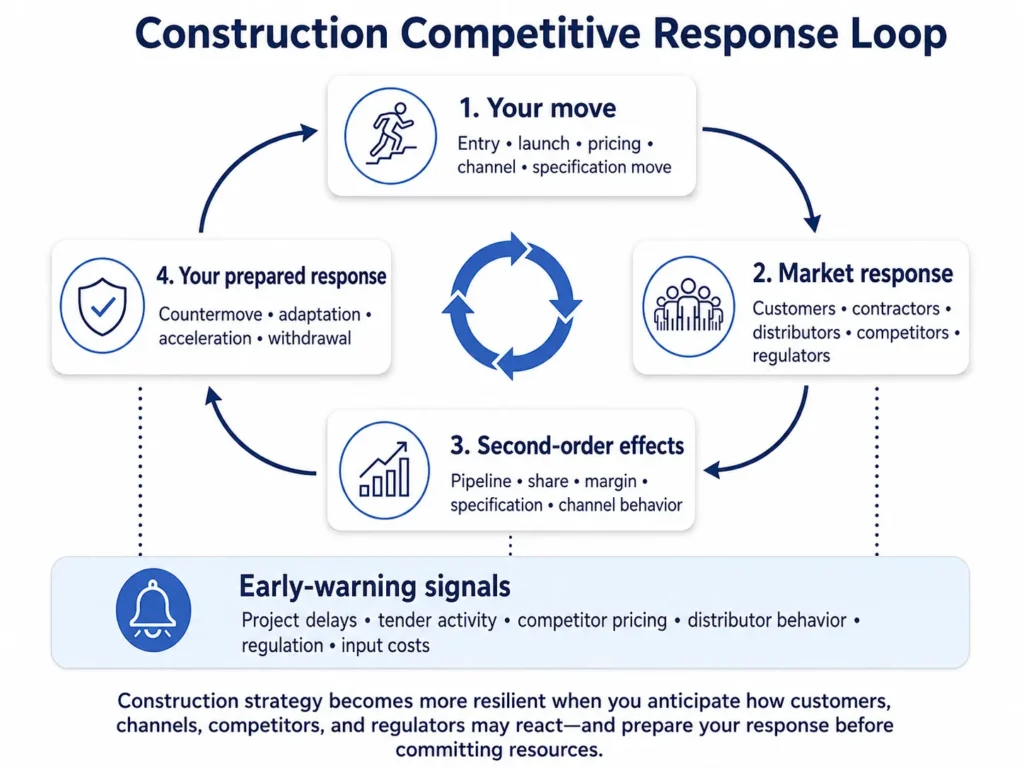
Figure 3: Construction strategy becomes more resilient when you anticipate how customers, channels, competitors, and regulators may react—and prepare your response before committing resources.
Construction Products Consulting Can Combine Several Strategic Workstreams
Your decision may require one focused engagement or several capabilities working together.
Market entry consulting. Compare countries, regions, construction segments, barriers, entry models, partners, economics, and implementation priorities. Explore market entry consulting.
Strategy consulting. Turn market, customer, project, competitor, and internal evidence into strategic choices, priorities, ownership, and an execution roadmap. Explore strategy consulting.
Wargame consulting. Anticipate competitor, channel, contractor, specifier, and regulatory reactions before a major move. Explore wargame consulting.
Benchmarking consulting. Understand the practices and capabilities behind stronger margins, distribution, specification influence, service, and commercial performance. Explore benchmarking consulting.
Competitor analysis consulting. Build a deeper view of rival strategy, pricing, channels, specification position, strengths, vulnerabilities, and likely actions. Explore competitor analysis consulting.
Market analysis consulting. Size opportunities, understand project and application demand, segment customers, map channels, and build the market fact base. Explore market analysis consulting.
Value proposition consulting. Translate technical performance into financial and operational value that customers and specifiers can understand. Explore value proposition consulting.
Win-loss analysis consulting. Understand why customers, contractors, developers, distributors, or other decision-makers chose you—or chose an alternative. Explore win-loss analysis consulting.
Brand consulting. Strengthen credibility, relevance, trust, and differentiation in categories where products can otherwise be treated as commodities. Explore brand consulting.
The advantage of combining these capabilities is that your construction strategy is built as one coherent decision system rather than as disconnected studies.
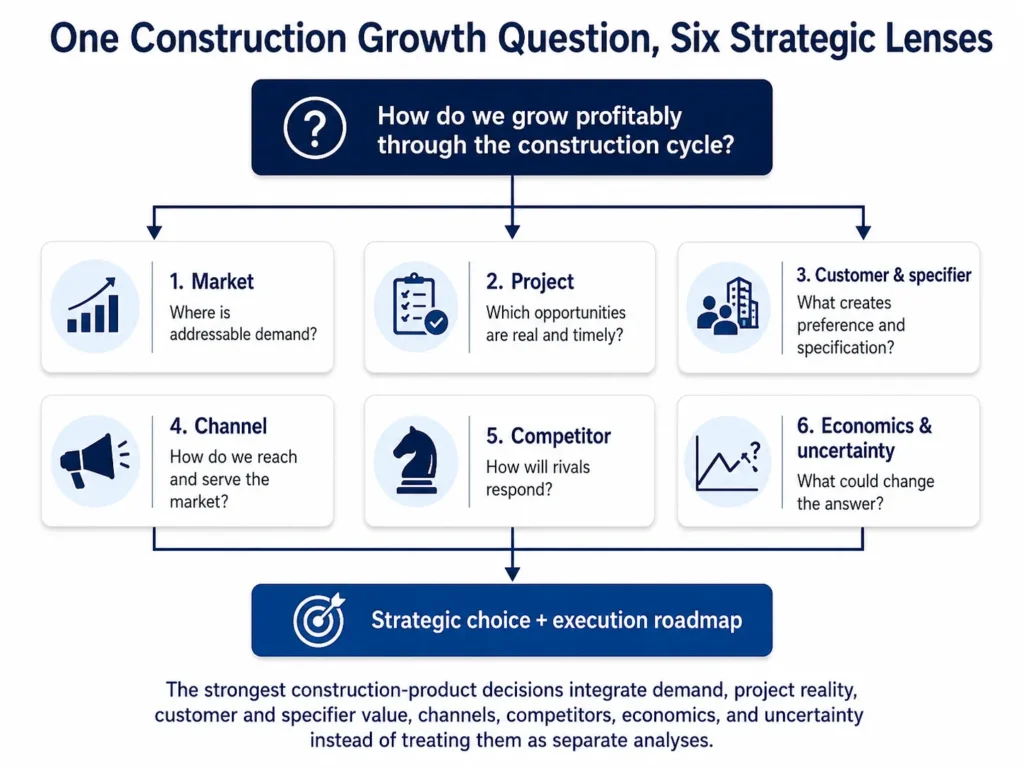
Figure 4: The strongest construction-product decisions integrate demand, project reality, customer and specifier value, channels, competitors, economics, and uncertainty instead of treating them as separate analyses.
Case Example: Growing Share by Redesigning Distribution and Technical Support
A multinational coatings company had an innovative regional product but was not achieving the expected sales across Argentina, Brazil, Colombia, and Mexico.
The product itself was not the only issue. The existing distribution strategy was not providing enough market reach, customer support, or commercial effectiveness.
Midas Consulting combined secondary research with in-depth interviews involving customers and distributors to identify strengths, weaknesses, and gaps in the route-to-market model.
The analysis helped the company identify practical changes rather than relying on a broad channel expansion.
Among the initiatives, the company introduced concepts that linked technology migration more closely with product purchases and strengthened technical support by visiting customers jointly with distributors.
According to the published Midas case, these changes contributed to a significant increase in market share.
The broader lesson is that distribution performance depends on more than geographic coverage. Incentives, technical capability, customer support, partner behavior, and the value proposition all need to reinforce the same strategy.
Client identity and commercially sensitive details are withheld. This example reflects the circumstances of one engagement and should not be interpreted as a guarantee of equivalent outcomes for another company or market.
Build the Evidence Around the Decision
Construction markets often look transparent because project, permit, tender, and economic data exist. In practice, those sources rarely explain who influences the specification, whether a project will happen on time, why a distributor is effective, or what really drives substitution.
Depending on the assignment, we may combine:
- Official construction and infrastructure data
- Project and tender databases
- Permit and starts data
- Customer and contractor interviews
- Distributor and dealer interviews
- Architect and engineer interviews
- Installer and technical-user interviews
- Former industry executives
- Store and channel checks
- Pricing and credit information
- Import and trade data
- Competitive intelligence
- Company sales and margin data
- Management hypotheses
Important conclusions are triangulated whenever feasible.
We distinguish facts, estimates, hypotheses, assumptions, and unknowns. When the market does not support one precise number, we prefer a defensible range or scenario to false precision.
Use Credible External Sources to Strengthen the Context
Client-specific strategy should not be built from generic construction forecasts alone. However, authoritative sources can strengthen the context surrounding infrastructure investment, building activity, urbanization, energy performance, and macroeconomic conditions.
Depending on the engagement, useful sources may include the World Bank’s infrastructure resources, UN-Habitat, the International Energy Agency’s buildings resources, and relevant national statistical agencies, construction ministries, procurement systems, and industry associations.
These sources provide context. They do not replace primary research with customers, contractors, specifiers, distributors, competitors, and other market participants when the decision requires direct evidence.
Why Companies Choose Midas for Construction Products Consulting
More Than 25 Years of Experience
Midas Consulting has supported construction-product companies since 2000 across building materials, coatings, engineered products, construction systems, equipment-related categories, and other products used in buildings and infrastructure.
That experience matters because profitable construction growth depends on more than the cycle. It requires understanding projects, specifications, customers, channels, credit, technical support, competitors, and local execution.
Experience From the Management Side of the Table
Our perspective is shaped by professionals who have held management roles as well as consulting roles. That helps us frame recommendations around the trade-offs, resource constraints, and execution realities management teams face.
Regional Experience Across Latin America
Construction cycles, project pipelines, distribution structures, payment practices, specification behavior, regulation, and competitive positions can differ significantly across countries and cities.
We avoid treating Latin America as one homogeneous construction market.
Senior Involvement
Senior professionals remain involved in problem definition, research design, strategic interpretation, and management discussions.
Primary Market Intelligence
When public information is not enough, we can develop evidence through customers, contractors, distributors, dealers, specifiers, installers, former executives, and other informed sources, subject to access and participant willingness.
Transparent Limitations
Construction pipelines can be delayed, canceled, resized, or redefined. Public information may also mix announced investment with committed demand.
We make evidence gaps, assumptions, estimates, and uncertainty visible rather than presenting artificial precision.
Confidentiality
Construction projects can involve sensitive information about pricing, projects, customers, distributors, bids, competitors, products, investments, and future strategy.
We can work under confidentiality agreements and anonymize public examples when disclosure has not been authorized.
Recommendations Designed for Execution
Your strategy must work commercially, financially, operationally, technically, and organizationally.
We focus on choices, trade-offs, actions, ownership, and practical next steps—not only on analysis.
What Construction Products Consulting Clients Have Said About Working With Midas
“Midas delivered practical, high-impact ideas that helped us expand market share in a competitive environment.”
Marketing Manager, Construction Products Company — identity withheld due to confidentiality
“Midas was highly effective, giving us the insights and tools we needed to co-create a robust strategy for complex markets.”
Finance executive, Construction Products Company — identity withheld due to confidentiality
“Midas helped us reassess priorities and focus our efforts where they truly mattered.”
Global Market Segment Leader, Construction Products Company — identity withheld due to confidentiality
“For more than a decade, Midas has been our trusted partner in Latin America. Every project has been a success.”
President, Construction Products Company — identity withheld due to confidentiality
We have a Net Promoter Score of 82.2% for client feedback collected during 2020–2025.
When Construction Products Consulting Creates the Most Value
An external strategic perspective can be especially useful when:
- You are entering or expanding in a Latin American construction market.
- You need to prioritize countries, regions, project types, applications, or customer segments.
- Your growth is below expectations and the cause is unclear.
- Procurement pressure is turning your category into a price comparison.
- You need to quantify the financial value behind technical differentiation.
- Your sustainable or lower-carbon product is not gaining adoption as quickly as expected.
- Your distributor model provides coverage but weak specification or customer influence.
- You are losing projects and internal explanations are inconsistent.
- You need to improve your specification strategy.
- You need to benchmark sales, channel, technical-service, pricing, or project-conversion capabilities.
- You are preparing a major launch, price move, or distributor change.
- You need a clearer view of competitor strategy or likely responses.
- Several attractive opportunities are competing for the same resources.
- Different internal teams hold conflicting views of the market.
- You need to challenge a strategy before committing significant capital or management attention.
- Interest rates, public budgets, input costs, tariffs, regulation, or project timing could materially change your assumptions.
When the cost of a wrong decision is high, improving the fact base before execution can be far less expensive than learning only after capital, inventory, channel credibility, or project momentum have already been committed.
Frequently Asked Questions About Construction Products Consulting
What is Construction Products Consulting?
Construction Products Consulting is decision-oriented strategic consulting for companies that sell materials, products, systems, technologies, or services into buildings and infrastructure. It can combine market analysis, project and customer research, competitor intelligence, market entry, channel strategy, value proposition design, benchmarking, win-loss analysis, strategic foresight, and strategy development around a specific growth or competitive decision.
What types of construction-product companies do you support?
We support companies involved in building materials, coatings, construction chemicals, cement-related products, cables, pipes, insulation, roofing, flooring, fixtures, engineered systems, equipment-related categories, and other products used in residential, commercial, industrial, and infrastructure construction.
The methodology depends on your product, application, customer structure, project cycle, and strategic question.
Which markets can you cover with your construction products consulting?
Our core experience is in Latin America, including Argentina, Brazil, Chile, Colombia, Mexico, Peru, Central America, and other regional markets. The appropriate geographic scope depends on your decision.
Can you estimate the market for a construction product?
Yes, when sufficient evidence is available.
Depending on the product, we may combine project data, construction activity, installed base, floor area, material intensity, application assumptions, import and trade information, pricing, channel research, customer interviews, and competitor intelligence.
When the evidence does not support one precise number, we normally use ranges and make the assumptions explicit.
Can you distinguish announced projects from realistic demand?
Yes. We can assess project status, timing, funding, developer or government commitment, permitting, procurement stage, technical fit, and other evidence relevant to your decision.
No project pipeline is perfectly predictable, so probability ranges and timing assumptions should be made visible.
Can you research architects, engineers, contractors, and specifiers?
Yes. Depending on the category and access, primary research may include architects, engineers, developers, contractors, installers, technical users, distributors, dealers, procurement professionals, and other informed market participants.
Can you evaluate distributors or dealers?
Yes. We can assess geographic coverage, project and customer access, inventory, credit, technical capabilities, sales resources, competing brands, management commitment, service, logistics, economics, and strategic fit.
We can also support decisions involving partner replacement, supplementation, segmentation, or hybrid direct-and-indirect models.
Can you help us defend a price premium?
Yes. Margin defense may require understanding which technical, operational, service, supply, installation, lifecycle, sustainability, or risk-reduction benefits customers value and whether those benefits can be quantified credibly.
The appropriate response depends on the underlying source of value and the stakeholder who captures it.
Can you analyze competitors beyond public information?
Yes, subject to legal and ethical research practices.
We can combine public information, customer and channel interviews, former-industry-executive input, benchmarking, commercial observations, and other legitimate sources of competitive intelligence.
We do not seek confidential competitor information through deception or improper means.
Can Construction Products Consulting include sustainability strategy?
Yes, when the question is strategic and commercial—for example, which segments value lower-carbon products, where willingness to pay exists, how sustainability changes specification behavior, how competitors are positioning, or which markets deserve investment.
Formal environmental certification, lifecycle assessment, engineering, regulatory compliance, or carbon-accounting work may require appropriately qualified specialists.
Can the engagement combine several Midas services?
Yes. Construction decisions frequently cut across market analysis, market entry, competitors, channels, value propositions, benchmarking, win-loss evidence, foresight, and strategy. We can structure the work as one integrated program or as phases with decision gates between them.
How long does a Construction Products Consulting project take?
A focused market, competitor, distributor, customer, or opportunity assessment may require several weeks. A multicountry or integrated strategy program can require longer.
We define the scope, milestones, deliverables, and expected timing before the engagement begins.
What information do you need from us?
Useful inputs may include your strategic objectives, products, applications, sales, margins, priority markets, customers, distributors, pricing, existing research, project hypotheses, competitor views, and decision timetable.
We start with what is already available and identify which additional evidence is worth obtaining.
How do you protect confidential information?
We treat client information as confidential and can work under a nondisclosure agreement. Sensitive information about customers, distributors, bids, projects, pricing, products, competitors, and future plans can be anonymized in public examples when disclosure has not been authorized.
Do you guarantee a specific commercial result?
No responsible strategy advisor should guarantee a specific sales, margin, market-share, project, distributor, tender, or market-entry result.
Performance depends on project timing, customer decisions, product performance, pricing, specification, distribution, execution, competitors, credit, regulation, and economic conditions. Our role is to strengthen the evidence, choices, preparation, and execution behind your decisions.
Ready to Make the Next Construction Growth Decision With Greater Confidence?
You may be deciding where to invest, which projects or customer segments to prioritize, how to defend a premium, how to improve distribution, why you are losing specifications, or how to prepare for the next construction-cycle shift.
You do not need to have the entire problem defined before contacting us.
Tell us the decision you are facing, what you already know, and what remains uncertain. We will help you determine which evidence is worth gathering, which assumptions deserve to be challenged, and which strategic choices require management attention.